Monday, April 15, 2019

Romanticism and the Rise of the Superheroes: Who Are the Saviours of the Oppressed?

 
Myth, Reification, Tradition, Modern


For what is a man, what has he got?
If not himself, then he has naught
To say the things he truly feels and not the words of one who kneels.
— Paul Anka, My Way


Oh! isn’t it a pity, such a pretty girl as I
Should be sent to the factory to pine away and die?
Oh! I cannot be a slave, I will not be a slave,
For I’m so fond of liberty,
That I cannot be a slave.
— Lowell Mill girls protest song in 1836 strike.


The rise of the superheroes in cinema is demonstrated by the proliferation of superhero films today and is a phenomenon that is unprecedented in culture. Many superhero films are based on superhero comics while some are original for the screen, some are based on animated television series, and others are based on Japanese manga and television shows.
This essay will look at the history and origins of superheroes in Romantic ideas, comparing them to an opposing ideology of working class heroes who compete with superheroes for the attention of the oppressed masses who are to be ‘freed’ and/or saved, especially in the 20th century.

 According to Cooper Hood in Screen Rant:
2019 will be the year of superhero movies, seeing the release of a record-setting amount: a whopping eleven films. As the superhero movie craze continues, next year looks poised to be the prime example of how invested Hollywood as a whole really is. There’s the usual amount of Marvel movies, but increased output from Warner Bros. and DC, as well as some final Fox X-Men titles. All of these make up an astonishing ten confirmed 2019 superhero movies.
This is nearly double the 2018 output of six live-action superhero movies: Black Panther, Avengers: Infinity War, Deadpool 2, Ant-Man & the Wasp, Venom and Aquaman.


Superheroes take their inspiration from earlier heroes such as Robin Hood and the Scarlet Pimpernel but the idea originates in Romantic ideas about heroes that save the world and the powers of the superhero.
Despite their designation as science fiction, superheroes have their ideological roots in the anti-science, individualistic philosophy of Romanticism.


What is Romanticism?
Romanticism is a movement in the arts and literature that emphasises inspiration, subjectivity, and the primacy of the individual and originated in the late 18th century. It was also a reaction to the Industrial Revolution and the Age of Enlightenment, and in particular, the scientific rationalization of nature — all components of modernity.
In the The Roots of Romanticism, Isaiah Berlin discusses the Romantic’s negative view of science:
The only persons who have ever made sense of reality are those who understand that to try to circumscribe things, to try to nail them down, to try to describe them, no matter how scrupulously, is a vain task. This will be true not only of science, which does this by means of the most rigorous generalisations of (to the Romantics) the most external and empty kind, but even of scrupulous writers, scrupulous describers of experience – realists, naturalists, those who belong to the school of the flow of consciousness, [e.g. Proust and Tolstoy] labour under the illusion that it is possible once and for all to write down, to describe, to give any finality to the process which they are trying to catch, which they are trying to nail down, unreality and fantasy will result.1
Thus the Romantics fundamentally oppose the general values and objectives of science and in particular Realist and Naturalist artists who use scientific knowledge or methods to develop their art. It goes without saying then that on a philosophical level scientific ideas about the progress of mankind are also rejected by the Romantics.


Batman and "The Wanderer Above the Sea of Fog" by Caspar David Friedrich (1818)
[Thanks to Maya Nogradi]


This is because for the Romantics, “new abysses open, and these abysses open to yet other abysses.”1 However, scientists understand that new abysses open as they dig deeper into new levels of understanding. Yet, they are not afraid and they don’t throw up their hands in frustration or despair: they see these discoveries as new paths and concepts also to be explored fearlessly.
Berlin believes that one of the most influential writers against the science-based Enlightenment and who began the Romantic backlash was Johann Georg Hamann who believed, according to Berlin, that “the sciences were very well for their own purposes” but that:
this is not what men ultimately sought. If you asked yourself what were men after, what did men really want, you would see that what they really wanted was not at all what Voltaire supposed they wanted. Voltaire thought that they wanted happiness, contentment, peace, but this was not true. What men wanted was for all their faculties to play in the richest and most violent possible fashion. What men wanted was to create, what men wanted was to make, and if this making led to clashes, if it led to wars, if it led to struggles then this was part of the human lot.2
This view of violence and war as irrational chaos that cannot be controlled is also an element of superhero narratives which the superhero tries to overcome.


“The Reign of the Superman”, short story by Jerry Siegel (January 1933)


Superheroes: emotions over logic
These ideas of individualism, emotion, personalised motivations and cynicism towards the concept of a progressive society are all part of the Superhero psyche. Mason Woodard writes:
One of the first Romantic elements of Batman is his motivation. He is a vigilante, sometimes hunted by Gotham Police. But the reason Bruce fights crime even in face of the law is because a common criminal murdered his parents when Wayne was just a boy. The emotion of avenging his parents and stopping this from happening drives him far more. This is an example of emotions over logic, a Romantic idea. […] One component of Romanticism embodied by Superman is to trust your instincts and emotions before logic and reasoning. Superman will often be seen saving his love, Lois Lane, or a group of kids in the midst of a massive fight, even when a logical analysis tells you to sacrifice the people and finish off the baddie (even though Superman does win in the end).
Thus the personalised empathy of the superhero covers over the narcissism of a costumed attention-seeker.

The Golden Age and the Warrior
The Romantics looked back to the Golden Age of the autonomous, powerful warrior who looks after his tribe and is the earliest version of this idea – the peasant as noble savage.  The Golden Age denotes “a period of primordial peace, harmony, stability, and prosperity. During this age peace and harmony prevailed, people did not have to work to feed themselves, for the earth provided food in abundance. They lived to a very old age with a youthful appearance, eventually dying peacefully, with spirits living on as “guardians”.”

There may have been some material basis for the concept of a Golden Age. Old European culture, for example, is believed to have centred around a nature-based ideology that was gradually replaced by an anti-nature, patriarchal, warrior society when Europe was invaded by the Kurgan peoples from c. 4000 to 1000 BC. It was believed to have been a tumultuous and disastrous time for the peoples of Old Europe and may have led to the concept of the Fall. The idea of a fall, the end of a Golden Age, is a common theme in many ancient cultures around the world. Richard Heinberg, in Memories and Visions of Paradise, examines various myths from around the world and finds common themes such as sacred trees, rivers and mountains, wise peoples who were moral and unselfish, and in harmony with nature and described heavenly and earthly paradises.

The Romantic view of the Golden Age was a reaction to the contemporary slave-like conditions of the working class in factories and mills. Romantic rejection of modernity was rooted in this over-rationalisation of the worker and its affect on the human spirit. This rationalisation could be seen as the continuation of earlier slavery but in a modern day form as ‘wage slavery’.
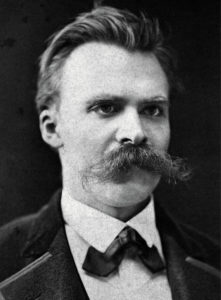

 
Friedrich Nietzsche


‘Supermen’ or ‘Übermensch [Overmen]’
This modern slavery had a profound affect on Nietzsche who defined the first ‘Supermen’ or ‘Übermensch [Overmen]’ (super – Latin: over/beyond) as a goal humanity can set for itself. The Overman would be a new human who was to be neither master nor slave and all human life would be given meaning by how it advanced a new generation of human beings. Like Marx, Nietzsche recognised the social uses of religion to divert attention and action away from the exploitative nature of the social and economic system itself. The individualism of Nietzsche’s ideas also attracted the anarchists. According to Spencer Sunshine:
There were many things that drew anarchists to Nietzsche: his hatred of the state; his disgust for the mindless social behavior of ‘herds’; his anti-Christianity; his distrust of the effect of both the market and the State on cultural production; his desire for an ‘overman’ — that is, for a new human who was to be neither master nor slave; his praise of the ecstatic and creative self, with the artist as his prototype, who could say, ‘Yes’ to the self-creation of a new world on the basis of nothing; and his forwarding of the ‘transvaluation of values’ as source of change, as opposed to a Marxist conception of class struggle and the dialectic of a linear history.

 
William Bell Scott Iron and Coal (1855–60)


While Marx and the Anarchists had opposing views on the role of the state, what Marx did have in common with anarchist thinkers like Mikhail Bakunin and Peter Kropotkin was the belief that wage slavery was a class condition in place due to the existence of private property and the state. This class situation was based on the lack of direct access to, or ownership by workers of, the means of production.
Henceforth the working class took to the stage as social classes started lifting themselves up particularly in the aftermath of the revolutions of the 19th and 20th centuries.
In the 20th century the battle was on for who would become the saviours of the oppressed – the fictional superheroes who fought crime or working class leaders who advocated social change? On a philosophical level the battle between Romanticism and Enlightenment ideas resurfaced between elite individualism and the opposing collectivist historical materialism of Marx.
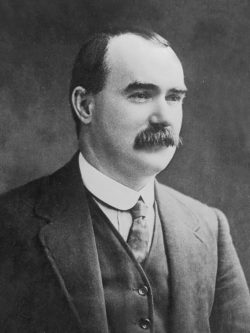

 
James Connolly (1868 – 1916)


In Ireland, for example, the changing relationship between the master and the slave could be seen in the formation of the Irish Citizens Army (ICA) by James Larkin, James Connolly and Jack White on 23 November 1913. Connolly wrote of the ICA in Workers’ Republic in 1915:
An armed organisation of the Irish working class is a phenomenon in Ireland. Hitherto the workers of Ireland have fought as parts of the armies led by their masters, never as a member of any army officered, trained and inspired by men of their own class. Now, with arms in their hands, they propose to steer their own course, to carve their own future.
James Connolly, an Irish working class hero, led the ICA into a failed uprising against British colonialism in 1916 and was executed by the British not long after. He was a self-taught scholar, a socialist, and an outstanding Labour leader of Ireland. While some may see the uprising as a failed Romantic gesture this could not be further from the truth from Connolly’s philosophical and ideological perspective.


Irish Citizens Army


Superhero reified
Ultimately the question has to be asked – do superheroes ‘save’ the people? Of course, they are symbolic heroic figures and so do not save anyone. Is it possible then to become a real life ‘superhero’? This idea is developed in the film Kick-Ass where a fictional ‘reification’ of the superhero concept happens. Kick-Ass “tells the story of an ordinary teenager, Dave Lizewski (Aaron Johnson), who sets out to become a real-life superhero, calling himself “Kick-Ass”. Dave gets caught up in a bigger fight when he meets Big Daddy (Nicolas Cage), a former cop who, in his quest to bring down the crime boss Frank D’Amico (Mark Strong) and his son Red Mist (Christopher Mintz-Plasse), has trained his eleven-year-old daughter (Chloë Grace Moretz) to be the ruthless vigilante Hit-Girl.”

While initially Kick-Ass is constantly getting his ass kicked by thugs precisely because he does not have super powers, he eventually saves the day by arriving on the scene strapped to a jet pack fitted with miniguns and kills the remaining thugs. Thus, in the ‘real world’ Kick-Ass has to resort to ‘real weapons’ and falls into the normal superhero pattern of solving crimes with the usual extra-juridical killing and cathartic ending.

Problems of Romanticism
Overall then, there are different problems associated with superheroes, particularly from the point of view of the very people to be saved. At first, in an era of socio/political cynicism and helplessness in the face of poverty, corruption and crime, superheroes are cathartic as we purge our emotions watching the difficulties they have ‘solving’ our problems. In this way action is shifted sideways as we wait for a hero to arrive rather than being active ourselves.

Secondly, the ideology of superheroes comes from above, from elites, and not from below, from the masses themselves and therefore is directed towards the agendas of elites. Superheroes are bourgeois vigilantes who ultimately do not question the structure of society itself but merely try and solve the problems created by structural inequality.  Emotions are poured into superhero individualists who battle against crime while diverting attention away from questions of collective control of society and progress.

Thirdly, they represent the anti-logical emotionalism of Romanticism, itself a reaction to science and enlightenment. While described as science fiction, superheroes are given fanciful powers that have more in common with the ancient Greek gods than modern science.
To give them credibility in providing results for the struggling oppressed, superheroes must have super powers, (as people know you need more than an individual poor-man’s resources to battle against the system itself), ergo, the need ultimately for the superpower of working class solidarity and collectivist action to bring about real changes in society.

Notes
[1] The Roots of Romanticism: Second Edition (The A. W. Mellon Lectures in the Fine Arts) (Princeton Uni Press, Princeton, 2013) by Isaiah Berlin (Author), Henry Hardy (Editor), John Gray (Foreword), p140
[2] The Roots of Romanticism: Second Edition (The A. W. Mellon Lectures in the Fine Arts) (Princeton Uni Press, Princeton, 2013) by Isaiah Berlin (Author), Henry Hardy (Editor), John Gray (Foreword), p140
[3] The Roots of Romanticism: Second Edition (The A. W. Mellon Lectures in the Fine Arts) (Princeton Uni Press, Princeton, 2013) by Isaiah Berlin (Author), Henry Hardy (Editor), John Gray (Foreword), p50


Caoimhghin Ó Croidheáin is an Irish artist, lecturer and writer. His artwork consists of paintings based on contemporary geopolitical themes as well as Irish history and cityscapes of Dublin. His blog of critical writing based on cinema, art and politics along with research on a database of Realist and Social Realist art from around the world can be viewed country by country here. He is a Research Associate of the Centre for Research on Globalization.

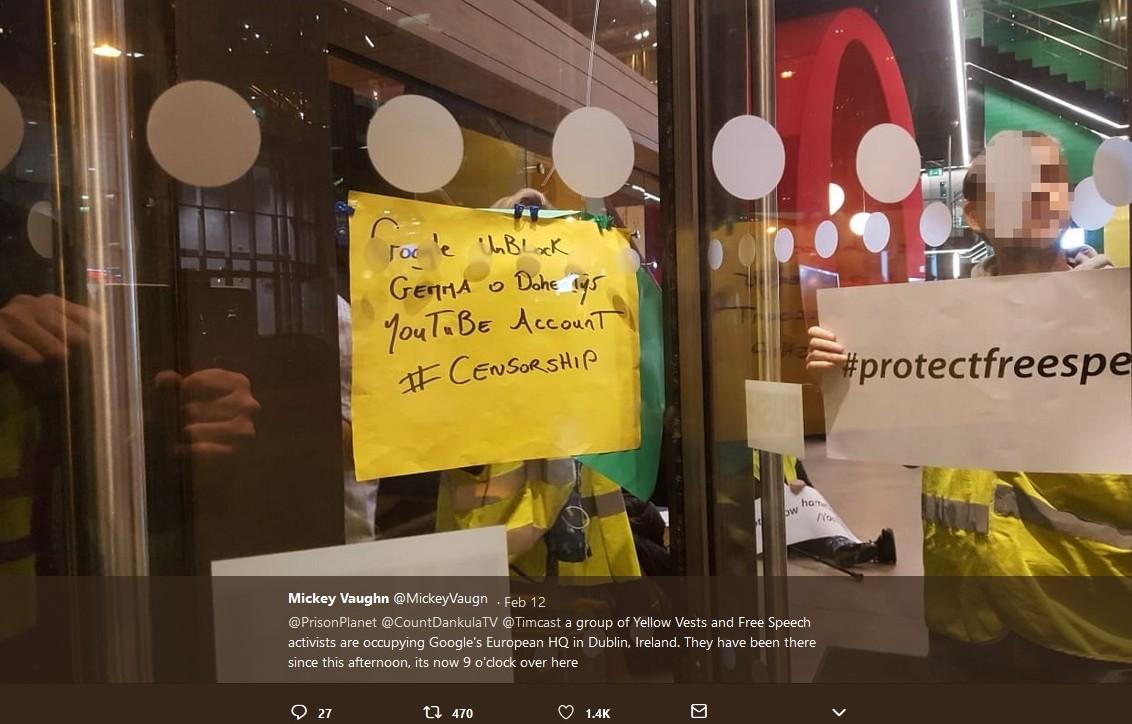
Taking on Goliath: Irish Journalist Gemma O’Doherty Takes on Google

Google’s European headquarters in Dublin were surprised when Irish journalist Gemma O’Doherty and Yellow Vests Ireland staged a protest over YouTube shutting down the Livestream facility of her channel.

Gemma is known for her work in exposing alleged corruption in the country’s criminal justice system and police force. She also worked for 16 years as Chief Features Writer at the Irish Independent until she was sacked for investigating the Garda penalty points system.

The protesters were locked in to the building (Tuesday, 12 February) at 1pm for 12 hours before Google/YouTube apologized and restored her Livestream facility at 1am.
Afterwards she tweeted:
“A victory for free speech tonight by #YellowVest #Ireland. Our occupation of @Google HQ ended in success following the reinstatement of my @YouTube. We will continue to fight all censorship by #SiliconValley who are fleecing Irish taxpayers #EndGlobalismNow #GiletsJaunes”
O’Doherty’s channel has become a popular site for alternative views on globalism and free speech. Her videos have covered many different topics such as vaccines, abortion, wind energy, censorship, cultural Marxism, corruption within the UN, the Clinton Foundation and much more.


It is unfortunate for Google and advantageous for Gemma that their European headquarters are based in Dublin, thus providing a physical target for an Irish peaceful protest. This is the Achilles Heel for Google in this case as these worldwide firms are usually difficult to approach online through the very medium within which they can exert so much control.

 Featured image is from Irish Examiner

Caoimhghin Ó Croidheáin is an Irish artist, lecturer and writer. His artwork consists of paintings based on contemporary geopolitical themes as well as Irish history and cityscapes of Dublin. His blog of critical writing based on cinema, art and politics along with research on a database of Realist and Social Realist art from around the world can be viewed country by country here. He is a Research Associate of the Centre for Research on Globalization.
Cuba: Trump Turns the Vise. Social Inequality and Cuba’s Dual Currency System. The Creation of a Well-Off Middle Class


January the 1st, 2019 marked the 60th anniversary of the Cuban Revolution. Back in December 1958 the city of Santa Clara fell to the combined forces of Che Guevara, Cienfuegos, and Revolutionary Directorate (RD) rebels led by Comandantes Rolando Cubela, Juan (“El Mejicano”) Abrahantes, and William Alexander Morgan. Upon hearing the news of the defeat of his forces by the Fidel Castro-led revolutionaries, Batista left Cuba and flew to the Dominican Republic on 1 January 1959.


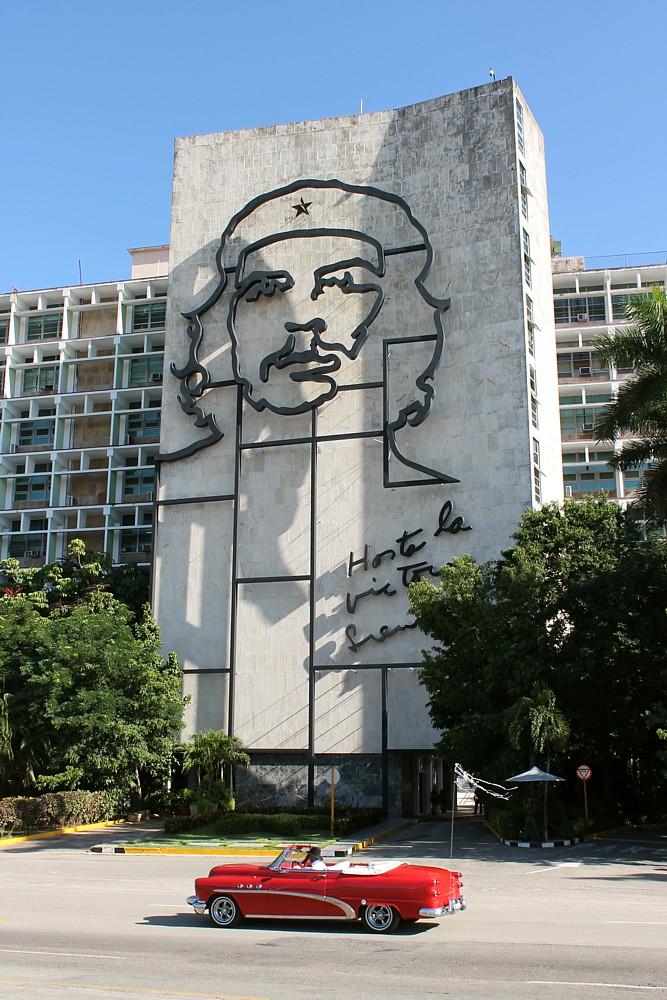
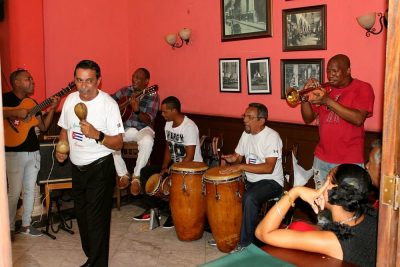
 Havana (October, 2018)


Since then the Cuban people have struggled to maintain their independence as allies came and went and enemies tried to reverse the revolution. In recent years President Obama attempted to normalise relations between Cuba and the United States (known as the Cuban Thaw) by reducing U.S. travel and remittances restrictions and reopening the U.S. embassy in Havana and the Cuban embassy in Washington. Obama even became the first U.S. President to visit Cuba since 1928.
However, since the election of Donald Trump many of these gains have been reversed.


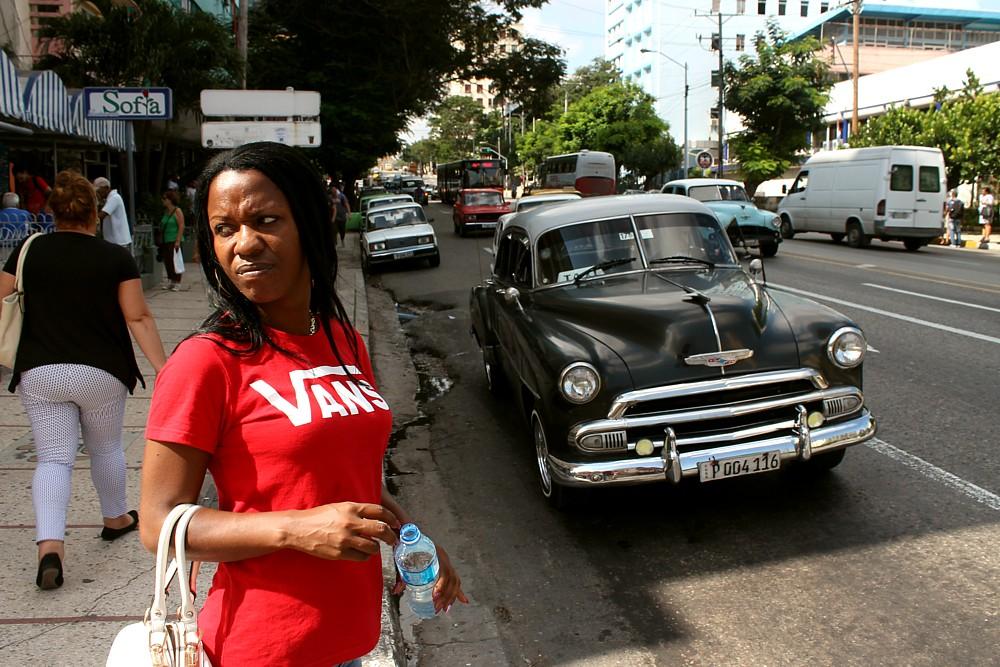
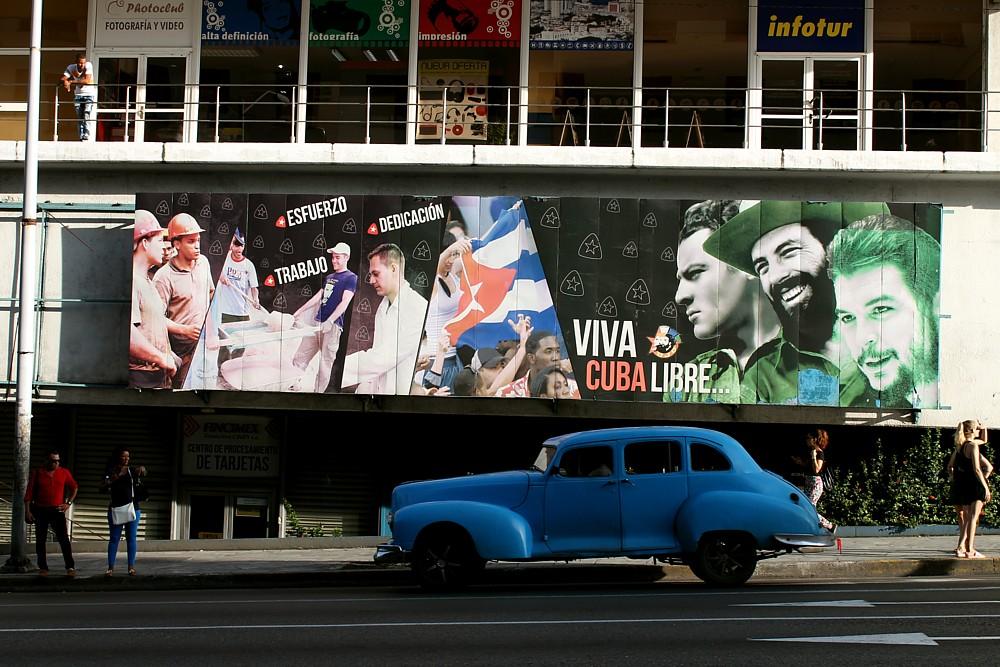
Havana (October, 2018)
In November 2018 the US government reversed the positive changes brought in by Obama. The Trump government will disallow most individual visits and (as before Obama’s changes) Americans will have to travel in groups licensed for specific purposes. Most importantly Americans will be barred from staying in state-owned hotels, and frequenting state-owned restaurants and stores. The plan seems to be to starve the government of revenue while at the same time encouraging the growth of the private sector e.g. private accommodation and restaurants.


Havana (October, 2018)

A recent article noted:
“The Trump administration is adding new names to a list of Cuban tourist attractions that Americans are barred from visiting. The 26 names range from the new five-star Iberostar Grand Packard and Paseo del Prado hotels in Old Havana to modest shopping centers in beachside resorts far from the capital. All are barred because they are owned by Cuba’s military business conglomerate, GAESA.”


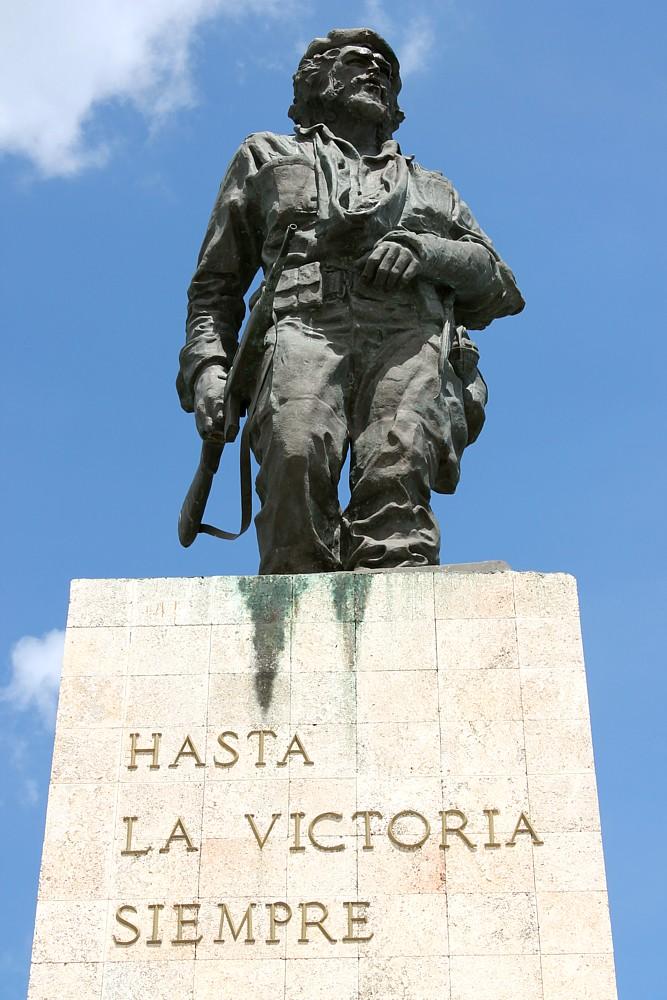
Santa Clara (October, 2018) Che Guevara Mausoleum


Adding to these difficulties is the existence of two operating currencies: the Cuban peso (CUP) and the Cuban convertible peso (CUC). The CUC is pegged to the dollar and is worth 25 times more than the CUP. One Cuban convertible peso (CUC) is about one Euro. Most Cuban citizens are paid in CUP but consumer goods are priced in CUC. While it was announced a few years ago that this system was going to end, it is still going strong.


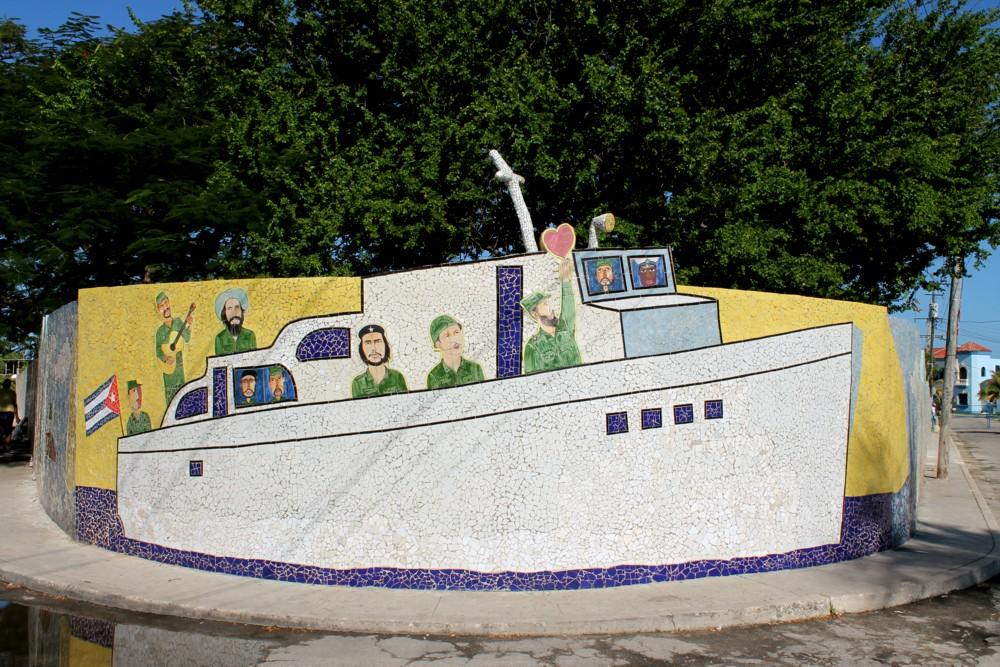
Havana (October, 2018)

Disparity
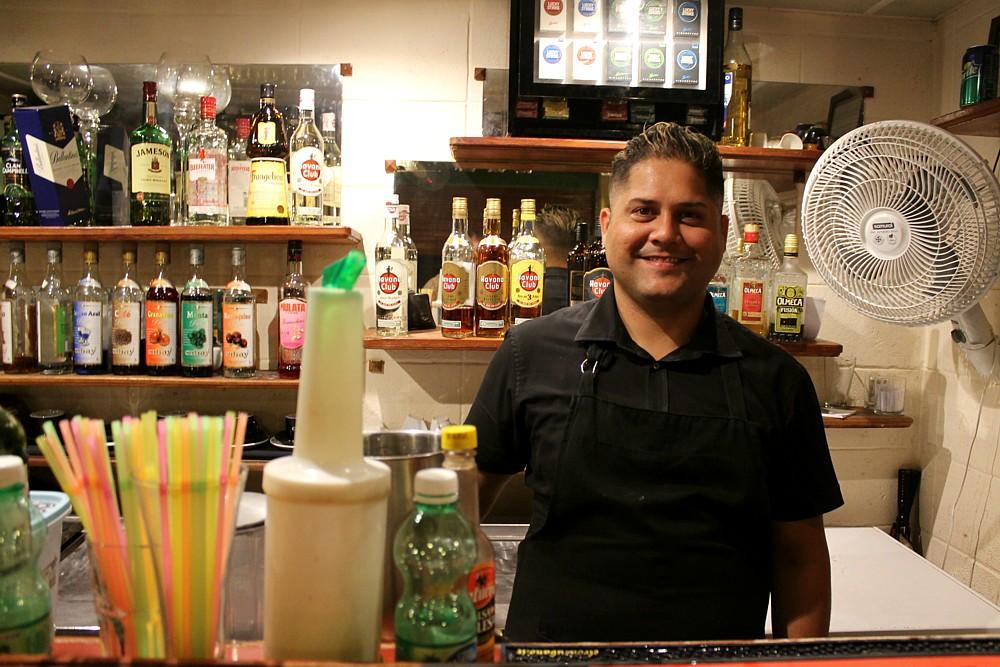
It is a system that could cause major problems for the government. While most citizens are paid in CUP – 1000-2000 pesos (40-80 Euros) per month –  those working in the tourism sector can earn CUC. One can earn 30 CUC (30 Euros) driving a tourist from the airport to the centre of Old Havana or 20 CUC (20 Euros) a night in a private Airbnb room letting.  The local bars, restaurants and even supermarkets all use CUC. Cigar factory workers are paid in CUP, yet one Cohiba cigar could cost 10 CUC in the factory shop. On my recent trip there I asked the bar and restaurant staff in Havana for CUP notes (the three peso note carries a picture of Che Guevara) only to find them asking all their workmates if they had any CUP and eventually arriving back triumphantly with the requested notes and handing them to me as a gift, demonstrating the growing gap in the value of the two currencies.


Havana (October, 2018)


Is it possible that the growing disparity between those who earn CUP and those who earn CUC is creating a well-off new middle class? It is interesting to note that Trump’s Cuban policies seem to be created to ensure the exacerbation of these discrepancies. Is there a political strategy developing here? If we look at the essential elements of recent Colour Revolutions we generally find the combination of a disgruntled middle class and mobile data access to the internet.
To avail of the internet in Havana most people buy ETECSA prepaid internet cards and go to a nearby WiFi hotspot (usually the local park). However, data packages are becoming available. They are expensive if you are earning only CUP and only the relatively well-off will be able to afford them (e.g. 4GB of data for $30 – a month’s wages in CUP). But for those working in the tourist sector this should be affordable potentially creating the basis for a powerful social media in Cuba.
The growth of the private sector can be seen in the number of new private restaurants, bnb/pension type accommodation, cafes and bars in Havana. Yet many of the Cubans I met could not afford to buy even a sandwich in the cafes as they are priced in CUC. The collapse of state enterprises already under a lot of stress could lead to cheap real estate being bought up by the cash-rich and generally benefit non-supporters of Castro and left wing ideology, politically and financially.
As it is, there is increasing pressure on the government with only 1.2 percent growth in the economy and a 40 percent drop in Venezuelan oil deliveries (since 2014) in a society where state-run companies account for and control most economic activity.


Havana (October, 2018)
Embargoes
The difficulties for the Cuban people are increased by the ongoing United States-led embargo against Cuba. In October 2018 the UN General Assembly adopted its annual resolution to end the embargo. Ma Zhaoxu, China’s permanent representative to the United Nations stated that the blockade “is contrary to the principle of the United Nations Charter and cause[s] huge financial and economic damage for Cuba” and “hinders Cuba’s ability to achieve the Sustainable Development Goals”.
For the Cuban people it will be a case of ‘resist to exist’ like the Palestinian situation but in Cuba one can see frustration and determination for a better life all around. The 60th anniversary celebrations of 2019 will be a most important symbolic reminder in the discussions on the differing possible paths for Cuba’s future.


Caoimhghin Ó Croidheáin is an Irish artist, lecturer and writer. His artwork consists of paintings based on contemporary geopolitical themes as well as Irish history and cityscapes of Dublin. His blog of critical writing based on cinema, art and politics along with research on a database of Realist and Social Realist art from around the world can be viewed country by country here. He is a Research Associate of the Centre for Research on Globalization.
All images in this article are from the author.

“Cultural Marxism”: The Quixotic Catch-All Term to Cover Feminism, Multiculturalism, Identity Politics, Civil Rights, …

“The whole aim of practical politics is to keep the populace alarmed (and hence clamorous to be led to safety) by menacing it with an endless series of hobgoblins, all of them imaginary.”
— H. L. Mencken


Cultural Marxism is a strange catch-all term being thrown around a lot these days. Why is it strange? Because if you scratch below its surface all that seems logical melts into air.
The term ‘cultural Marxism’ is used to cover feminism, multiculturalism, identity politics, civil rights, postmodernism and globalism. It has also been used recently to describe multiculturalist curricula in the education system.
Let’s take a look at these concepts in a little more detail:

Feminism
Marxist ideas about women covered ideas of equality and examined the historical and contemporary position and exploitation of women. Marx and Engels wrote about death from overwork, cheap labour, women and children in the mills, etc. They were interested in the living conditions of working class women.

Karl Marx wrote little about women's oppression and then only as part of working-class oppression. Marx and Engels appear to have had a low opinion of feminism. In a letter from Engels to Paul Ernst, Engels writes:
“Furthermore, I am not at all acquainted with what you call the feminist movement in Scandinavia; I only know some of Ibsen’s dramas and have not the slightest idea whether or to what extent Ibsen can be considered responsible for the more or less hysterical effusions of bourgeois and petty bourgeois women careerists.”
Therefore, the inclusion of feminism into the meaning of cultural Marxism is odd.

Multiculturalism
Marxist ideas are based on the idea of citizenship and the state, that all citizens should be treated equally under the law with the common identity of “citizen”. However, it seems that the deeper the political and financial crises of the state and the subsequent whittling down of the rights of the citizen, the more emphasis is put on multicultural policies, as if to provoke the majority population into negative reactions. Marxist ideology was reflected in Article Two of the constitution of the Russian Socialist Federated Soviet Republic of 1918 whereby citizenship was held:
“(22) The Russian Socialist Federated Soviet Republic, recognizing the equal rights of all citizens, irrespective of their racial or national connections, proclaims all privileges on this ground, as well as oppression of national minorities, to be contrary to the fundamental laws of the Republic.”
One description of multiculturalism in Western countries, notes that multiculturalism “was seen to combat racism, to protect minority communities of all types, and to undo policies that had prevented minorities from having full access to the opportunities for freedom and equality promised by the liberalism that has been the hallmark of Western societies since the Age of Enlightenment.”
If it was necessary for minority groups to fight for rights, “to protect minority communities”, “to undo policies that had prevented minorities from having full access” to opportunities then it seems that this too also has very little to do with Marxist ideology. Being involved in the struggle for basic rights does not necessarily mean you are a Marxist.

Identity politics and civil rights
The same can be said for identity politics whereby people of a particular religion or race form exclusive political alliances and move away from traditional broad-based party politics. It is true that minority cultural groups have experienced exclusion in the past and today, and fight for their rights but Marxist ideas focus on the concept of CLASS, not race, religion or ethnic group. Marxist politics is formulated on the basis of class struggle not the political objectives of individuals or minority groups which may ultimately only serve to divide class solidarity.

Postmodernism
Strangest of all is the inclusion of postmodernism in descriptions of Cultural Marxism. Postmodernism is a movement characterised by an attitude of REJECTION of all meta-narratives of which Marxism is one. A metanarrative (or grand narrative) is a theory that tries to give a totalizing, comprehensive account of history, culture etc based upon the appeal to universal truth truth e.g. Enlightenment, Christian ideology, Freudian psychology, political democracy, natural science, positivism, and patriarchal order.

Postmodernism calls into question various assumptions of Enlightenment rationality, the idea of man free from Church-run society. Yet such Enlightenment ideas form the BASIS of Marxist philosophy and socialist ideology.

Globalism
Globalism is a word associated with with world-systems or other global trends. The term is associated with “post-war debates debates of the 1940s in the United States. In their position of unprecedented power, US planners formulated policies to shape the kind of postwar world they wanted, which, in economic terms, meant a globe-spanning capitalist order centered exclusively upon the United States.” Again, not very Marxist concepts, cultural or otherwise. You are more likely to find Marxist ideas in anti-globalisation movements or internationalist movements uniting the international working classes in opposition to any form of capitalist class-concilliatory globalist movements.

If not 'Cultural Marxism', then what?
It can be seen from all of the above that the basic ideas associated with cultural Marxism have more in common with crises of neo-liberalism and international capitalism than with Marxism:

1) feminism rather than women and men in class struggle together,
2) multiculturalism replacing citizenship,
3) identity politics instead of class politics,
4) Postmodernism against class ideology, 
5) globalism instead of international working class solidarity.

It may be true that the origins of ‘cultural Marxism’ lie in the Frankfurt school of the 1930s in the attempts of critics like Max Horkheimer, Theodor Adorno, Herbert Marcuse and Walter Benjamin to mix Marxist ideas with Freud to break down the effects of the church and state on revolutionary consciousness but it seems that later anything not associated with the conservative values of the nationalist “white”  Christian became ascribed to cultural Marxism.

While the neo-nationalist right ascribes many different ideas and movements to cultural Marxism it can be shown that in the main they all actually benefit the political right.

Monolithism as a tool to serve right wing politics

Vertical movements incorporate all classes and are usually led by elite agendas of war against other vertical movements e.g. nationalist wars of two different countries in resource competition and set the working class of each of the warring countries against each other. Vertical movements that incorporate all classes are a far cry from the conscious horizontal movements of class politics which in turn also force elites into a class war.

Vertical movements can also be monolithic (something having a uniform or inflexible quality or character) because they deny or minimise group tensions or internal contradictions. Monolithism can be used to wipe out dissent by presenting good and bad, rich and poor, progressive and reactionary as being all the same, wiping out all resistance.

Below are three different ways monolithism can be used to stifle dissent.

(1) It is in the education system that we can begin to see monolithism being used to appear progressive and concerned with minority issues (multiculturalism) while at the same time implementing a right wing agenda. For example, recent changes in the French education system have been criticised for devoting more time to a 14th century Malian king, Mansa Kankan Mussa, (who was also a great scholar, an economist as well as an art lover!) compared to the study of Napoleon or even replacing French revolution lessons.

By treating French history as monolithic (i.e. for the political right the threatening (revolutionary) and non-threatening elements can be treated as one), the baby can be thrown out with the bathwater, and the revolutionary tradition of the French people can be safely removed from the education system. Therefore the progressive parts of French history can be removed while appearing to be concerned about minority history. The added bonus is that non-threatening ethnic historical figures can be chosen too.

(2) The second way dissent can be silenced using monolithism is to portray minority groups as being made up of similar people all sharing similar views. As Kenan Malik writes:
“Multiculturalists tend to treat minority communities as if each was a distinct, singular, homogenous, authentic whole, each composed of people all speaking with a single voice, each defined primarily by a singular view of culture and faith. In so doing, they all too often ignore conflicts within those communities. All the dissent and diversity gets washed out. As a result, the most progressive voices often gets silenced as not being truly of that community or truly authentic, while the most conservative voices get celebrated as community leaders, the authentic voices of minority groups.”
The ‘authentic’ conservative gets privileged over the dissenting critic, once again serving the political right.

(3) A third way monolithism works is in the change from the Marxist idea of class struggle (the proletariat vs the bourgeoisie) to categories of the oppressed vs the oppressor (a postmodern non-class concept). Yet again, we see a non-Marxist idea being ascribed to cultural Marxism. The oppressor is changed from the bourgeoisie to all privileged people. So for example, white people become the ‘oppressor’ and black people become the ‘oppressed’, the privileged vs the underprivileged, despite the fact that white people can have very varied economic backgrounds from very poor to ultra-rich. This way of grouping people (colour, creed, ethnicity) creates identities which are not class-based and therefore, from the perspective of the political right, also non-threatening.

Moving targets
It is ironic that what the main targets described by the term cultural Marxism all have in common is the removal of the class (or individual) dissenting elements, or simply have no connection with Marxist ideology at all. The overriding concern, then, is that politics will be reduced to competing groups realigned along specific cultural boundaries, all blind to clever elite manipulation. Firing the term cultural Marxism at any divergent social, cultural or political activity will not enlighten people about what is really happening under their noses but will send them off tilting at windmills instead.


Caoimhghin Ó Croidheáin is an Irish artist, lecturer and writer. His artwork consists of paintings based on contemporary geopolitical themes as well as Irish history and cityscapes of Dublin. His blog of critical writing based on cinema, art and politics along with research on a database of Realist and Social Realist art from around the world can be viewed country by country here. He is a Research Associate of the Centre for Research on Globalization.
Friday, December 21, 2018

The People’s Christmas: Art, Tradition and Climate Change


COME, bring with a noise,
My merry, merry boys,
The Christmas log to the firing ;
While my good dame, she
Bids ye all be free ;
And drink to your heart’s desiring.
With the last year’s brand
Light the new block, and
For good success in his spending
On your psaltries play,
That sweet luck may
Come while the log is a-teending.

Ceremonies for Christmas by Robert Herrick (1591–1674)
(Psaltries: a kind of guitar, Teending: kindling)


No season has so much association with music as the mid-winter, Christmas celebrations. The aural pleasure associated with the tuneful music and carols of Christmas has been reduced in recent years by the over-playing of same in shopping malls, banks, airports etc. yet it is still enjoyed and the popularity of choirs has not diminished.
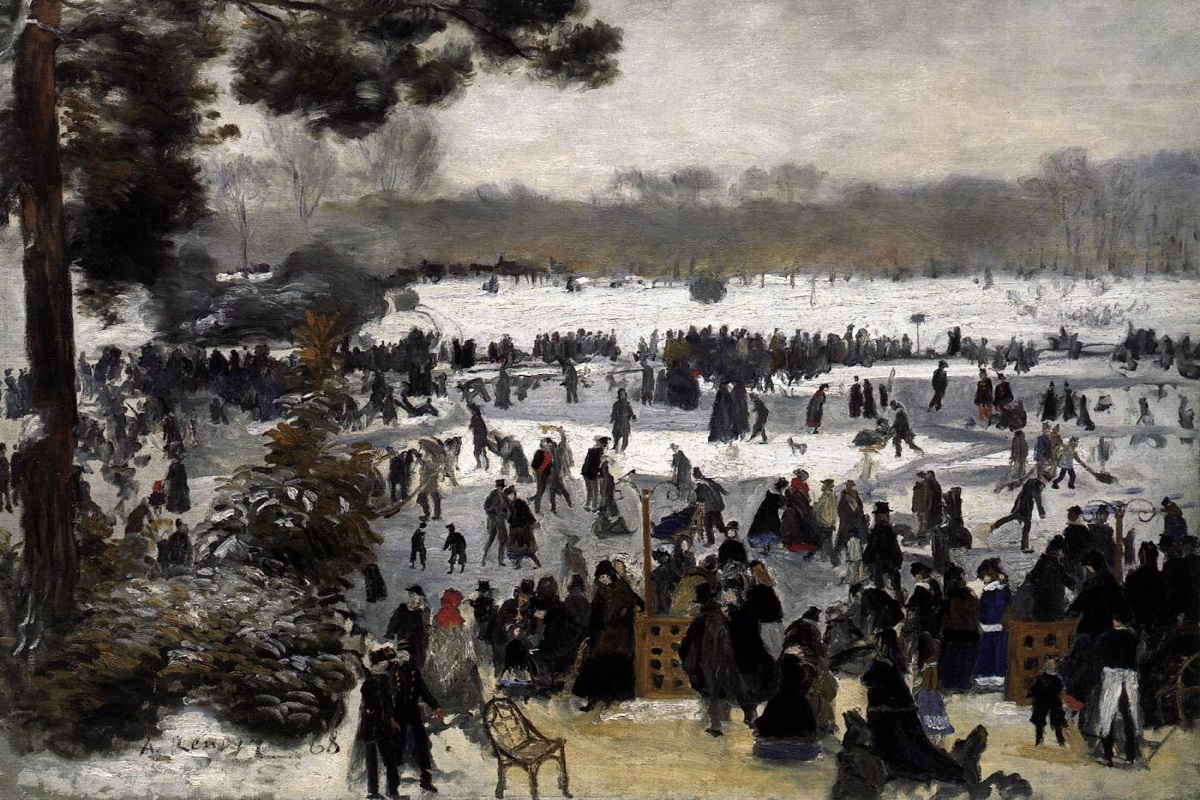
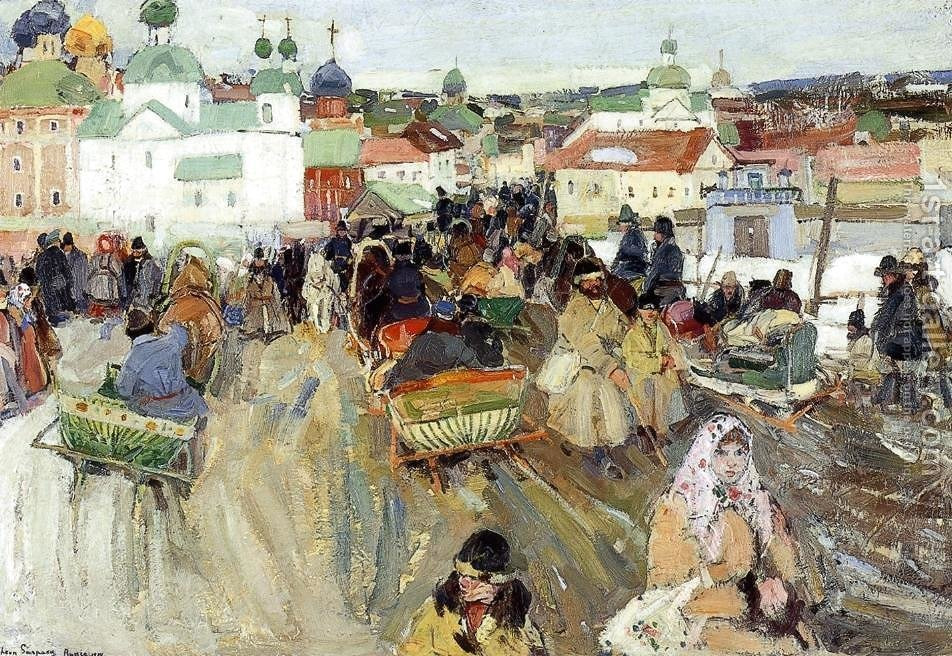
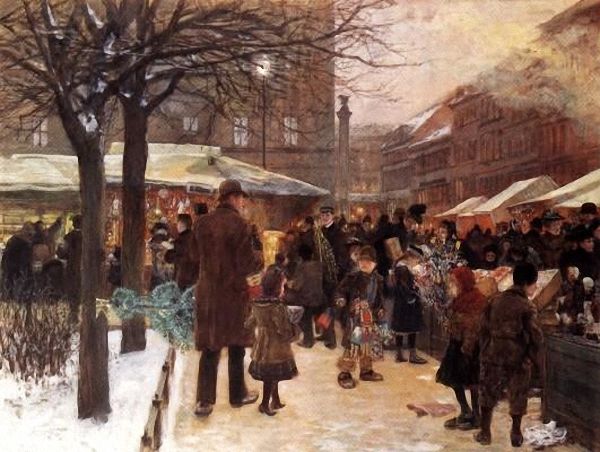
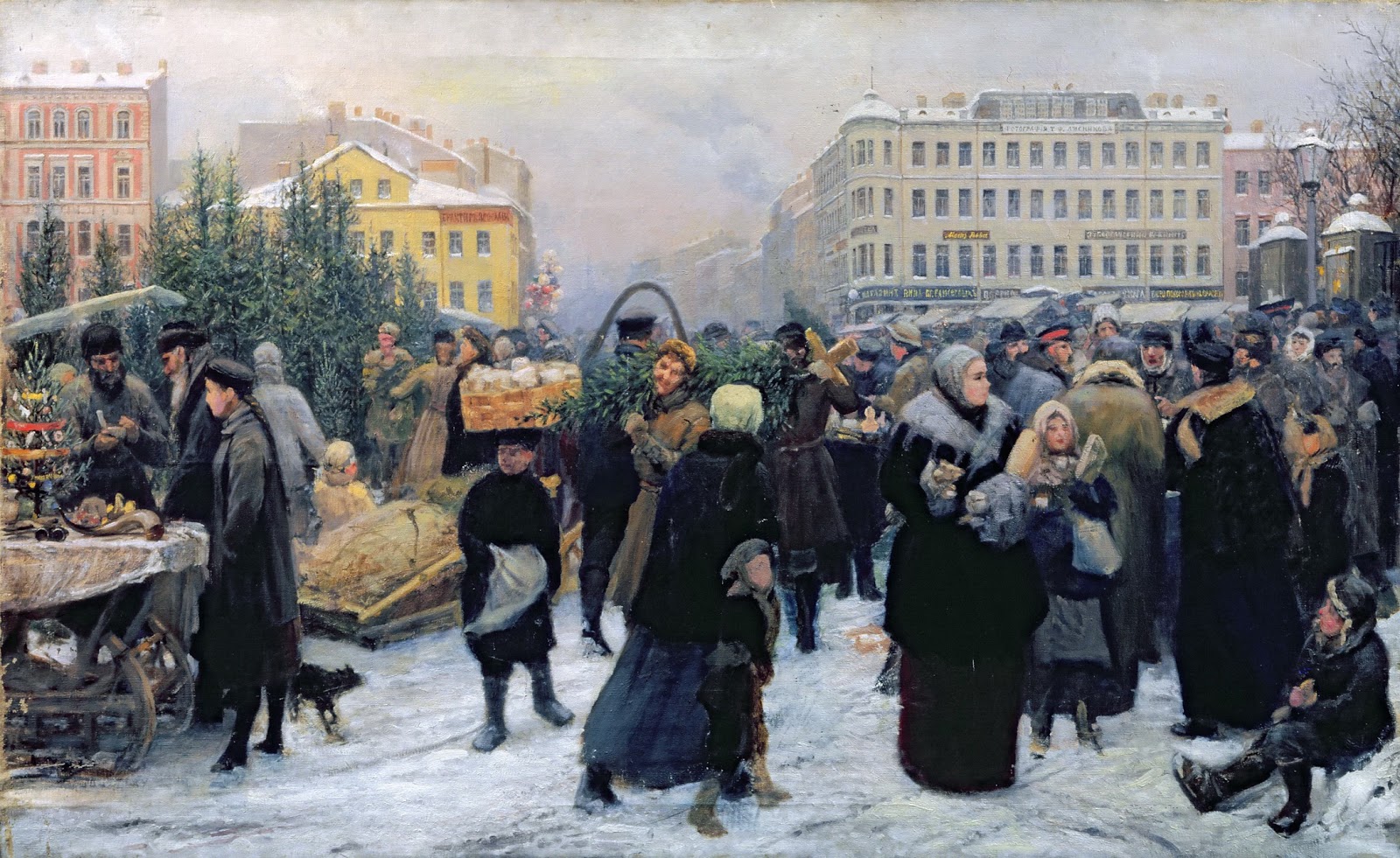
However, the visual depictions of mid-winter, Christmas celebration have also been popular since the 19th century through books, cinema and television.

The depictions of Christmas range from religious iconography through to the highly commercialised red-suited, rosy-cheeked, rotund Santa Claus.

Yet, between these two extremes of the sombre sacred and the commercialised secular lies a popular iconography best expressed in the realm of fine art and illustration.

Down through the centuries the pagan aspects of mid-winter celebration and Christmas such as the Christmas tree, the Yule log, wassailing and carol singing along with winter sports such as ice skating and skiing have been depicted by many different artists.
These paintings and illustrations are also beloved for the visual pleasure they afford.
More importantly, they show aspects of Christmas which are becoming more important now in our time of climate change. That is, their depictions of our past respect for nature.
In recent times, as we gradually learned to harness nature for our own ends through developments in science we also became less and less worried about the vicissitudes of nature.
Our forebears, however, knew all too well hunger and cold in the depths of winter and in their own religious and superstitious ways tried to attenuate the worst of winter hardship through traditions and practices which would ensure a bountiful proceeding year.
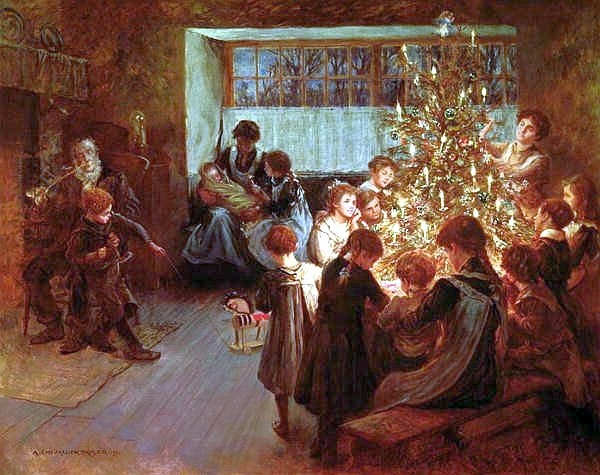
For example, the Christmas Tree is a descendant of the sacred tree which was respected as a powerful symbol of growth, death and rebirth. Evergreen trees took on meanings associated with symbols of the eternal, immortality or fertility (See my article on Christmas Trees here). Evergreen boughs and then eventually whole evergreen trees were brought into the house to ward off evil influences. Burning the Yule log was an important rite to help strengthen the weakened sun of midwinter.


The Christmas Tree (1911)
Albert Chevallier Tayler (1862–1925)

Wassailing, or blessing of the fruit trees, is also considered a form of tree worship and involves drinking and singing to the health of the trees in the hope that they will provide a bountiful harvest in the autumn. Mumming has also been associated with the spirit of vegetation or the tree-spirit and is believed to have developed into the practice of caroling even though mumming is alive and well in many places in Ireland and England.
All these nature-based practices seem to have been banned by the church at different times and then gradually integrated into church rituals (presumably because the church was not able to stop them).
Therefore our relationship with nature was demonstrated through winter activities both inside and outside the home. Outside activities consisted of ice skating, caroling, wassailing, bringing home the Yule log and the Christmas tree.

Inside activities consisted of large gatherings of family and friends eating, drinking and parlour games. The indulgence of Christmas activities was balanced by an overriding concern that nature had been propitiated or appeased.
One aspect the many depictions of these activities have in common is the festive gathering of large groups of people. Modern depictions of Christmas tend to emphasise the nuclear family gathered around the Christmas tree with the focus on what Santa brought for the children. Thus Christmas today is experienced as a more isolated experience than in the past.
The decline of the nuclear family in recent decades with single parent families, divorce, cohabitation, etc has created extended family gatherings more akin to the past village groupings. Outdoor activities have also declined though one can still hear carollers singing on occasion, though still common in city streets.
Many artists of over the years have tried to depict the essence of Christmas and midwinter traditions (see my article on midwinter traditions here) and thus helped to keep them in our consciences.
Let’s look at some of the illustrations and paintings that depict mid-winter festivities over the centuries.


Carols
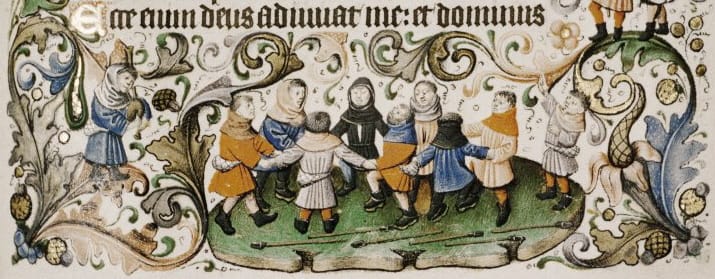
Poetry and song are our earliest records of Christmas celebrations. According to Clement Miles the word “‘carol’ had at first a secular or even pagan significance: in twelfth-century France it was used to describe the amorous song-dance which hailed the coming of spring; in Italian it meant a ring- or song-dance; while by English writers from the thirteenth to the sixteenth century it was used chiefly of singing joined with dancing, and had no necessary connection with religion.”[1]
The word carol itself comes from the Old French word carole, a circle dance accompanied by singers (Latin: choraula). Carols were very popular as dance songs and processional songs sung during festivals. In medieval times the Church referred to caroling as “sinful traffic” and issued decrees against it in 1209 A.D. and 1435 A.D.
According to Tristram P. Coffin in his Book of Christmas Folklore, “For seven centuries a formidable series of denunciations and prohibitions was fired forth by Catholic authorities, warning Everyman to ‘flee wicked and lecherous songs, dancings, and leapings’” (p98).

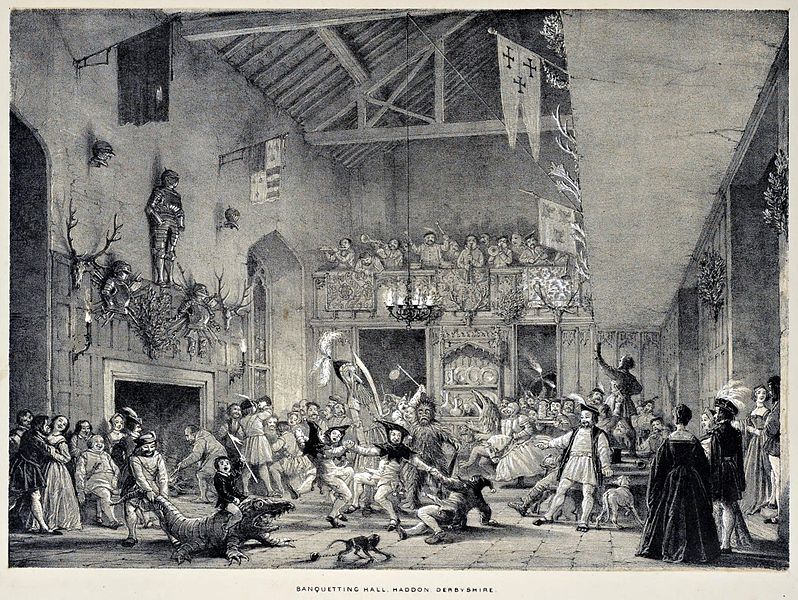
Banqueting Hall

Mumming
The processional aspects of caroling are linked to mumming, an ancient tradition which was mentioned in early ecclesiastical condemnations.
During the Kalends of January a sermon ascribed to St Augustine of Hippo writes that the heathen reverses the order of things as some of these ‘miserable’ men “are clothed in the hides of cattle; others put on the heads of beasts, rejoicing and exulting that they have so transformed themselves into the shapes of animals that they no longer appear to be men … How vile further, it is that those who have been born men are clothed in women’s dresses, and by the vilest change effeminate their manly strength by taking on the forms of girls, blushing not to clothe their warlike arms in women’s garments; they have bearded faces, and yet they wish to appear women.” [2]
The original idea of wearing the hides of animals, Miles writes, may have sprung “from the primitive man’s belief ‘that in order to produce the great phenomena of nature on which his life depended he had only to imitate them’. [3]
Indeed, in Ireland, mumming is a tradition that is still going strong.
In a recent article in The Fingal Independent, Sean McPhilibin notes that “In North County Dublin the masking would be traditionally made from straw and would have been big straw hats that cover the face and come down to the shoulders.” McPhilibin also states that mumming was “a mid-winter custom that in Ireland and North County Dublin and in parts of England as well, the masking element is accompanied by a play. So there’s a play in it with set characters. It’s a play where the principal action takes place between two protagonists – a hero and a villain. The hero slays the villain and the villain is revived by a doctor who has a magical cure and after that happens there’s a succession of other characters called in, each of whom has a rhyme. So every character has a rhyme, written in rhyming couplets.[…] The other thing to say about it is that you find these same type of characters all across Spain, Portugal, France, Germany, Austria, Switzerland, over into Slovenia and elsewhere.”
James Frazer, in The Golden Bough, discusses at length many international examples of people being being completely covered in straw, branches or leaves as incarnations of the tree-spirit or the spirit of vegetation, such as Green George, Jack-in-the-Green, the Little Leaf Man, and the Leaf King.[4]


Wassail
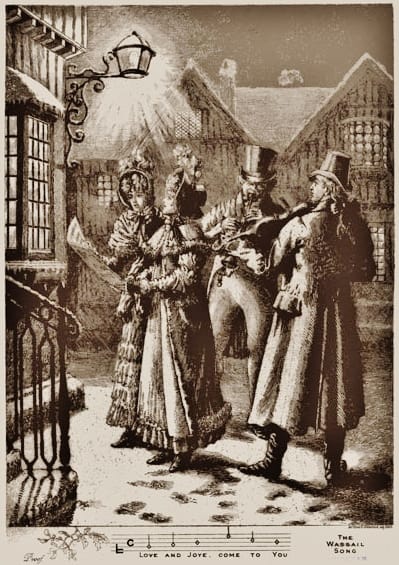
The word wassail comes from Old English was hál, related to the Anglo-Saxon greeting wes þú hál, meaning “be you hale”—i.e., “be healthful” or “be healthy”.

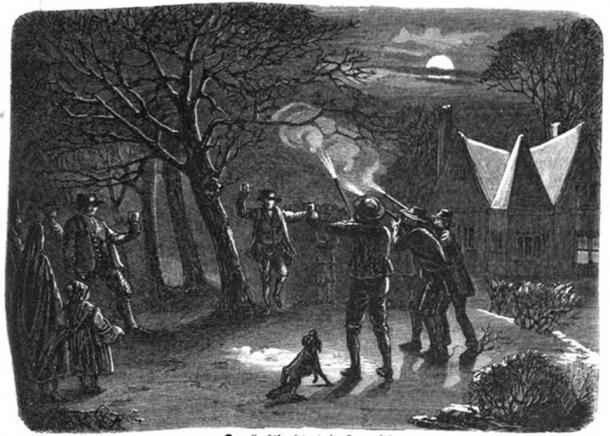
There are two variations of wassailing: going from house to house singing and sharing a wassail bowl containing a drink made from mulled cider made with sugar, cinnamon, ginger and nutmeg, topped with slices of toast as sops or going from orchard to orchard blessing the fruit trees, drinking and singing to the health of the trees in the hope that they will provide a bountiful harvest in the autumn. They sing, shout, bang pots and pans and fire shotguns to wake the tree spirits and frighten away evil demons.

The wassail itself “is a hot, mulled punch often associated with Yuletide, drunk from a ‘wassailing bowl’. The earliest versions were warmed mead into which roasted crab apples were dropped and burst to create a drink called ‘lambswool’ drunk on Lammas day, still known in Shakespeare’s time. Later, the drink evolved to become a mulled cider made with sugar, cinnamon, ginger and nutmeg, topped with slices of toast as sops and drunk from a large communal bowl.” (See traditional wassail recipe here)


The Lord of Misrule
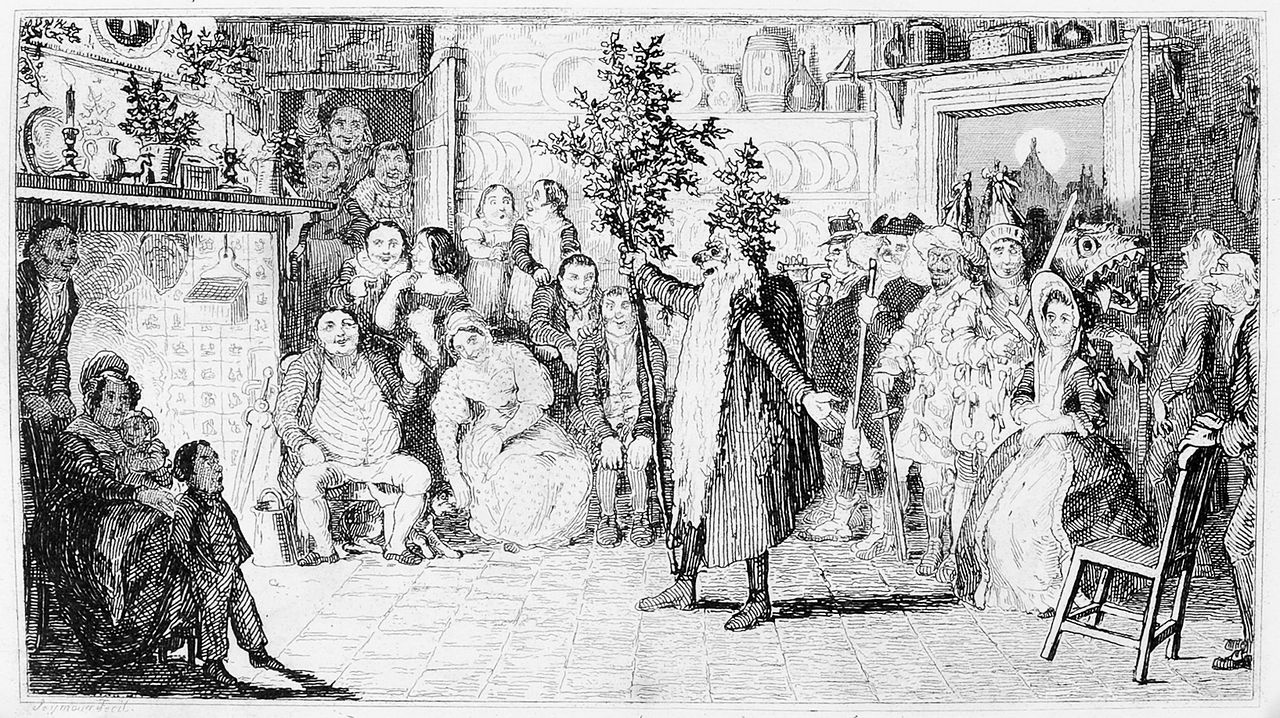
The Lord of Misrule was a common tradition that existed up to the early nineteenth century whereby a peasant or sub-deacon appointed to be in charge of Christmas revelries, thus the normal societal roles where reversed temporarily. The Lord of Misrule “would invite traveling actors to perform Mummer’s plays, he would host elaborate masques, hold large feasts and arrange the procession of the annual Yule Log.”


Mummers by Robert Seymour, 1836


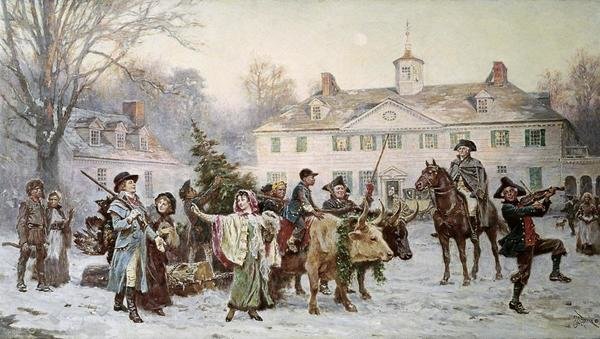
The Mount Vernon Yule Log
Jean Leon Gerome Ferris (1863–1930)

The Bean King
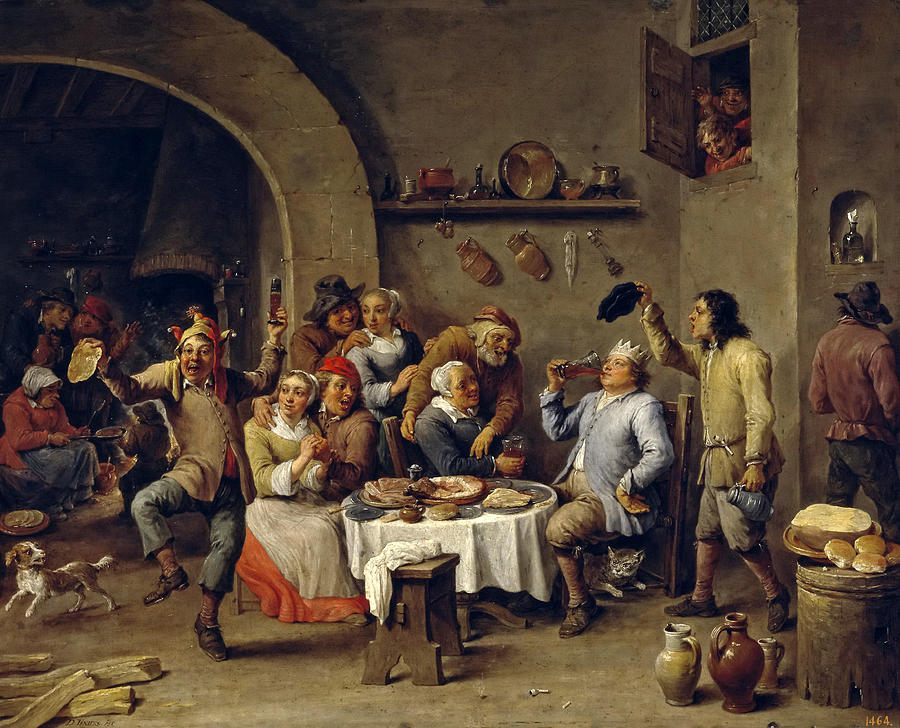
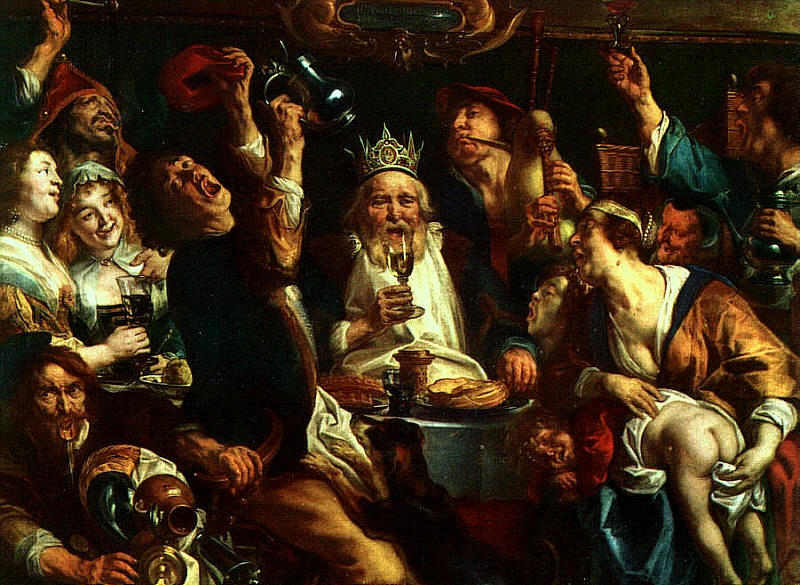
During the the Twelfth Night feast a cake or pie would be served which had a bean baked inside. The person who got the slice with the bean would be ‘crowned’ the Bean King with a paper crown and appointed various court officials. A mock respect would be shown when the king drank and all the party would shout “the king drinks”. Robert Herrick mentions this in his poem Twelfth Night: or, King and Queen:
“NOW, now the mirth comes
With the cake full of plums,
Where bean’s the king of the sport here ;
Beside we must know,
The pea also
Must revel, as queen, in the court here.”

Twelfth-night (The King Drinks)
David Teniers the Younger (1610–1690)


The King Drinks (c.1640)
Jacob (Jacques) Jordaens (1593–1678)


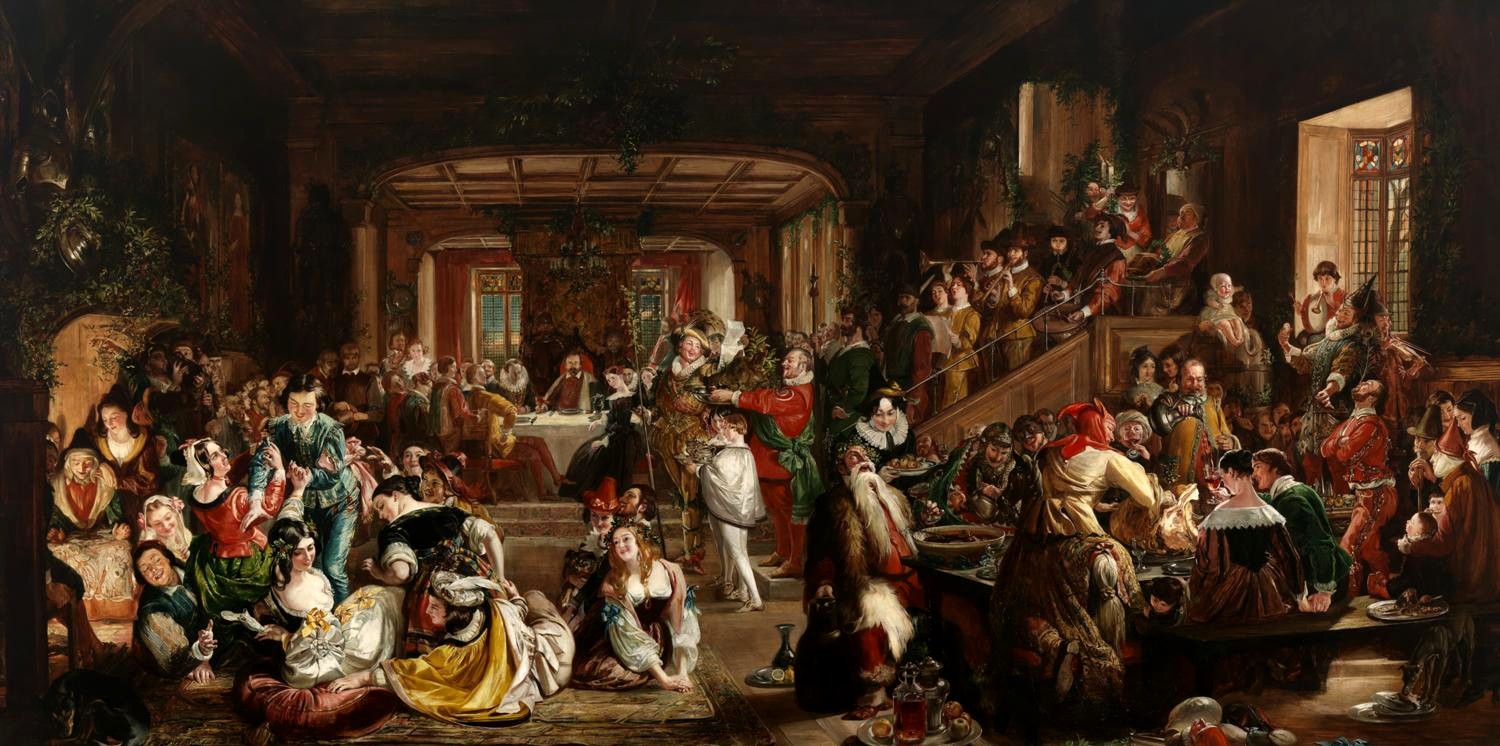
Merry Christmas in the Baron’s Hall (1838)
Daniel Maclise (1806-1870)


Merry Christmas in the Baron’s Hall (1838)
Daniel Maclise’s painting Merry Christmas in the Baron’s Hall (1838) contains many aspects of the traditional Christmas festivities. The Lord of Misrule stands in the centre holding his staff and leading the procession of musicians and carolers coming down the stairs. Father Christmas, ‘ivy crown’d’, sits in front of the wassail bowl and is surrounded by mummers (the Dragon and St George sit side by side) and local people. On the left side of the picture we see a group of people playing a parlour game called Hunt the Slipper.

Maclise was influenced by Sir Walter Scott’s poem Marmion: A Tale of Flodden Field, published in 1808. Marmion is a historical romance in verse of 16th-century Britain, ending with the Battle of Flodden in 1513. Marmion has a section referring to Christmas festivities:

“The wassel round, in good brown bowls,
Garnish’d with ribbons, blithely trowls.
There the huge sirloin reek’d; hard by
Plum-porridge stood, and Christmas pie:
Nor fail’d old Scotland to produce,
At such high tide, her savoury goose.
Then came the merry maskers in,
And carols roar’d with blithesome din;
If unmelodious was the song,
It was a hearty note, and strong.
Who lists may in their mumming see
Traces of ancient mystery;
White shirts supplied the masquerade,
And smutted cheeks the visors made;
But, O! what maskers, richly dight,
Can boast of bosoms half so light!”
(See full text here)

It seems that Maclise was also taken enough by the poem to pen his own poem about his painting which was published in Fraser’s Magazine for May in 1838. The poem is titled: Christmas Revels: An Epic Rhapsody in Twelve Duans and was published under the pseudonym, Alfred Croquis, Esq. The painting includes over one hundred figures covering many different traditions of Christmas and in his poem Maclise describes most of the activities taking place as some these excerpts from the poem demonstrate:
“Before him, ivied, wand in hand,
Misrule’s mock lordling takes his stand;
[…]
Drummers and pipers next appear,
And carollers in motley gear;
Stewards, butlers, cooks, bring up the rear.
Some sit apart from all the rest,
And these for merry masque are drest;
But now they play another part,
Distinct from any mumming art.
[…]
First, Father Christmas, ivy-crown’d,
With false beard white, and true paunch round,
Rules o’er the mighty wassail-bowl,
And brews a flood to stir the soul:
That bowl’s the source of all their pleasures,
That bowl supplies their lesser measures”
(See full text here)

Winter Landscapes
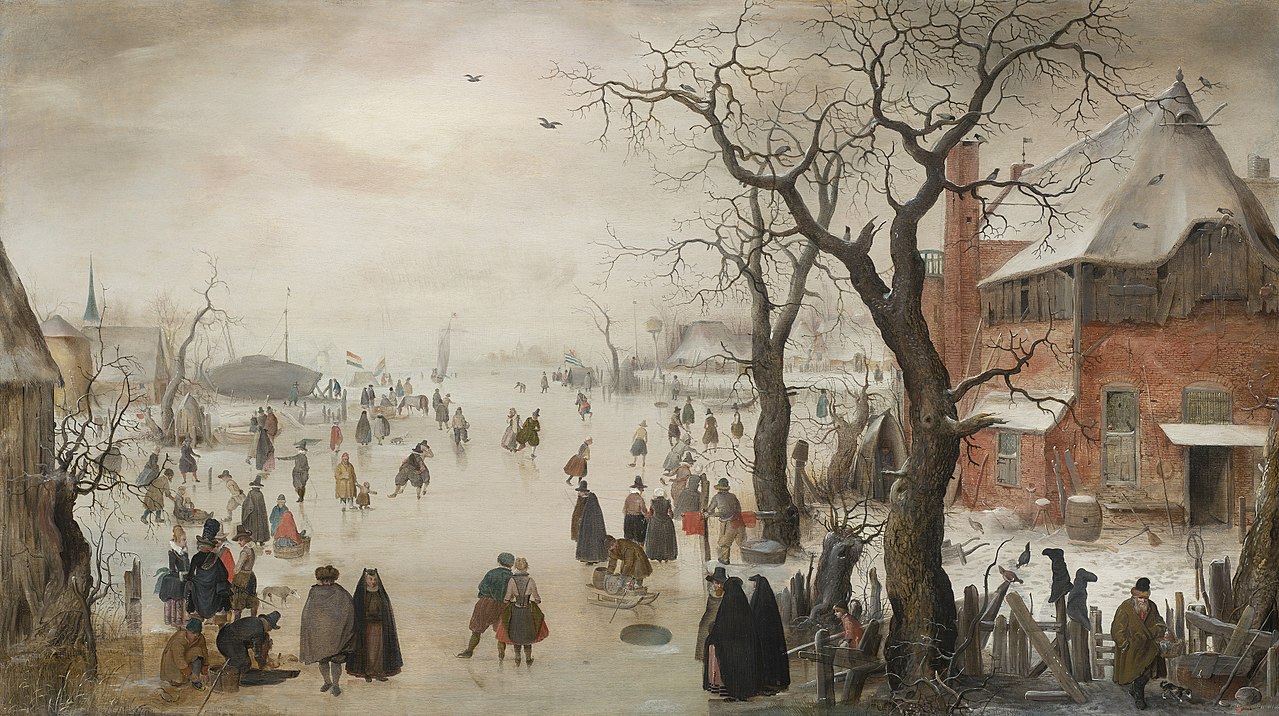
Winter Landscape near a Village
Hendrick Avercamp (1585 (bapt.) – 1634 (buried))

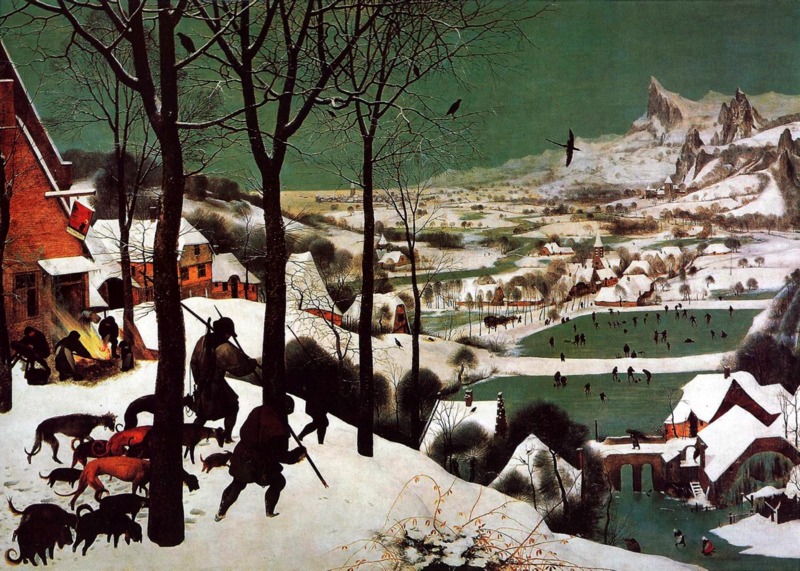
The Hunters in the Snow (1565)
Pieter Bruegel the Elder (c.1525-1530–1569)


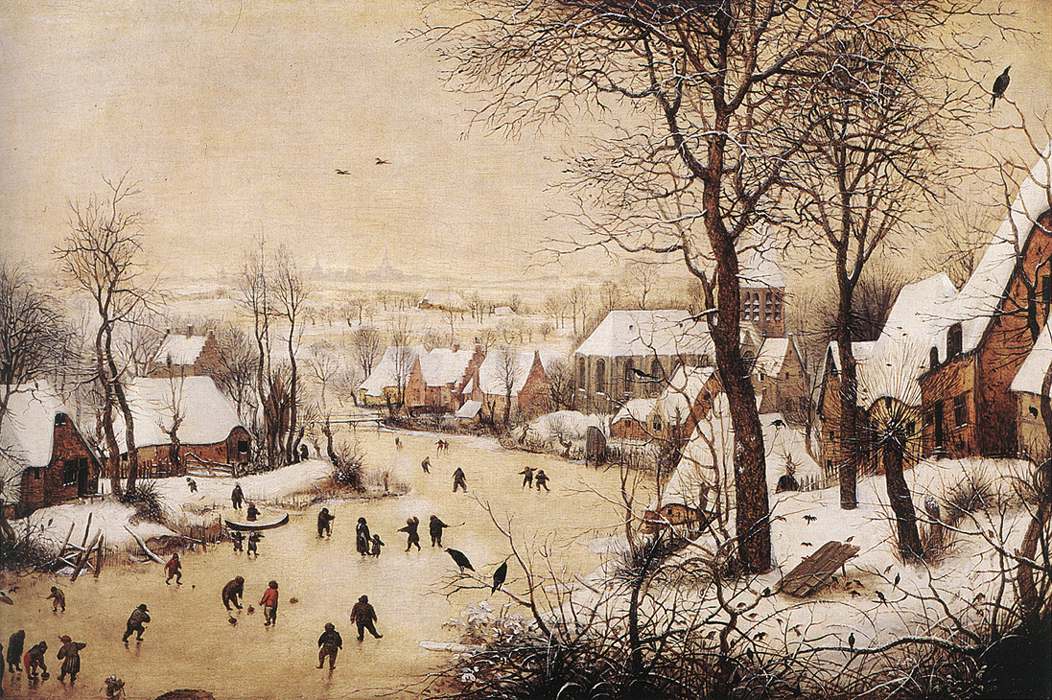
Winter Landscape with Skaters and Bird Trap (1565)
Pieter Bruegel the Elder (c.1525-1530–1569)

These famous winter landscape paintings by Pieter Brueghel the Elder, such as The Hunters in the Snow and Winter Landscape with Skaters and Bird Trap are all thought to have been painted in 1565. Hendrick Avercamp also made made many snow and ice landscapes coinciding with the Little Ice Age. Three particularly cold intervals have been described as the Little Ice Age: “one beginning about 1650, another about 1770, and the last in 1850, all separated by intervals of slight warming”.

Outdoor Activities: Skating, Markets and Fairs
Patineurs au bois de Boulogne (1868)
Pierre-Auguste Renoir (1841–1919)

Russian Christmas
Leon Schulman Gaspard (1882-1964)

The Christmas Market in Berlin (1892)
Franz Skarbina (1849-1910)


Christmas Fair (1904)
Heinrich Matvejevich Maniser


Nature-Based vs Anti-Nature
Polydore Vergil (c.1470–1555), the Italian humanist scholar, historian, priest and diplomat, who spent most of his life in England, wrote this about Christmas: “Dancing, masques, mummeries, stage-plays, and other such Christmas disorders now in use with the Christians, were derived from these Roman Saturnalian and Bacchanalian festivals; which should cause all pious Christians eternally to abominate them.”[5]

However,  Clement Miles takes a more positive view of these traditions. He writes: “The heathen folk festivals absorbed by the Nativity feast were essentially life-affirming, they expressed the mind of men who said “yes” to this life, who valued earthly good things. On the other hand Christianity, at all events in its intensest form, the religion of the monks, was at bottom pessimistic as regards this earth, and valued it only as a place of discipline for the life to come; it was essentially a religion of renunciation that said “no” to the world.” [6]

Now we have a religion of consumerism and mass consumption with Santa Claus as its main protagonist. The one extreme of the sacred St Nicholas has flipped over to the other extreme of Santa, the corporate saint. Either way the pious and the consumer pose no threat to the status quo.

Catharsis
There is no doubt that the Christmas festivities were used by elites as a form of social catharsis. The Lord of Misrule and the Bean King, encouraged by raucous mummers and  lively caroling, allowed the lowly to throw off pent-up aggression and feel what it was like to be in a position of power for a very short period of time. This brief social revolution was an important part of midwinter celebrations such as the Roman Kalends and the Feast of Fools. Libanius (c.314–392 or 393), the fourth century Greek philosopher, wrote: “The Kalends festival banishes all that is connected with toil, and allows men to give themselves up to undisturbed enjoyment. From the minds of young people it removes two kinds of dread: the dread of the schoolmaster and the dread of the stern pedagogue. The slave also it allows, so far as possible, to breathe the air of freedom.” [7]

The survivals of an ancient time when man and nature were at peace (see article here), and not enslaved and forced to overexploit our natural resources for the benefit of the few, were allowed to resurface briefly at the time of year when the labouring classes were mostly idle and, once sated, posed little threat. Yet, retaining the memory of past respectful attitudes towards nature and old traditions of social upheaval will go a long way towards healing our damaged home into the future.

Caoimhghin Ó Croidheáin  2018-12-18


Notes
:
[1] Clement A. Miles, Christmas Customs and Traditions: Their History and Significance, Dover Publications, 2017,  p47.
[2] Miles, Christmas Customs and Traditions, p170.
[3] Miles, Christmas Customs and Traditions, p163.
[4] James Frazer, The Golden Bough, Wordsworth, 1994. See: The tree-spirit p297, Green George p126, Jack-in-the-Green p128, the Little Leaf Man p128 and the Leaf King p130.
[5] Hazlitt, W. Carew, Faiths and Folklore of the British Isles, 2 vols, New York: Benjamin Blom, Inc., 1965, p118-19
[6] Miles, Christmas Customs and Traditions, p25.
[7] Miles, Christmas Customs and Traditions, p168.

Caoimhghin Ó Croidheáin is an Irish artist, lecturer and writer. His artwork consists of paintings based on contemporary geopolitical themes as well as Irish history and cityscapes of Dublin. His blog of critical writing based on cinema, art and politics along with research on a database of Realist and Social Realist art from around the world can be viewed country by country here. He is a Research Associate of the Centre for Research on Globalization.


Cultural Marxism: The Quixotic Catch-All

The whole aim of practical politics is to keep the populace alarmed (and hence clamorous to be led to safety) by menacing it with an endless series of hobgoblins, all of them imaginary.
— H. L. Mencken, In Defense of Women, 1918
Cultural Marxism is a strange catch-all term being thrown around a lot these days. Why is it strange? Because if you scratch below its surface all that seems logical melts into air.The term ‘cultural Marxism’ is used to cover feminism, multiculturalism, identity politics, civil rights, postmodernism and globalism. It has also been used recently to describe multiculturalist curricula in the education system.
Let’s take a look at these concepts in a little more detail:

Feminism

Marxist ideas about women covered ideas of equality and examined the historical and contemporary position and exploitation of women. Marx and Engels wrote about death from overwork, cheap labour, women and children in the mills, etc. They appear to have had a low opinion of feminism. In a letter from Engels to Paul Ernst, Engels writes:
Furthermore, I am not at all acquainted with what you call the feminist movement in Scandinavia; I only know some of Ibsen’s dramas and have not the slightest idea whether or to what extent Ibsen can be considered responsible for the more or less hysterical effusions of bourgeois and petty bourgeois women careerists.
Therefore, the inclusion of feminism into the meaning of cultural Marxism is odd.

Multiculturalism

Marxist ideas are based on the idea of citizenship and the state, that all citizens should be treated equally under the law with the common identity of “citizen”. However, it seems that the deeper the political and financial crises of the state and the subsequent whittling down of the rights of the citizen, the more emphasis is put on multicultural policies, as if to provoke the majority population into negative reactions. Marxist ideology was reflected in Article Two of the constitution of the Russian Socialist Federated Soviet Republic of 1918 whereby citizenship was held :
(22) The Russian Socialist Federated Soviet Republic, recognizing the equal rights of all citizens, irrespective of their racial or national connections, proclaims all privileges on this ground, as well as oppression of national minorities, to be contrary to the fundamental laws of the Republic.
One description of multiculturalism in Western countries notes that multiculturalism “was seen to combat racism, to protect minority communities of all types, and to undo policies that had prevented minorities from having full access to the opportunities for freedom and equality promised by the liberalism that has been the hallmark of Western societies since the Age of Enlightenment.”
If it was necessary for minority groups to fight for rights, “to protect minority communities”, “to undo policies that had prevented minorities from having full access” to opportunities then it seems that this too also has very little to do with Marxist ideology. Being involved in the struggle for basic rights does not necessarily mean you are a Marxist.

Identity politics and civil rights

The same can be said for identity politics whereby people of a particular religion or race form exclusive political alliances and move away from traditional broad-based party politics. It is true that minority cultural groups have experienced exclusion in the past and today, and fight for their rights but Marxist ideas focus on the concept of class, not race, religion or ethnic group. Marxist politics is formulated on the basis of class struggle not the political objectives of individuals or minority groups.

Postmodernism

Strangest of all is the inclusion of postmodernism in descriptions of Cultural Marxism. Postmodernism is a movement characterised by an attitude of rejection of meta-narratives such as Marxism. A meta-narrative (or grand narrative) is a theory that tries to give a totalizing, comprehensive account of history, culture, etc. based upon the appeal to universal truth. Postmodernism calls into question various assumptions of Enlightenment rationality, the idea of man free from Church-run society. Yet such Enlightenment ideas form the basis of Marxist philosophy and socialist ideology.

Globalism

Globalism is a word associated with world-systems or other global trends. The term is associated with “post-war debates of the 1940s in the United States. In their position of unprecedented power, US planners formulated policies to shape the kind of postwar world they wanted, which, in economic terms, meant a globe-spanning capitalist order centered exclusively upon the United States.” Again, not very Marxist concepts, cultural or otherwise. You are more likely to find Marxist ideas in anti-globalisation movements.

It can be seen from all of the above that the basic ideas associated with cultural Marxism have more in common with crises of neo-liberalism and international capitalism than with Marxism. It may be true that the origins of ‘cultural Marxism’ lie in the Frankfurt school of the 1930s in the attempts of critics like Max Horkheimer, Theodor Adorno, Herbert Marcuse and Walter Benjamin to mix Marxist ideas with Freud to break down the effects of the church and state on revolutionary consciousness but it seems that later anything not associated with the conservative values of the nationalist “white”  Christian became ascribed to cultural Marxism.

Monolithism

While the neo-nationalist right ascribes many different ideas and movements to cultural Marxism it can be shown that in the main they all actually benefit the political right. This is through monolithism (something having a uniform or inflexible quality or character), an approach that can be used as a sleight of hand to implement other agendas. Below are three different ways monolithism can be used to stifle dissent.

It is in the education system that we can begin to see monolithism being used to appear progressive and concerned with minority issues (multiculturalism) while at the same time implementing a right wing agenda. For example, recent changes in the French education system have been criticised for devoting more time to a 14th century Malian king, Mansa Kankan Mussa, (who was also a great scholar, an economist as well as an art lover!) compared to the study of Napoleon or even replacing French revolution lessons. By treating French history as monolithic (i.e. for the political right the threatening (revolutionary) and non-threatening elements can be treated as one), the baby can be thrown out with the bath water, and the revolutionary tradition of the French people can be safely removed from the education system. Therefore the progressive parts of French history can be removed while appearing to be concerned about minority history. The added bonus is that non-threatening ethnic historical figures can be chosen too.  (A more subtle approach than in Ireland where the study of History is being made optional at junior cycle in the secondary schools)

The second way dissent can be silenced using monolithism is to portray minority groups as being made up of similar people all sharing similar views. As Kenan Malik writes:
Multiculturalists tend to treat minority communities as if each was a distinct, singular, homogenous, authentic whole, each composed of people all speaking with a single voice, each defined primarily by a singular view of culture and faith. In so doing, they all too often ignore conflicts within those communities. All the dissent and diversity gets washed out. As a result, the most progressive voices often gets silenced as not being truly of that community or truly authentic, while the most conservative voices get celebrated as community leaders, the authentic voices of minority groups.
The ‘authentic’ conservative gets privileged over the dissenting critic, once again serving the political right.

A third way monolithism works is in the change from the Marxist idea of class struggle (the proletariat vs the bourgeoisie) to categories of the oppressed vs the oppressor (a postmodern non-class concept). Yet again, we see a non-Marxist idea being ascribed to cultural Marxism. The oppressor is changed from the bourgeoisie to all privileged people. So, for example, white people become the ‘oppressor’ and black people become the ‘oppressed’, the privileged vs the underprivileged, despite the fact that white people can have very varied economic backgrounds from very poor to ultra-rich. This way of grouping people (colour, creed, ethnicity) creates identities which are not class-based and therefore, from the perspective of the political right, also non-threatening.

Moving targets

It is ironic that what the main targets described by the term cultural Marxism all have in common is the removal of the class (or individual) dissenting elements, or simply have no connection with Marxist ideology at all. The overriding concern, then, is that politics will be reduced to competing groups realigned along specific cultural boundaries, all blind to clever elite manipulation. Firing the term cultural Marxism at any divergent social, cultural or political activity will not enlighten people about what is really happening under their noses but will send them off tilting at windmills instead.

Caoimhghin Ó Croidheáin / December 20th, 2018