Friday, April 8, 2022

The Re-Humanisation of Culture: Dickens and the Social Realist Cinema of the 1930s and 1940s


Charles Dickens  (7 February 1812 – 9 June 1870)
in New York, c. 1867–1868


Between 1935 and 1952 seven films were made based on the novels of Charles Dickens (7 February 1812 – 9 June 1870) .[1] They were filmed in the social realist style, a style that was popular after the Great Crash and reflected the hardships facing people at the time. Social realism is a style often used by directors, artists, composers and writers to expose the living conditions of the poor and government lack of action.

Dickens's works on film, as in their literary forms, satirise the money lenders, bankers, the rich, the aristocracy, and the landed gentry, while at the same time showing the effects of poverty on the working class in what some would see as overly sentimental depictions. This is not surprising as sentimentalism was an earlier literary movement at the time and which Dickens was likely to have been influenced by. However, Dickens's novels went way beyond the sentimentalist style and delved into critical realism which made them ideal for later social realist films. These films stand in stark contrast to much cinema today for their satire, humanity and empathy with the downtrodden. Here I will look at the ideas and influences in Dickens's novels and why they are still important as a standard for contemporary literature.

Was Dickens a sentimentalist or realist?

The extent of extreme poverty in the eighteenth and nineteenth centuries is not disputed but at the time few wrote about the poverty and less cared about it. Robert C. Solomon wrote that: "There have always been the very rich. And of course there have always been the very poor. But even as late as the civilized and sentimental eighteenth century, this disparity was not yet a cause for public embarrassment or a cry of injustice. [...] Poverty was considered just one more "act of God," impervious to any solution except mollification through individual charity and government poorhouses to keep the poor off the streets and away from crime." [2]

Enlightenment ideas eventually gave rise to social trends that emphasised humanism and the heightened value of human life. These trends had their complement in art, creating what became known as the 'sentimental novel'. While today sentimentalism evokes maudlin self-pity, in the eighteenth century it was revolutionary as sentimental literature that:

"focused on weaker members of society, such as orphans and condemned criminals, and allowed readers to identify and sympathize with them. This translated to growing sentimentalism within society, and led to social movements calling for change, such as the abolition of the death penalty and of slavery. Instead of the death penalty, popular sentiment called for the rehabilitation of criminals, rather than harsh punishment."

So how did the elites react to such criticism of their way of life in literature? In the eighteenth century, as Ralph Fox writes: "'Society,' by which we mean the ruling class, could not allow the moral perversion of the 'public'". However, the writer of the English novel in the eighteenth century could "sit apart and observe the life of the nation, to be angry, ironical, pitiful and cruel as the occasion demanded" as "there was no chance of any but the smallest number of his characters, the wealthy and the privileged ones, reading his books." [3]

However, this all changed as books became more affordable and a large reading public developed in the nineteenth century. Literary style moved from the subjectivity of sentimentalism to the objectivity of realism:

"Realism as a movement in literature was a post-1848 phenomenon, according to its first theorist Jules-Français Champfleury. It aims to reproduce "objective reality", and focused on showing everyday, quotidian activities and life, primarily among the middle or lower class society, without romantic idealization or dramatization. It may be regarded as the general attempt to depict subjects as they are considered to exist in third person objective reality, without embellishment or interpretation and "in accordance with secular, empirical rules."

The interest in documenting the living and working conditions of the poor in objective literary works could be seen in such works as The Condition of the Working Class in England (1845) by Friedrich Engels, London Labour and the London Poor (1851) by Henry Mayhew, and Past and Present (1843) by Thomas Carlyle. The works of Mayhew and Carlyle had a profound effect on Dickens. The incorporation of such observations and detailed contemporary reports into Dickens' style of writing effectively made him more of a realist than a sentimentalist. In fact, the critical nature of his work and the popularity of the realist style led Marx to comment:

"The present splendid brotherhood of fiction-writers in England, whose graphic and eloquent pages have issued to the world more political and social truths than have been uttered by all the professional politicians, publicists and moralists put together, have described every section of the middle class from the “highly genteel” annuitant and fundholder who looks upon all sorts of business as vulgar, to the little shopkeeper and lawyer’s clerk. And how have Dickens and Thackeray, Miss Brontë and Mrs. Gaskell painted them? As full of presumption, affectation, petty tyranny and ignorance; and the civilised world have confirmed their verdict with the damning epigram that it has fixed to this class that “they are servile to those above, and tyrannical to those beneath them.”"


Films based on Charles Dickens novels

Here I will summarise briefly not the plot of each movie but the characters and their treatment that Dickens wants to draw attention to:


David Copperfield (1935)
David's father dies before David is born and his mother remarries with Murdstone, a harsh man who is intent on beating education and respect into the young boy with a cane (reflecting changing attitudes towards children and childhood). David is sent to work in a bottling plant and this gives Dickens a chance to show working conditions and child labour (of which he knew from first-hand experience, Dickens was forced to leave school and work ten-hour days at Warren's Blacking Warehouse). David leaves the factory and seeks out his aunt who appears harsh at first but is actually a humane person who deals kindly with her mentally unstable friend, Mr. Dick (reflecting changing attitudes towards the mentally ill).


A Tale of Two Cities (1935)
An historical novel set in London and Paris covering several years before and during the French Revolution. It deals with the inhumane attitudes of the aristocracy which led to the revolution. Dickens shows that not all were bad as the main aristocratic villain's nephew, Charles Darnay, is sympathetic to the plight of the oppressed and impoverished French masses. He is denounced by his uncle, relinquishes his title and goes to England to begin a new life. The long suffering peasants gather to see the aristocrats' executions at the guillotine. Dickens also depicts the ultimate in heroism as the cynical lawyer Sydney Carton switches places with Darnay, who is innocently condemned to die at the guillotine.


Great Expectations (1946)
Orphan Phillip "Pip" Pirrip lives with his shrewish older sister and her kindhearted blacksmith husband, Joe Gargery. Pip meets an vicious escaped convict, Magwitch, who threatens him into bringing some food and drink back to him the next day. This he does and the convict thanks him. However the convict is caught and is seen quietly being returned to prison. A rich spinster arranges for him to visit and play with her adopted daughter. Six years later Pip is informed that he has a mysterious benefactor who has offered to transform him into a gentleman. Grown up and living in London Pip is visited by Magwitch and is shocked and anxious after his childhood experience. Magwitch tells Pip that he escaped from prison again and made a fortune sheep-farming in New South Wales, Australia. He then tells Pip that he was very taken by Pip's kindness in bringing the food instead of revealing his whereabouts to the police, and resolved to help Pip have a better life with his new found wealth. Here Dickens shows the basic humanity of convicts as victims of an oppressive society who can change for the better, in line with popular sentiment that called for the rehabilitation of criminals, rather than harsh punishment.


The Life and Adventures of Nicholas Nickleby (1947)
Nicholas Nickleby, travels to London with his mother and his younger sister Kate, to seek help from their wealthy but cold-hearted uncle Ralph, a money-lender. Nicholas gets a job teaching at a boarding school which is run like a prison. The owners "physically, verbally, and emotionally abuse their young charges on a regular basis". He meets Madeline Bray whose father gambled away his fortune and now is indebted to Nicholas's uncle. In this narrative Ralph's past deeds catch up with him and he faces prison and financial ruin, but instead commits suicide.


Oliver Twist (1948)
Here Dickens shows up the institutional abuse of the parish workhouse as children go hungry and corrupt officials live well. Oliver runs away to London and falls in with a street gang whose leaders corrupt the boys and train them to steal valuables for their benefit. In his spare time Dickens campaigned vigorously for children's rights, education and other social reforms.


Scrooge (1951)
Scrooge is a well known film and adaptation of Charles Dickens's A Christmas Carol (1843). The plot revolves around Scrooge being informed that he will be visited by three spirits: the Ghost of Christmas Past (a device to show Scrooge's lonely childhood, and broken engagement because of his dedication to "a golden idol"),  the Ghost of Christmas Present (a device to break down Scrooge's misanthropy and cynicism), and the Ghost of Christmas Yet to Come (a device to show that unless he changes his ways he will leave no positive reputation or respect behind him). Thus, Dickens "catalysed the emerging Christmas as a family-centered festival of generosity, in contrast to the dwindling community-based and church-centered observations, as new middle-class expectations arose."


The Pickwick Papers (1952)
The Pickwick Papers is a sequence of loosely related adventures written for serialization in a periodical wherein Dickens satirises a wide range of English types and English life in a good humoured style.


José Ortega y Gasset

In his books, Dickens manages to comment on every section of society and dramatise it in such a way as to create empathy where there was none, and to satirise those who thought they could enrich themselves without criticism. José Ortega y Gasset wrote about the effect of realism on culture:

"Works of this nature are only partially works of art. In order to enjoy them we do not have to have artistic sensitivity. It is enough to possess humanity and a willingness to sympathize with our neighbour's anguish and joy. It is therefore understandable that the art of the nineteenth century should have been so popular, since it was appreciated by the majority in proportion to its not being art, but an extract from life." [4]

Ortega y Gasset also wrote about emotions in art, and why they are important:

"What do the majority of people call aesthetic pleasure? What goes on in their mind when a work of art 'pleases' them? There is no doubt about the answer: people like a work of art that succeeds in involving them in the human destinies it propounds. The loves, hates, griefs and joys of the characters touch their heart: they participate in them, as if they were occurring in real life. And they say a work is 'good' when it manages to produce the quantity of illusion necessary for the imaginary characters to rate as living persons." [5]


Contemporary fiction

It is in this way that Dickens's novels delighted and enraged his audiences. His style of critical realism, in terms of form and content, is still relevant today. Sally Rooney, the Irish novelist, writes that:

"The problem with the contemporary Euro-American novel is that it relies for its structural integrity on suppressing the lived realities of most human beings on earth. To confront the poverty and misery in which millions of people are forced to live, to put the fact of that poverty, that misery, side by side with the lives of the 'main characters' of a novel, would be deemed either tasteless or simply artistically unsuccessful. [...] Do the protagonists break up or stay together? In this world, what does it matter? So the novel works by suppressing the truth of the world — packing it down tightly underneath the glittering surface of the text. And we can care once again,as we do in real life, whether people break up or stay together - if, and only if, we have successfully forgotten about all the things more important than that, i.e. everything." [6] 

Yet, it is still possible to enter the mainstream with satire and humour, to recognise "the lived realities of most human beings on earth", to acknowledge the importance of social truth in art and to be sharply critical of social and political ills.

What can the writer write about? Tara Henley (TV and radio producer, on-air columnist) summarises her frustration with media policy at CNC (Canadian Broadcasting Corporation) while inadvertently showing so many things that can be part of contemporary fiction, without being "either tasteless or simply artistically unsuccessful". Things that may be suppressed at media policy level but not in a work of art. She writes:

"It is to become less adversarial to government and corporations and more hostile to ordinary people with ideas that Twitter doesn’t like. It is to endlessly document microaggressions but pay little attention to evictions; to spotlight company’s political platitudes but have little interest in wages or working conditions. It is to allow sweeping societal changes like lockdowns, vaccine mandates, and school closures to roll out — with little debate. To see billionaires amass extraordinary wealth and bureaucrats amass enormous power — with little scrutiny. And to watch the most vulnerable among us die of drug overdoses — with little comment. It is to consent to the idea that a growing list of subjects are off the table, that dialogue itself can be harmful. That the big issues of our time are all already settled. It is to capitulate to certainty, to shut down critical thinking, to stamp out curiosity. To keep one’s mouth shut, to not ask questions, to not rock the boat. This, while the world burns."

Dickens did it and was hugely popular for it. Today, there is certainly plenty to be critical about. There is, of course, plenty of wealth, as there was in  Dickens's day. But there is also poverty, very high rents, low-paid jobs, homelessness, avaricious banks, and a general system of economics and culture to make sure it stays that way. Sure, it does not have the same look as poverty did in Dickens's era. There are social welfare systems, better standards of housing, and better working conditions. However, overall contemporary income in many cases allows young people and the working class to just about get by without much hope for improvement, despite living in a system that produces massive amounts of wealth. In other words, there are similarities with  Dickens's time but on a modern, international scale that also deserves a sharp, critical, writerly eye.

Notes:

[1] Silent films were made too but I will just discuss the talkies.
[2] Robert C Solomon, A Passion for Justice: Emotions and the Origins of the Social Contract (Rowman and Littlefield Pub., Lanham, 1995) p13
[3] Ralph Fox, The Novel and the People (Lawrence and Wishart, London, 1979) p71
[4] José Ortega y Gasset, The Dehumanization of Art, p69
[5] José Ortega y Gasset, The Dehumanization of Art, p67
[6]  Sally Rooney, Beautiful World, Where Are You (Faber and Faber, London, 2021) p95/6


Caoimhghin Ó Croidheáin is an Irish artist, lecturer and writer. His artwork consists of paintings based on contemporary geopolitical themes as well as Irish history and cityscapes of Dublin. His blog of critical writing based on cinema, art and politics along with research on a database of Realist and Social Realist art from around the world can be viewed country by country here.   

Sunday, December 26, 2021

Violence and the state: Examining Two Recent Irish Films - Arracht (2019) and Herself (2020)

Contains spoilers


From Macalla Teoranta website

In mainstream culture, social and political violence by the poor depicted in cinema is generally situated in narratives that try to maintain the legitimacy of the state. Consequently it also tries to delegitimize violence that may threaten the state.  For example, the recent Mexican-French film New Order (2020) depicts the street violence and demonstrations of the poor as mindless violence, murder, and robbery, rather than as an inevitable reaction to decades of extreme poverty and oppression.

In these scenarios, the indigent, the poor, the working class, have no rational program, no ideological agenda, and no democratic future where they could be in the driving seat of economic and cultural progress. They are forever condemned to explosive, cathartic and senseless cyclical violence that is then simply stage-managed by the state through its courts, police, army and prisons. It could be argued that the main reason for these depictions of the poor is that mainstream culture is itself one of the tools used in the maintenance of that status quo.


Arracht Trailer on youtube.com
https://www.youtube.com/watch?v=jYmZ8mPrm5A


Two recent Irish films, Arracht (‘Monster’) (2019) and Herself (2020), depict violence in very different eras. Arracht is based in Connemara in the middle of the nineteenth century, while Herself is set in a modern urban setting in Dublin. On another level, both films show how violence is allowed to be depicted in mainstream cinema.

Arracht, for example, is a well made film with much work gone into the authenticity of the depiction of the potato blight and the subsequent desperation of the local inhabitants. The narrative centres on Colmán Sharkey who lives on the Atlantic coast with his wife and young son. Colmán has taken on Patsy Kelly as a farmhand and fisherman, a dodgy character who was in the Royal Navy. The landlord has raised the rents and Colmán decides to talk to him personally, bringing Patsy with him. However,

“At the landlord's estate, Colmán unsuccessfully tries to persuade him not to raise rents due to the famine devastating the country. Patsy wanders off where he encounters the two collection agents and the landlord's daughter. He murders all three before being discovered by Colmán, who is shocked by what he finds and notices a frightened young girl has witnessed the scene. Patsy kills the landlord, leading to a confrontation with the Sharkey brothers in which Sean [Colmán’s brother] is fatally stabbed. Enraged, Colmán brutally beats Patsy and leaves him for dead.”

Soon these murders enter local nationalist folk culture in the form of a ballad sung by local fishermen. It is assumed that Colmán killed the landlord and he is seen as an heroic resistance fighter. However, it was shown that Colmán is not a violent person from an earlier scene when Patsy disarms an armed man sent to collect the rents, and Colmán orders Patsy to return the gun.

We know that the violence in the landlord's house was committed by Patsy and not Colmán. In this case it is the actions of a sociopath (Patsy) which are immortalized in culture despite Colmán’s non-violent approach to resistance. There is a sleight of hand here that shows radical nationalist culture as illegitimate violence carried out by sociopaths and furthermore depicts the singers of the ballad as being ignorant of the facts of the situation, and that they are glorifying deeds that are basically portrayed as terrorism.

Given the severity of colonial oppression in Ireland in the nineteenth century, violence against the landlords or representatives of the state is unsurprising. Resistance by the peasants is delegitimized and limited to the legal and courts system, which is upholding the landlord rent increases and evictions that are exacerbating the conflict in the first place.

A similar cinematic sticking point over legitimate and illegitimate violence occurs in Neil Jordan’s film Michael Collins set during the Irish War of Independence. Jordan has the IRA explode a car bomb even though car bombs were not used until much later during the Troubles. Some critics focused in on this event as legitimating the later IRA campaign which they saw simply as modern terrorism unlike the earlier struggle for independence. 

In Herself, the contemporary story of a woman (Sandra) fighting back against her violent ex-husband in the courts system, is a more positive narrative in that it shows her struggle against the structural violence of state bureaucracy. Furthermore, her tenacity in also resisting criminal violence by her ex-husband works well on both literal and symbolic levels.


Poster for Herself


While her battle against domestic violence is an uphill struggle against the prejudices of the state court system she eventually wins custody of her children. Her decision to build her own house in the back garden of the wealthy doctor she works for is an interesting twist in that her desire to be free and independent is determined by middle class power and control. However, her determination to create something for herself is significant as the learning processes involved in building a house counters modern consumerist ideology with the practical knowledge of production.

Furthermore, Sandra organizes a team to help her build the house, working for free, which harks back to an old Irish social tradition of a meitheal (where neighbours would come together to assist in the saving of crops or other tasks).

Unfortunately, the finished house is then burned down by her ex-husband in a criminal act of revenge. Yet this does not deter her (or her friends) from starting afresh. Thus the film carries a positive message that one can win out through struggle within the system, but also symbolically without the system, with the collective help of others despite enormous setbacks and challenges.


 Herself Official Trailer on youtube.com
https://www.youtube.com/watch?v=xwJ5IFxyc5c


Despite the fact that the legitimacy of the state is maintained in Herself (winning custody of her children through the courts, her husband being caught and put away for years), the message of struggle, learning, and co-operation towards a common goal is quite subversive. She learns not only how to fight the system but also how to construct a new way of being within the system which has profound possibilities for the future (learning new skills, working collectively, solidarity, etc.).

A similar situation can be seen in The Wind that Shakes the Barley (2006), a film by Ken Loach set during the Irish War of Independence (1919–1921) and the Irish Civil War (1922–1923), wherein the First Dáil  sets up a parallel court system to the colonial institutions, which not only became accepted and recognized by the local people (de facto) but were eventually to become de jure with the setting up of the new Irish state.

However, whether the message is conservative (Arracht) or progressive (Herself), it is usually oblique, as overtly radical content rarely gets screened. Cinema is an extremely costly business, and screenplay and finished film decisions are made by wealthy and conservative producers. Yet, every now and then films depicting working class life and struggles are produced which are significant, for example, Salt of the Earth (1954), The Organizer (1963) (Italian), The Battle of Algiers (1966)(Italian-Algerian), Blue Collar (1978) (USA), Norma Rae (1979) (USA), Vera Drake (2004) (UK), I, Daniel Blake (2016) (UK).


Caoimhghin Ó Croidheáin is an Irish artist, lecturer and writer. His artwork consists of paintings based on contemporary geopolitical themes as well as Irish history and cityscapes of Dublin. His blog of critical writing based on cinema, art and politics along with research on a database of Realist and Social Realist art from around the world can be viewed country by country here.

He is a Research Associate of the Centre for Research on Globalization.


Christmas, Nature, and the Art of Slaughter

"The fear of you and the dread of you shall be upon every beast of the earth and upon every bird of the heavens, upon everything that creeps on the ground and all the fish of the sea. Into your hand they are delivered. Every moving thing that lives shall be food for you. And as I gave you the green plants, I give you everything."
Genesis 9:2-3


There is no doubt that Christmas is a time when we become aware of the precariousness of nature as the sun's light fades, leaves fall off the trees and the weather gets colder. The sun seems to stop moving (solstice) for three days, and then as if by magic starts moving again in the other direction and seems to be reborn. This phenomenon was noticed thousands of years before Christian celebrations of the birth of Jesus. At some point, elements of Saturnalia, Midwinter, Yule and other pagan traditions became merged into the general Christmas traditions that are observed today. It is a festival that celebrates life in all its forms. Christmas cards glorify nature in their depictions of many types of snowy woodland scenes and animals: robins, reindeer, donkeys, sheep, oxen (bullocks), doves, etc. In every culture today there are still elements of nature-worship: in the maintenance of old traditions like the goddess Pachamama (revered by the indigenous peoples of the Ande) or various forms of neo-paganism that hark back to pre-Christian times. 
 

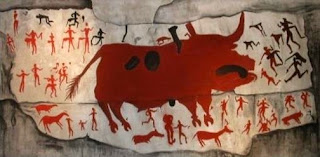
Çatalhöyük Wall Paintings, Çatalhöyük, Bull hunting scene. Copies of painting on plaster. 6 th millennium BC.


Modern secular paganism places "great emphasis on the divinity of nature" while the animistic aspects of Pagan theology asserts "that all things have a soul - not just humans or organic life - so this bond is held with mountains and rivers as well as trees and wild animals." For example:"Secular Paganism is a set of principles shared by diverse groups around the world. It is a natural outgrowth of many peoples’ personal ethics and beliefs about life. It is not a religion but rather an ethical view based on the belief that nature is sacred and must be respected and treasured. Secular Pagans believe that we are a part of nature, not her master."


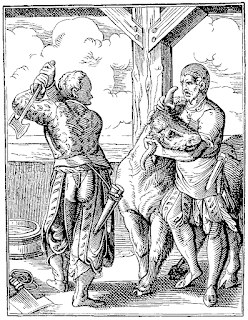
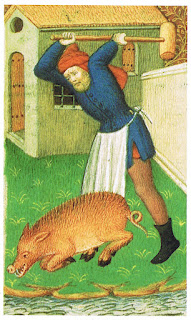
Illustration of medieval pig stunning, from The Medieval Cookbook


However, our relationship with nature is contradictory and we treat the different parts of nature in very different ways. This can be seen in the way we treat some animals as pets, others as a danger, and most as a source of food that is produced on a massive industrial scale with slaughterhouses, factories, and many forms of processing. This is reflected in art down through the ages, some of which glorifies hunting and killing animals, and some which tries to show the terror animals are put through before coming to a grisly end. In her book Why We Love Dogs, Eat Pigs, and Wear Cows: An Introduction to Carnism, Melanie Joy tries to make sense of this and theorizes a distinction between carnivores and carnists: "Carnivores require meat in their diet for survival, but carnists choose to eat meat based on their beliefs." Thus:

"carnism denies there is a problem with eating animals; second, it justifies eating meat as normal, natural, and necessary; third, to prevent cognitive dissonance, carnism alters the perception of the animals as living individuals into food objects, abstractions, and categories. Joy argues there is a neurological basis for empathy; most people care about nonhuman animals and want to prevent their suffering. Further, humans value compassion, reciprocity, and justice. However, human behavior does not match these values. To continue to eat animals, Joy argues, people engage in psychic numbing, which alters the perception of our behavior towards animals and uses defense mechanisms to block empathy."

Psychic numbing describes the way we withdraw from overwhelming issues like the contradiction between our love of animals and the way we treat them. It can be the way we deal with many big problems such as "impending doom, chaos, and ultimately mankind's extinction."


The Butcher and his Servant (1568), drawn and engraved by Jost Amman


We withdraw because we know that dealing with one serious issue tends to open up many other interlinked issues, while, at the same time getting progressively bigger as well as stretching backwards and forwards in time. Claudia von Werlhof grasps these widening problems and deals with them head on. She believes that the essential problem is rooted in an ideology which has as its basis a hatred for life itself. She blames the centuries-old socio-political systems of patriarchy and capitalism that are "characterized by exploitation, extraction and appropriation." She notes:

"The sinister motive of hating life needs to be hidden. The unspeakable crimes that all patriarchies have committed against life itself, against children, women, and all human beings, against the Earth, animals, and plants must not be revealed. The hatred of life is the reason and the rational justification for the violence against it; a violence that intends to prevent any rebellion or uprising of those not believing in the system it protects; a system that many would see as a grave assault on their dignity if they only recognized it."

Furthermore she makes a distinction between killing and death:

"It has been repeatedly suggested that the patriarchal system is a system of death. That is not entirely correct. The patriarchal system is a system of killing, that is of artificial death: ecocide, matricide, homicide in general and finally “omnicide,” the killing of everything. [...] We are up against a totalitarian system that does not care for its subjects, that cannot (or no longer) be stopped, and that is constantly becoming faster and more efficient in its attempt to end life on this planet – while turning even this very process into a tool for further accumulation of profit and power."


Man's best friend, animals' worst enemy

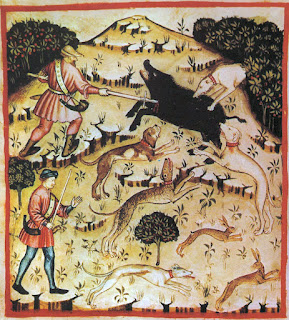
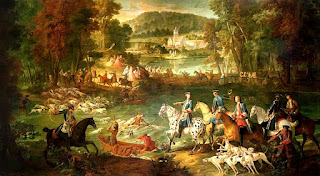
Over the centuries the system of killing has become more and more sophisticated. In art, depictions of hunting show changes from trapping to chasing with dogs to shooting with guns. In many paintings dogs are the 'collaborationists' who turn on their fellow animals for the benefit of their masters.


A 14th-century depiction of boar hunting with hounds from Tacuina sanitatis (XIV century)


Jean-Baptiste Oudry, Hunting At The Saint-jean Pond In The Forest Of Compiegne, Before 1734 


In one extraordinary set of paintings by the artist Paulus Potter (1625–1654), Punishment of a Hunter, we see different forms of entrapment and killing depicted around two central paintings, one of which shows the hunter going on trial before a court of animals, while the other shows some animals dancing for joy as the 'treacherous' dogs are hung and the dead hunter is roasted in a roaring fire. 


Punishment of a Hunter, painting with 14 frames by Paulus Potter, 1 of which is by Cornelis van Poelenburgh (ca.1650)


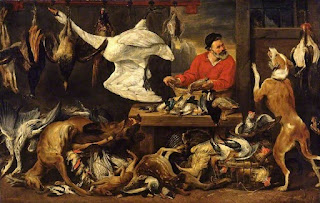
Frans Snyders (1579-1657) (studio of) - The Fowl Market


Changing attitudes towards hunting and selling of animal carcasses has been growing in recent decades and can be seen similarly in the artistic depiction of such practices as Maxwell Williams notes: "Upset students at Cambridge University successfully petitioned to have a painting depicting a butcher removed from their dining hall. The painting, The Fowl Market by the studio of early-17th-century Dutch painter Frans Snyders, loomed large above those in the dining room at Hughes Hall, a postgraduate school within Cambridge. The painting depicts the butcher at his labors, surrounded by a veritable mountain of dead animals. Nearby, a living dog appears to be barking."


Hunting the seas

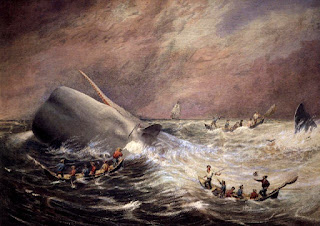
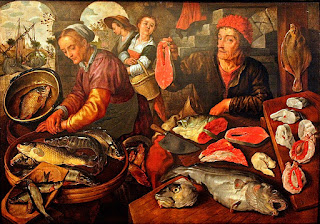
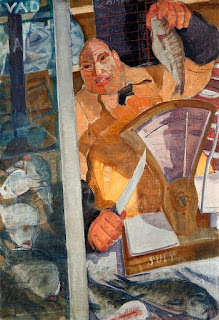
Negative attitudes towards hunting on land also extend to whale hunting and fishing as the seas are depleted of life and thus potentially creating a catastrophic collapse of the marine ecological cycle. Factory ships, fish farming and whaling have come in for much criticism, while quotas for certain species of fish have been imposed by governments due to overfishing.  In the examples shown here we see whale hunting being depicted as heroic as the hunters deal with huge whales and fierce weather, then an ambivalent merchant, to a later painting of a cruel, knife-wielding monger.


Robert Walter Weir Jr, Taking a Whale / Shooting a Whale with a Shoulder Gun (ca. 1855-1866)


A 16th-century Flemish fishmonger painted by Joachim Beuckelaer.


 Gyula Derkovits (1894-1934) - Fish seller (1930)


Slaughterhouse industry

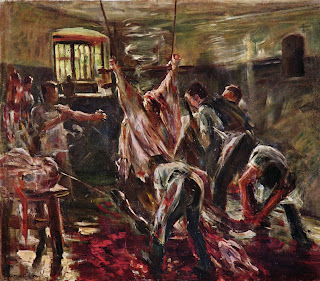
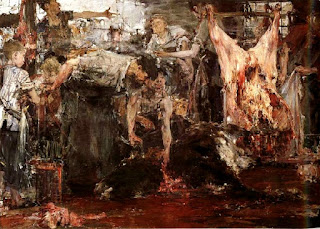
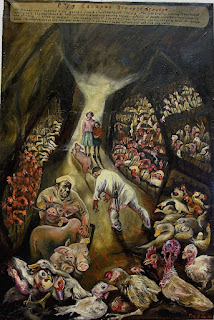
The greatest criticism in recent decades has been reserved for the practices carried out in slaughterhouses using what were declared to be 'humane' ways of killing animals. Time and time again shocking, secretly filmed footage has emerged of extreme cruelty towards sentient beings uttering horrific shrieks as they are chased and battered to death. In recent depictions shown here artists use Expressionist techniques to try and depict the horror of the slaughterhouse bloodletting.

Lovis Corinth (1858–1925), Im Schlachthaus (1893)


Nicolai Fechin (1881–1955) - The Slaughterhouse (1919)


Sue Coe (born 1951) is an English artist and illustrator who goes one step further by using her works to benefit animal rights organizations as well as illustrating books and essays to explore issues such as factory farming and meat packing.


Sue Coe - My mother and I watch a pig escape the slaughterhouse


The struggle against all these different old and modern practices of industrializing and converting our fellow beings into various types of products seems to be finally taking hold of the popular imagination.  In a recent article in the UK Andrew Anthony wrote that:

"Meat consumption in this country has declined by 17% over the past decade. The Economist magazine named 2019 “The Year of the Vegan”. And last year the World Health Organization recommended a plant-based diet for a healthy life. That endorsement, along with growing concerns about the impact of dairy farming on the environment, combined with the lifestyle rethink enabled by the lockdown, has significantly increased the number of people turning their backs on animal products in the UK."

The Vegan Society commissioned research that found that: "At least 542,000 people in Britain are now following a vegan diet and never consume any animal products including meat, fish, milk, cheese, eggs and honey. This is a whopping increase since the last estimate of 150,000 ten years ago, making veganism one of Britain’s fastest growing lifestyle movements." Furthermore, Jasmijn de Boo, CEO of The Vegan Society commented that "more people than ever before are acting upon the health and environmental benefits of veganism, and finding out what really goes on in the meat and dairy industries and deciding they do not want to contribute to the pain and suffering of animals.” Maybe we are seeing the seeds of a new enlightened attitude towards animals which will also be reflected in a more positive art in the future.


Caoimhghin Ó Croidheáin is an Irish artist, lecturer and writer. His artwork consists of paintings based on contemporary geopolitical themes as well as Irish history and cityscapes of Dublin. His blog of critical writing based on cinema, art and politics along with research on a database of Realist and Social Realist art from around the world can be viewed country by country here.

He is a Research Associate of the Centre for Research on Globalization (CRG)

Sunday, October 24, 2021

No Time To Think: The Changing Geopolitics of International Blockbusters?

Review of James Bond No Time To Die film


The latest Bond flick No Time To Die was certainly a rollercoaster ride of exciting action scenes and great special effects, yet contained more than a quantum of longueurs. With a running time of 163 minutes it certainly tries the patience and the bladders of its audiences (who I saw popping out of the cinema throughout the film). Personally, I think 90 minutes is enough for any film, especially since the disappearance of the intermission and ice-cream selling of yore. In this case, the increased length seems to have been to incorporate backstories of some of the individuals involved. The effect of this is to attenuate Bond's appearances in the film, while adding very little to the story (hence the longueurs). 


By Official James Bond 007 Website


One effect of this narrative style is to put more emphasis on the story of Bond and less on the usual geopolitics and action we associate with Bond films. Now this is very interesting considering that if one was to ask oneself: which country would be the most likely target and villain of the latest Bond film as a cultural representative of the world's imperialist and neo-colonial powers? It would have to be: China.
 

Who's bad?
 
Yet there were no Chinese baddies, no stereotyped 'yellow peril', no Chinese mad scientists, no Chinese monomaniacal nutter bent on ruling the world. Why would this be? Could it be something to do with new British geopolitical sensitivities and Brexit anxieties over its current position in the world? In the past the Russians were usually targeted, as well as the more abstract multinational SPECTRE baddies. At least during the Cold War (and some time after) there was definitely a cultural reflection of the realities of geopolitics in the James Bond narratives. Are they keeping one eye on the potential economic and military alliances of the future while keeping the other eye on their current alliances?

Instead what we get is yet another Russian mad scientist with a comically exaggerated Russian accent, lots of SPECTRE goings on, and the monomaniacal nutter 'Lyutsifer Safin' (with equally crazy spelling). Thus we have a caricature of the early Bond films with some 'emotionally deep' background filling to make up for its lack of relevance to current geopolitics.

Added to this emasculated plotline is the Bond's 007 replacement with Nomi, his successor - a female black Bond. Not that there's anything wrong with a female black Bond, but it does show one of the weaknesses of current identity politics, that her identity as an operative for an imperialist, militarist organisation is more important than her identity as a colonial victim of imperialist, militarist organisations in the past.
 
The Noname Book Club, for example tweeted the general point that:
 
"under white domination we consistently celebrate the “first black …” because we’ve been taught that assimilation into white society means safety, upward mobility, liberation. beyond how this can lead to black children idolizing the first black billionaire or war criminal, [...] it also individualizes / romanticizes black success. it reduces our desire for collective liberation and makes us hyper focus on white approval."

There is also a slight ramping up of what I call the 'theatre of cruelty' factor - that is the pushing beyond the normal standards of 'common decency' that underlies cinema narratives in the public sphere. In general the depiction of violence and cruelty has been increasing steadily since the 1950s and 1960s, progressively desensitising audiences to basic human norms (another role of action movies like the Bond films). In this case, a child (Mathilde) is used in the narrative as a human shield but in the end the film does not go so far as to actually hurt her - there are still some limits to what is acceptable in the public's eyes.


Militarism
 
However, there seems to be very few limits to the extent to which the British government is creating new and targeted strategies to promote support for the military, for example:

"Armed Forces Day, Uniform to Work Day, Camo Day, National Heroes Day - in the streets, on television, on the web, at sports events, in schools, advertising and fashion – the military presence in civilian life is on the march. The public and ever younger children are being groomed to collude in the increasing militarisation of UK society."

The role of these forms of militarism has been to encourage people "to see the military, and spying, in positive terms; to think of violent, military solutions as the best way to solve international disagreements; and to ignore peaceful alternatives."

Children have long been drawn in through comics such as The Boy's Own Paper, published from 1879 to 1967, and aimed at young and teenage boys. For example the first volume's serials included "From Powder Monkey to Admiral, or The Stirring Days of the British Navy" and promoted the British Empire as the peak of civilization.

Later comics about World War 2 were founded in the late 1950s and early 1960s, such as War Picture Library (1958), The Victor (1961) and Commando (1961) (which is still in print today) were popular for decades after the war. According to Rod Driver, these comics

"had a strong focus on patriotism and heroism. They stereotyped people from enemy countries as cruel or cowardly, and used derogatory terms such as jerries, huns or krauts for German people, eyeties for Italian people, or nips for Japanese people. A generation of children grew up with a very distorted view of the war and people in other countries."

As for the adults, stereotypes and cruelty are still the stock in trade of culture producers and the James Bond films rejoice in them.


The Victor cover


Recruitment campaigns
 
The significance of Nomi as a black 007 can be seen in new recruitment advertisements which feature a black female soldier. Women represent less than 10% of the British Army, so they launched a new female-led recruitment campaign. According to Imogen Watson, the 'This is Belonging' campaign:

"follows the army's most successful recruitment to date. Four days after the launch, the record was broken for the highest number of applications received in a single day. After a month, 141% of the army’s application target was reached. By March, it had surpassed 100% of its annual recruiting target for soldiers, for the first time in eight years."


International institutions
 
In one sense James Bond films depict a reality that despite the many International institutions dedicated to promoting world peace, military build-ups continue apace. In an article entitled 'The False Promise of International Institutions', John J. Mearsheimer writes "that institutions have minimal influence on state behavior, and thus hold little promise for promoting stability in the post-Cold War world."[p7]
He discusses the differences between the ideas of Realists and Critical Theorists. The Realists believe that there is an objective and knowable world while the Critical Theorists see "the possibility of endless interpretations of the world before them", and therefore there is no reason "why a communitarian discourse of peace and harmony cannot supplant the realist discourse of security competition and war".

However, there is a contradiction in that, for example, Americans who think seriously about foreign policy dislike realism as it clashes with their basic values and how they prefer to think about themselves in the wider world. Mearsheimer outlines the negative aspects of realism that depict a world of stark and harsh competition, where there is no escape from the evil of power and which treats war as inevitable. Realism goes against deep-seated beliefs that progress is desirable and "and with time and effort reasonable individuals can solve important social problems." One major problem is that while the international system strongly shapes the behavior of states, "states still have considerable freedom of action". He gives the example of the failure of the League of Nations to address German and Japanese aggression in the 1930s. Thus, the role of international institutions may actually be to stave off war until countries feel ready to attack or defend themselves.

What he does not discuss however is the situations where ordinary people rose up to extricate their nations from imperialist wars, such as Ireland in 1916 ("We serve neither King nor Kaiser), and the Peace! Land! Bread! campaign of the Bolsheviks in 1917. These campaigns show that while ordinary people are generally considered cannon fodder in times of war, it is possible for future mass movements to transcend the narrow triumphalism and national chauvinism encouraged by recruitment campaigns and blockbuster films.

Caoimhghin Ó Croidheáin is an Irish artist, lecturer and writer. His artwork consists of paintings based on contemporary geopolitical themes as well as Irish history and cityscapes of Dublin. His blog of critical writing based on cinema, art and politics along with research on a database of Realist and Social Realist art from around the world can be viewed country by country here.
He is a Research Associate of the Centre for Research on Globalization.

Friday, October 8, 2021

Awakening: Martin Luther King and the Poor People's Campaign


In the days ahead we must not consider it unpatriotic to
raise certain basic questions about our national character. We
must begin to ask: Why are there forty million poor people in
a nation overflowing with such unbelievable affluence?
Martin Luther King Where Do We Go from Here: Chaos or Community? [p141]


The usage of the term 'woke' has spread rapidly in the last ten years from meaning awareness of racial prejudice and discrimination to describing the identity politics of various ethnic groups in the USA. The term has a long history reaching back to the 1930s when Black American folk singer-songwriter Huddie Ledbetter, a.k.a. Lead Belly finished a song advising people with the words to 'best stay woke, keep their eyes open.'


Lead Belly with a melodeon c. 1942


The history of ethnic- or identity- based politics has long been a long one in the United States going back to the ethnocultural (ethnic, religious and racial identity) politics of the 19th century. Identity- based politics resurfaced in the 1960s with the Black Panther Party (BPP) (originally the Black Panther Party for Self-Defense), a Black Power political organization founded by college students Bobby Seale and Huey P. Newton in 1966. In the 1970s, identity politics were seen with the Black feminist socialist group, Combahee River Collective, and spread with the LGBT movements of the 1980s. Today 'wokism' is associated with identity-based groups such as Black Lives Matter (BLM).

The complexity of identity politics in all its positive and negative forms has become more prevalent in recent years with the production of many 'woke' films. These could be described as films that have women in leading positions, gender or racial swaps, and the inclusion of gay characters in a diverse cast, etc. However, prior to this change in ideology there was also the identity politics of dominant heterosexual white men, so for some there is also the satisfaction and feeling of social justice with the depiction of racial and gender reversals.

One prominent and popular TV series to look at both sides of the complexity of identity politics was The Sopranos. The episode "Christopher" is the 42nd episode and the third of the show's fourth season. The teleplay was written by Michael Imperioli, from a story idea by Imperioli and Maria Laurino and was directed by Tim Van Patten. It aired on September 29, 2002. Imperioli, who played Christopher Moltisanti in The Sopranos, is an American actor, writer, and director, and it seems he was also impressed with Howard Zinn's book A People's History of the United States which this episode is based on. He even has Tony Soprano's son reading the book for school over breakfast at home. The episode focuses on Columbus day and the different perceptions of Columbus by individuals of various ethnic backgrounds. The influence of the book on this episode can be seen in the historical and political awareness of the history of identity politics that is depicted. Imperioli not only shows the complexity of various  identities in the USA but  also how these identities are manipulated to foment strife between different groups both on the street and in the mass media.


Agent provocateur in combats, black jacket and black beanie


This is very cleverly done in a scene where the Sopranos arrive at an anti-Columbus demonstration being held by Native Americans and students. A bottle is thrown and fighting ensues. It is interesting to see how the different characters are picked out in this scene. The Native Americans look generally like Native Americans (skin color, hair etc), the students (long hair, denim) and the character who threw the bottle is distinguished by combats, black jacket and black beanie (connoting the military, the state, undercover i.e. agent provocateur). This scene happens so fast it is almost an easter egg (I had to slow it down frame by frame to get a screenshot). Thus, like in real life, the provocateur gets lost in the mayhem and the later clashes seen on the news are described as 'tragic'.


Ralphie holds up poster of Iron Eyes Cody


The complexity of ethnic identity feeds some of the humour in the show, when, for example, Dr. Del Redclay doesn't realise that Iron Eyes Cody who portrayed Native Americans in many Hollywood films was actually Italian; Pauli didn't know that James Caan's heritage is German, not Italian; and Chief Doug Smith, 'Tribal chairman of the Mohonk Indians and CEO of Mohonk Enterprises', announces: "Frankly, I passed most of my life as white until I had an awakening and discovered my Mohonk blood. My grandmother on my father's side, her mother was a quarter Mohonk." Even Redclay's TA, Maggie Donner, turns out to be one-eighth Italian - her "great-great something-or-other".


Chief Doug Smith, 'Tribal chairman of the Mohonk 
Indians and CEO of Mohonk Enterprises'


The same humour is used in the title of Maria Laurino's memoir, Were You Always an Italian?, which was a national bestseller and explored the issue of ethnic identity among Italian-Americans.

Chief Doug Smith represents the use of ethnic identity for private gain. In the 1970s the Supreme Court had ruled that only Indians have the authority to tax and regulate Indian activities by Indians on Indian reservations. Academia does not get off lightly either, as Professor Longo-Murphy, who is invited to give a lunch-time talk on modern Italian-ness to the Italian community, is obviously half Irish.

By having Tony's son read about Columbus and his encounters with the 'savages', Tony's power position as dominant white male is illuminated as he defends Columbus's actions and thereby shutting down any real discussion of the realities of history while maintaining ethnic group myths ("in this house Christopher Columbus is a hero. End of story.")


Tony's son reads Howard Zinn's book A People's History of the United States


It's interesting that this episode touched many nerves. In an article on this episode a writer describes the Native Americans as 'fanatics' (the author missed the agent provocateur) and describes the dialogue as being "like it was written by an eighth-grader assigned by his history teacher to write up Columbus's pros and cons." The whole Columbus theme is described as 'clunky', even though in many TV shows the political and cultural life of their characters is generally completely ignored. Out of 86 episodes this was the only one that touched on the cultural and political history of the Soprano family, and still managed to raise a lot of hackles. The reality is that often people dont know much about their own history and cling to nationalistic biases or myths. For example, a recent survey (2019) discussed in the New York Post noted that:

"Americans have an abysmal knowledge of the nation’s history and a majority of residents in only one state, Vermont, could pass a citizenship test. The Woodrow Wilson National Fellowship Foundation surveyed 41,000 Americans in all 50 states and Washington, DC, the organization said Friday. Most disturbingly, the results show that only 27 percent of those under the age of 45 across the country demonstrate a basic knowledge of American history. And only four in 10 Americans passed the exam."

The complexity of identity politics was further developed when Furio, an actual Italian gang member from southern Italy agrees with the negative analysis of Columbus:

"But I never liked Columbus. In Napoli, a lot of people are not so happy for Columbus because he was from Genoa. The north of Italy always have the money and the power. They punish the south since hundreds of years. Even today, they put up their nose at us like we're peasants."

Italy, the country, the nation, arose out of many different regions, ethnic groups and languages (only a small percentage of Italians spoke Italian at the time of unification in the 19th century). Indeed, the potential for Italy to break up into regions is never too far away either. Gianfranco Miglio, a political scientist wrote in 1990:

"Lega Nord, a federalist and, at times, separatist political party in Italy, proposed "Padania" as a possible name for an independent state in Northern Italy. According to Miglio, Padania (consisting of five regions: Veneto, Lombardy, Piedmont, Liguria and Emilia-Romagna) would become one of the three hypothetical macroregions of a future Italy, along with Etruria (Central Italy) and Mediterranea (Southern Italy), while the autonomous regions (Aosta Valley, Trentino-Alto Adige/Südtirol, Friuli-Venezia Giulia, Sicily and Sardinia) would be left with their current autonomy."


Italian unification
By Artemka - Own work, CC BY-SA 3.0


Thus, the definition of ethnic or even national identity can be rewritten at any time. The lines of the map of Europe were constantly being drawn and redrawn depending on the political and military strength of local elites who bring their 'people' with them and redefine their identity when and how it suits them. As elites gain strength they demand more autonomy, in defeat they are integrated into a larger region e.g. Catalonia.

The only way people can stop being a bobbing cork on the sea of international geopolitics is to switch from the vertical structure of ethnicity (full class structure) to a horizontal structure of class (e.g. trade unions). The particularist policies of identity politics leaves groups open to manipulation and divide and rule. The American journalist Christopher Lynn Hedges has written that identity politics: "will never halt the rising social inequality, unchecked militarism, evisceration of civil liberties and omnipotence of the organs of security and surveillance."


King was arrested in 1963 for protesting the treatment of blacks in Birmingham.


It seems that Martin Luther King came to the same conclusions about the weakness of identity politics when he wrote in Where Do We Go from Here: Chaos or Community?:

"Too many Negroes are jealous of other Negroes’ successes and progress. Too many Negro organizations are warring against each other with a claim to absolute truth. The Pharaohs had a favorite and effective strategy to keep their slaves in bondage: keep them fighting among themselves. The divide-and-conquer technique has been a potent weapon in the arsenal of oppression. But when slaves unite, the Red Seas of history open and the Egypts of slavery crumble." [p132]

In 1968, King was involved in organising the Poor People's Campaign to bring economic justice to all those struggling to make ends meet.  It was a "multiracial effort—including African Americans, white Americans, Asian Americans, Hispanic Americans, and Indigenous people—aimed at alleviating poverty regardless of race."

The Poor People's Campaign "sought to address poverty through income and housing. The campaign would help the poor by dramatizing their needs, uniting all races under the commonality of hardship and presenting a plan to start to a solution. Under the "economic bill of rights," the Poor People's Campaign asked for the federal government to prioritize helping the poor with a $30 billion anti-poverty package that included, among other demands, a commitment to full employment, a guaranteed annual income measure and more low-income housing. The Poor People's Campaign was part of the second phase of the civil rights movement."


Demonstrators in the Poor People's March at Lafayette Park 
and Connecticut Avenue in Washington, D.C. in June 1968


The necessity for unity between black and white is made more explicit by King in his book, where he writes:

"This proposal is not a “civil rights” program, in the sense that that term is currently used. The program would benefit all the poor, including the two-thirds of them who are white. I hope that both Negro and white will act in coalition to effect this change, because their combined strength will be necessary to overcome the fierce opposition we must realistically anticipate." [p174]

King was not naive about the potential conservative backlash such unity would create but saw it as the only way forward, as the movement would encompass ever greater numbers of people. As we have seen the fluid nature of identity politics can be summed up with the observations that: maps change (independent city-states and regional republics, ‘Padania’), identities can be complex  (North vs South, intermarriage), identities are not fixed (Cody, Caan), and identities can be manipulated (Divide and Rule, ethnic 'leaders'). King came to the realisation that any campaign group will be limited by the size of the movement and the breadth of its ideology, and soon moved away from his own prejudices and biases, although he was not able to bring his dream to fruition.

Caoimhghin Ó Croidheáin is an Irish artist, lecturer and writer. His artwork consists of paintings based on contemporary geopolitical themes as well as Irish history and cityscapes of Dublin. His blog of critical writing based on cinema, art and politics along with research on a database of Realist and Social Realist art from around the world can be viewed country by country here.
He is a Research Associate of the Centre for Research on Globalization.