"The fear of you and the dread of you shall be
upon every beast of the earth and upon every bird of the heavens, upon
everything that creeps on the ground and all the fish of the sea. Into
your hand they are delivered. Every moving thing that lives shall be
food for you. And as I gave you the green plants, I give you everything."
Genesis 9:2-3
Sunday, December 26, 2021
Christmas, Nature, and the Art of Slaughter
Sunday, October 24, 2021
No Time To Think: The Changing Geopolitics of International Blockbusters?
One effect of this narrative style is to put more emphasis on the story of Bond and less on the usual geopolitics and action we associate with Bond films. Now this is very interesting considering that if one was to ask oneself: which country would be the most likely target and villain of the latest Bond film as a cultural representative of the world's imperialist and neo-colonial powers? It would have to be: China.
Who's bad?
Yet there were no Chinese baddies, no stereotyped 'yellow peril', no Chinese mad scientists, no Chinese monomaniacal nutter bent on ruling the world. Why would this be? Could it be something to do with new British geopolitical sensitivities and Brexit anxieties over its current position in the world? In the past the Russians were usually targeted, as well as the more abstract multinational SPECTRE baddies. At least during the Cold War (and some time after) there was definitely a cultural reflection of the realities of geopolitics in the James Bond narratives. Are they keeping one eye on the potential economic and military alliances of the future while keeping the other eye on their current alliances?
Instead what we get is yet another Russian mad scientist with a comically exaggerated Russian accent, lots of SPECTRE goings on, and the monomaniacal nutter 'Lyutsifer Safin' (with equally crazy spelling). Thus we have a caricature of the early Bond films with some 'emotionally deep' background filling to make up for its lack of relevance to current geopolitics.
Added to this emasculated plotline is the Bond's 007 replacement with Nomi, his successor - a female black Bond. Not that there's anything wrong with a female black Bond, but it does show one of the weaknesses of current identity politics, that her identity as an operative for an imperialist, militarist organisation is more important than her identity as a colonial victim of imperialist, militarist organisations in the past.
There is also a slight ramping up of what I call the 'theatre of cruelty' factor - that is the pushing beyond the normal standards of 'common decency' that underlies cinema narratives in the public sphere. In general the depiction of violence and cruelty has been increasing steadily since the 1950s and 1960s, progressively desensitising audiences to basic human norms (another role of action movies like the Bond films). In this case, a child (Mathilde) is used in the narrative as a human shield but in the end the film does not go so far as to actually hurt her - there are still some limits to what is acceptable in the public's eyes.
Militarism
However, there seems to be very few limits to the extent to which the British government is creating new and targeted strategies to promote support for the military, for example:
The role of these forms of militarism has been to encourage people "to see the military, and spying, in positive terms; to think of violent, military solutions as the best way to solve international disagreements; and to ignore peaceful alternatives."
Children have long been drawn in through comics such as The Boy's Own Paper, published from 1879 to 1967, and aimed at young and teenage boys. For example the first volume's serials included "From Powder Monkey to Admiral, or The Stirring Days of the British Navy" and promoted the British Empire as the peak of civilization.
Later comics about World War 2 were founded in the late 1950s and early 1960s, such as War Picture Library (1958), The Victor (1961) and Commando (1961) (which is still in print today) were popular for decades after the war. According to Rod Driver, these comics
As for the adults, stereotypes and cruelty are still the stock in trade of culture producers and the James Bond films rejoice in them.
Recruitment campaigns
The significance of Nomi as a black 007 can be seen in new recruitment advertisements which feature a black female soldier. Women represent less than 10% of the British Army, so they launched a new female-led recruitment campaign. According to Imogen Watson, the 'This is Belonging' campaign:
International institutions
In one sense James Bond films depict a reality that despite the many International institutions dedicated to promoting world peace, military build-ups continue apace. In an article entitled 'The False Promise of International Institutions', John J. Mearsheimer writes "that institutions have minimal influence on state behavior, and thus hold little promise for promoting stability in the post-Cold War world."[p7]
He discusses the differences between the ideas of Realists and Critical Theorists. The Realists believe that there is an objective and knowable world while the Critical Theorists see "the possibility of endless interpretations of the world before them", and therefore there is no reason "why a communitarian discourse of peace and harmony cannot supplant the realist discourse of security competition and war".
What he does not discuss however is the situations where ordinary people rose up to extricate their nations from imperialist wars, such as Ireland in 1916 ("We serve neither King nor Kaiser), and the Peace! Land! Bread! campaign of the Bolsheviks in 1917. These campaigns show that while ordinary people are generally considered cannon fodder in times of war, it is possible for future mass movements to transcend the narrow triumphalism and national chauvinism encouraged by recruitment campaigns and blockbuster films.
Caoimhghin Ó Croidheáin is an Irish artist, lecturer and writer. His artwork consists of paintings based on contemporary geopolitical themes as well as Irish history and cityscapes of Dublin. His blog of critical writing based on cinema, art and politics along with research on a database of Realist and Social Realist art from around the world can be viewed country by country here.
He is a Research Associate of the Centre for Research on Globalization.
Friday, October 8, 2021
Awakening: Martin Luther King and the Poor People's Campaign
raise certain basic questions about our national character. We
must begin to ask: Why are there forty million poor people in
a nation overflowing with such unbelievable affluence?
The complexity of identity politics in all its positive and negative forms has become more prevalent in recent years with the production of many 'woke' films. These could be described as films that have women in leading positions, gender or racial swaps, and the inclusion of gay characters in a diverse cast, etc. However, prior to this change in ideology there was also the identity politics of dominant heterosexual white men, so for some there is also the satisfaction and feeling of social justice with the depiction of racial and gender reversals.
One prominent and popular TV series to look at both sides of the complexity of identity politics was The Sopranos. The episode "Christopher" is the 42nd episode and the third of the show's fourth season. The teleplay was written by Michael Imperioli, from a story idea by Imperioli and Maria Laurino and was directed by Tim Van Patten. It aired on September 29, 2002. Imperioli, who played Christopher Moltisanti in The Sopranos, is an American actor, writer, and director, and it seems he was also impressed with Howard Zinn's book A People's History of the United States which this episode is based on. He even has Tony Soprano's son reading the book for school over breakfast at home. The episode focuses on Columbus day and the different perceptions of Columbus by individuals of various ethnic backgrounds. The influence of the book on this episode can be seen in the historical and political awareness of the history of identity politics that is depicted. Imperioli not only shows the complexity of various identities in the USA but also how these identities are manipulated to foment strife between different groups both on the street and in the mass media.
This is very cleverly done in a scene where the Sopranos arrive at an anti-Columbus demonstration being held by Native Americans and students. A bottle is thrown and fighting ensues. It is interesting to see how the different characters are picked out in this scene. The Native Americans look generally like Native Americans (skin color, hair etc), the students (long hair, denim) and the character who threw the bottle is distinguished by combats, black jacket and black beanie (connoting the military, the state, undercover i.e. agent provocateur). This scene happens so fast it is almost an easter egg (I had to slow it down frame by frame to get a screenshot). Thus, like in real life, the provocateur gets lost in the mayhem and the later clashes seen on the news are described as 'tragic'.
Chief Doug Smith represents the use of ethnic identity for private gain. In the 1970s the Supreme Court had ruled that only Indians have the authority to tax and regulate Indian activities by Indians on Indian reservations. Academia does not get off lightly either, as Professor Longo-Murphy, who is invited to give a lunch-time talk on modern Italian-ness to the Italian community, is obviously half Irish.
By having Tony's son read about Columbus and his encounters with the 'savages', Tony's power position as dominant white male is illuminated as he defends Columbus's actions and thereby shutting down any real discussion of the realities of history while maintaining ethnic group myths ("in this house Christopher Columbus is a hero. End of story.")
It's interesting that this episode touched many nerves. In an article on this episode a writer describes the Native Americans as 'fanatics' (the author missed the agent provocateur) and describes the dialogue as being "like it was written by an eighth-grader assigned by his history teacher to write up Columbus's pros and cons." The whole Columbus theme is described as 'clunky', even though in many TV shows the political and cultural life of their characters is generally completely ignored. Out of 86 episodes this was the only one that touched on the cultural and political history of the Soprano family, and still managed to raise a lot of hackles. The reality is that often people dont know much about their own history and cling to nationalistic biases or myths. For example, a recent survey (2019) discussed in the New York Post noted that:
"Americans have an abysmal knowledge of the nation’s history and a majority of residents in only one state, Vermont, could pass a citizenship test. The Woodrow Wilson National Fellowship Foundation surveyed 41,000 Americans in all 50 states and Washington, DC, the organization said Friday. Most disturbingly, the results show that only 27 percent of those under the age of 45 across the country demonstrate a basic knowledge of American history. And only four in 10 Americans passed the exam."
The complexity of identity politics was further developed when Furio, an actual Italian gang member from southern Italy agrees with the negative analysis of Columbus:
"But I never liked Columbus. In Napoli, a lot of people are not so happy for Columbus because he was from Genoa. The north of Italy always have the money and the power. They punish the south since hundreds of years. Even today, they put up their nose at us like we're peasants."
"Lega Nord, a federalist and, at times, separatist political party in Italy, proposed "Padania" as a possible name for an independent state in Northern Italy. According to Miglio, Padania (consisting of five regions: Veneto, Lombardy, Piedmont, Liguria and Emilia-Romagna) would become one of the three hypothetical macroregions of a future Italy, along with Etruria (Central Italy) and Mediterranea (Southern Italy), while the autonomous regions (Aosta Valley, Trentino-Alto Adige/Südtirol, Friuli-Venezia Giulia, Sicily and Sardinia) would be left with their current autonomy."
The only way people can stop being a bobbing cork on the sea of international geopolitics is to switch from the vertical structure of ethnicity (full class structure) to a horizontal structure of class (e.g. trade unions). The particularist policies of identity politics leaves groups open to manipulation and divide and rule. The American journalist Christopher Lynn Hedges has written that identity politics: "will never halt the rising social inequality, unchecked militarism, evisceration of civil liberties and omnipotence of the organs of security and surveillance."
It seems that Martin Luther King came to the same conclusions about the weakness of identity politics when he wrote in Where Do We Go from Here: Chaos or Community?:
"Too many Negroes are jealous of other Negroes’ successes and progress. Too many Negro organizations are warring against each other with a claim to absolute truth. The Pharaohs had a favorite and effective strategy to keep their slaves in bondage: keep them fighting among themselves. The divide-and-conquer technique has been a potent weapon in the arsenal of oppression. But when slaves unite, the Red Seas of history open and the Egypts of slavery crumble." [p132]
In 1968, King was involved in organising the Poor People's Campaign to bring economic justice to all those struggling to make ends meet. It was a "multiracial effort—including African Americans, white Americans, Asian Americans, Hispanic Americans, and Indigenous people—aimed at alleviating poverty regardless of race."
The Poor People's Campaign "sought to address poverty through income and housing. The campaign would help the poor by dramatizing their needs, uniting all races under the commonality of hardship and presenting a plan to start to a solution. Under the "economic bill of rights," the Poor People's Campaign asked for the federal government to prioritize helping the poor with a $30 billion anti-poverty package that included, among other demands, a commitment to full employment, a guaranteed annual income measure and more low-income housing. The Poor People's Campaign was part of the second phase of the civil rights movement."
"This proposal is not a “civil rights” program, in the sense that that term is currently used. The program would benefit all the poor, including the two-thirds of them who are white. I hope that both Negro and white will act in coalition to effect this change, because their combined strength will be necessary to overcome the fierce opposition we must realistically anticipate." [p174]
King was not naive about the potential conservative backlash such unity would create but saw it as the only way forward, as the movement would encompass ever greater numbers of people. As we have seen the fluid nature of identity politics can be summed up with the observations that: maps change (independent city-states and regional republics, ‘Padania’), identities can be complex (North vs South, intermarriage), identities are not fixed (Cody, Caan), and identities can be manipulated (Divide and Rule, ethnic 'leaders'). King came to the realisation that any campaign group will be limited by the size of the movement and the breadth of its ideology, and soon moved away from his own prejudices and biases, although he was not able to bring his dream to fruition.
Caoimhghin Ó Croidheáin is an Irish artist, lecturer and writer. His artwork consists of paintings based on contemporary geopolitical themes as well as Irish history and cityscapes of Dublin. His blog of critical writing based on cinema, art and politics along with research on a database of Realist and Social Realist art from around the world can be viewed country by country here.
He is a Research Associate of the Centre for Research on Globalization.
Saturday, August 21, 2021
The Great Fear: The Accelerating Apocalypse
For apocalyptic disaster films, they don't get much more up close and personal (and apocalyptic) than the film Greenland (2020). Set in contemporary times, the story revolves around the news that an interstellar comet named Clarke is heading for Earth, and that it was made up of fragments of rock and ice big enough to wipe out modern civilization.
John Garrity, a structural engineer, receives a message from the Department of Homeland Security (DHS) notifying him that he and his family have been selected to go to emergency bunkers. While he is at home a massive fragment lands on Tampa, Florida and wipes it out live on TV. Garrity receives another message with instructions to head to Robins Air Force Base for an evacuation flight. They are to be taken to large bunkers in Thule, Greenland, as the largest fragment is expected to cause an extinction level event.
However, as panic sets in among his neighbours there is mutual shock as they realise that they have not been selected, and Garrity is unsure why he was. Gradually he realises that his skills as a structural engineer would be required in the rebuilding of the post-apocalyptic world, hence the reason for his inclusion.
As others realise the value of the wristbands the family have been given for the flight to Thule, Garrity and his family become targets for different kinds of attacks and schemes to wrest the wristbands from them throughout the narrative of the film.
Overall, Greenland is a well crafted film and focuses on the family's desperate attempts to make it to Thule before the main fragment of Clarke strikes Europe (!) and destroys civilization.
The most interesting aspect of the film is the drama around the conflicts between the 'chosen few' and the rest of the population. While Garrity may be an all-American citizen, he does not reject the elitism of his new status but embraces it wholeheartedly. He may be a member of a democracy, and hold democratic values but when push comes to shove, all that is very quickly forgotten about in the panic. It's every man for himself and he accepts the changes in state ideology from citizen to elect in a heartbeat.
The mass media play an important role in reducing resentment by playing up the activities of politicians, ideologically controlling the news and history, and popularising the use of specific language.
Everytime an idea critical of the ruling ideology becomes popular it is relabeled or branded with terms such as: 'political correctness' (covering up or trivialising legitimate concerns about "language or behavior that can be seen as excluding, marginalizing, or insulting to groups of people disadvantaged or discriminated against"); 'cultural Marxism' (covering up or trivialising legitimate concerns of, for example, feminism, multiculturalism, gay rights, etc); 'conspiracy theory' (covering up or trivialising legitimate concerns regarding anomalies in high profile events); 'The Good Guys'/'The Bad Guys' (covering up or trivialising legitimate concerns regarding who the state defines as progressive or reactionary); 'wokism' (covering up or trivialising legitimate concerns regarding racial prejudice, discrimination and social inequality, etc.); thereby sterilising the ideas and fitting them into 'acceptable', non-threatening language.
Every new deviation from the capitalist norm is diverted and instantly bubble-wrapped so that it does not impinge on the growing mass consciousness/suspicion that something is wrong. Whistleblowers are hounded (Assange, Snowden) and workers are kept quiet or ignored (Boeing).
Furthermore, Monolithism denies radical difference in ethnic groups (the most reactionary become the spokespersons of the group), while on a philosophical level Modernism, Postmodernism and Metamodernism deny reason and radical opposition. All with the promise that if you are good, if you behave yourself, you will be put on Santa's nice list and become one of the chosen few when the financial/political/social catastrophe or cataclysm begins.
During the crisis, the rhetoric of universal protection collapses (neighbours shocked and disappointed), leading to struggle for survival in elite terms (bunkers, planes, boltholes).
It is then that the masses realise that they have been duped, misled, or even deluded. Because Greenland could be said to represent the ideology of the elites, then one sees the choices offered by the elites are: to be chosen or damnation, and no other possibilities. Similarly, when the elites represent the masses they are in negative terms of fear, for example, the symbolism of the masses of zombies in the film World War Z (2013). (See also my article on World War Z here).
Caricature of the Third Estate carrying the First Estate (clergy) and the Second Estate (nobility) on its back.
Current elite ideology of the future tends towards ideas of bringing about global governance, or post-apocalyptic colonies on earth, the Moon or Mars. Like lemmings going over a cliff (or the aristocracy of the eighteenth century), they can only imagine a future with themselves in total control, or total destruction.
Thule in Greenland, where there is an American military base, is symbolically appropriate as "in classical and medieval literature, ultima Thule (Latin 'farthermost Thule') acquired a metaphorical meaning of any distant place located beyond the "borders of the known world"."
Caoimhghin Ó Croidheáin is an Irish artist, lecturer and writer. His artwork consists of paintings based on contemporary geopolitical themes as well as Irish history and cityscapes of Dublin. His blog of critical writing based on cinema, art and politics along with research on a database of Realist and Social Realist art from around the world can be viewed country by country here.
Thursday, August 5, 2021
Going to Hell and Back: Fighting Our Worst Nightmare
Review of the film Bullets of Justice (2019)
Interrogate the devil; he will tell you that beauty is a pair of horns, four claws and a tail.
Voltaire’s Philosophical Dictionary
Bullets of Justice is a gritty 2019 film made by Valeri Milev and Timur Turisbekov, which takes place in the United States during the Third World War. The story centres around Rob Justice, an ex-bounty hunter who is fighting a mixture of half humans and half pigs (human bodies and pig heads). They were bred under an American government secret project to create super soldiers called Muzzles. The project goes awry and years later the Muzzles are at the top of the food chain and are farming the remnants of the human race. Rob Justice is trying to find their source to eliminate the Muzzles once and for all. The film is shot with bleak scenes in very bleak colours and has quite explicit sexual and violent scenes. However, it also has a very dry sense of humour and can be very funny without intentionally playing for laughs.
Image Courtesy of The Horror Collective
The whole premise of the film is based on the symbolic reversal of our treatment of animals as food products, and shown in all its horror. Muzzles fatten up humans in cages, kill them upside down in factories and throw corpses on to conveyor belts. Their meat is even tinned and sold (“Human Meat, Always Fresh, Steak from a well fed male”). The idea that humans are somehow ‘special’ and superior to animals is ‘debunked’. In an early scene the Grave-digger unearths a human skull and says to his kids: “See, they don’t go nowhere. They just turn into dirty old bones. God is a human mistake. We die ‘cos of some shit and we die full of shit.”
Image Courtesy of The Horror Collective
There is an apocalyptic feeling to the film as humans are dying out and some strange human oddities form a resistance to the Muzzles (a woman with a prominent moustache, a fighter who can stop bullets with his chest, and a female leader who talks as if using a home-made speech synthesizer). However, we get the feeling that their resistance is pointless and the Muzzles are the strongest of the two opposing sets of monstrosities.
Image Courtesy of The Horror Collective
The portrayal of human monsters is not new in culture as the depictions of the Golem, Frankenstein’s monster and Zombies makes apparent: representations of humans that cannot really live or reproduce, the symbols of anti-nature. Our anxieties about our position in the natural order of things and our treatment of animals have always been reflected in our beliefs and depictions of ourselves as a higher order and created by an omnipotent being.
However, our relations with animals has always been fraught, as Yuval Noah Harari writes:
About 15,000 years ago, humans colonised America, wiping out in the process about 75% of its large mammals. Numerous other species disappeared from Africa, from Eurasia and from the myriad islands around their coasts. The archaeological record of country after country tells the same sad story. The tragedy opens with a scene showing a rich and varied population of large animals, without any trace of Homo sapiens. In scene two, humans appear, evidenced by a fossilised bone, a spear point, or perhaps a campfire. Scene three quickly follows, in which men and women occupy centre-stage and most large animals, along with many smaller ones, have gone. Altogether, sapiens drove to extinction about 50% of all the large terrestrial mammals of the planet before they planted the first wheat field, shaped the first metal tool, wrote the first text or struck the first coin.
The Golden Age
These realities contrast wildly with our mythical story-telling of a Golden Age when humans
lived in “primordial peace, harmony, stability, and prosperity. During
this age, peace and harmony prevailed in that people did not have to
work to feed themselves, for the earth provided food in abundance.” And
as Richard Heinberg has stated: Dicaearchus of the late fourth century
BCE noted “of these primeval men […] that they took the life of no animal”. [1]
Roman Orpheus mosaic, a very common subject. He wears a Phrygian cap and is surrounded by the animals charmed by his lyre-playing.
The Garden of Eden with the Fall of Man by Jan Brueghel the Elder and Pieter Paul Rubens, c. 1615, depicting both domestic and exotic wild animals such as tigers, parrots and ostriches co-existing in the garden.
However, as the Golden Age declined through the Silver Age, the Bronze Age, the Heroic Age, to the Iron Age, the dire warnings got direr. As men moved from the wondrous cornucopia of nature to the wars of extractivism, they paid a heavy price for their bloodlust. Pythagoras (c. 570 – c. 495 BC) wrote: “As long as Man continues to be the ruthless destroyer of lower living beings, he will never know health or peace. For as long as men massacre animals, they will kill each other. Indeed, he who sows the seed of murder and pain cannot reap joy and love.” Much later, Ovid (43 BC – 17/18 AD) follows up with similar sentiments:
Not so th’ Golden Age, who fed on fruit,
Nor durst with bloody meals their mouths pollute.
Then birds in airy space might safely move,
And tim’rous hares on heaths securely rove:
Nor needed fish the guileful hooks to fear,
For all was peaceful; and that peace sincere.
Whoever was the wretch, (and curs’d be he
That envy’d first our food’s simplicity!)
Th’ essay of bloody feasts on brutes began,
And after forg’d the sword to murder man.
— Ovid (43 BC – 17/18 AD) Metamorphoses Book 14
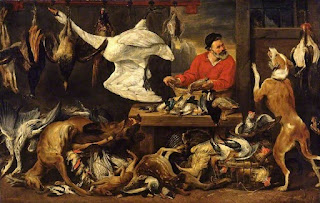
Still Life with Dead Game, Fruits, and Vegetables in a Market (1614)
Frans Snyders (1579–1657)
As Christianity took hold and changed the reverence for nature to the reverence for a monotheistic god, nature itself became demonised as the heavenly was substituted for the earthly. It is interesting to note the similarities between the Devil (“a pair of horns, four claws and a tail”) and the animal-like god of nature, Pan, “the god of the wild, shepherds and flocks, and connected to fertility and the season of spring. Pan’s goatish image recalls conventional faun-like depictions of Satan.”
Hell
In medieval depictions of Hell, the Devil and his helpers torture humans. Hell, as Sartre has said “is other people” and, like packed trains and buses, always seems to have an awful lot of people crammed into very small places. Moreover, the animal-like Devil and his helpers seem to be like animals getting their revenge on humans by killing them and cooking them in the same way that humans kill and eat animals, by hanging them upside down (blood draining?), roasting over a fire on a spit, boiling in large vats, or baking in a fiery oven.
The Torments of Hell, French book illumination, 15th century. Illustration for Augustinius’, De civitate Dei, Bibliotheque de Ste. Genevieve Ms. 246, vol. 389.
It seems that deep in our psychology, the more we brutalise animals the more we fear that one day the animals will rise up and brutalise us. However, in some sense it is already happening. As Mike Anderson writes, they do get their revenge but in a slower, but just as deadly, way:
As far as eating is concerned, humans are the most stupid animals on the planet. We kill billions of wild animals to protect the animals that we eat. We are destroying our environment to feed to the animals we eat. We spend more time, money and resources fattening up the animals that we eat, than we do feeding humans who are dying of hunger. The greatest irony is that after all the expenses of raising these animals, we eat them; and they kill us slowly. And rather than recognise this madness, we torture and murder millions of other animals trying to find cures to diseases caused by eating animals in the first place.
In his article ‘Industrial farming is one of the worst crimes in history’, Yuval Noah Harari wrote:
The fate of industrially farmed animals is one of the most pressing ethical questions of our time. Tens of billions of sentient beings, each with complex sensations and emotions, live and die on a production line. Animals are the main victims of history, and the treatment of domesticated animals in industrial farms is perhaps the worst crime in history. The march of human progress is strewn with dead animals.
At least in recent years, in tandem with the ever increasing herds and flocks of domesticated animals for human consumption, there has been the development of movements against the slaughter in animal rights activism. Peter Singer wrote about it in the 1970s in his book Animal Liberation and, inter alia, in the 2000s Joaquin Phoenix told us about this slaughter in two truly difficult-to-watch documentaries: Earthlings (2005) and Dominion (2018).
Animals - Studio album by Pink Floyd
An image of the Battersea Power Station in England, where a giant pig can be seen flying between its left chimneys. The album was developed from a collection of unrelated songs into a concept which, in the words of author Glenn Povey, "described the apparent social and moral decay of society, likening the human condition to that of mere animals".
Flying pigs
Image Courtesy of The Horror Collective
Colonialism and Genocide
Our attitude towards animals, our bloodthirstiness, has unfortunately carried over into our historical and current treatment of our fellow human beings in the form of colonialism and neo-colonialism. Joseph Conrad expressed it succinctly in his novel Heart of Darkness (1899) where Mr Kurtz (making a report for the International Society for the Suppression of Savage Customs) reveals his true colonial mentality when he writes ‘Exterminate all the brutes’. The colonial mindset that sees ethnic groups as not much better than animals (brutes) is predicated on the idea that the coloniser is somehow ‘superior’ and ‘civilised’ despite the fact that nowadays and ecology-wise, it is realised that these ‘primitive’ groups generally live in tune with nature rather than destroying it, as the ‘civilised’ West does. Sven Oskar Lindqvist (1932 – 2019) a Swedish author of mostly non-fiction, took Mr Kurtz’s exclamation as the title of his book on the history of colonialism and genocide, Exterminate All the Brutes (1992). The title was subsequently used again for a harrowing four part documentary series (2021) directed and narrated by Raoul Peck who worked with Lindqvist.
Punch (1881)
Furthermore, even in our more ‘enlightened’ era, our attitude towards animals as our fellow ‘earthlings’ has run into other, more serious problems, as Michael Cronin writes:
In more recent times, it is fears around what is seen as the neo-Malthusian pathology of deep ecology that prompts a reticence around stressing the animal nature of humans. In this reading of ecology, treating humans as one species among others leads inevitably to the conclusion that the only way to deal with human overpopulation is through the mass elimination of humans. As they would not enjoy higher ontological status than other species, such genocidal practices could be justified by the overall flourishing of species on the planet.[2]
Once again, our fears of our brutal selves lead us to try and characterise ourselves as more important than ‘mere’ animals in a self-defeating vicious cycle. Which brings us back to the point that Pythagoras made (‘as long as men massacre animals, they will kill each other’). In other words, as long as we treat animals like ‘animals’ (brutes) we will treat each other like ‘animals’ too.
- Richard Heinberg, (1989) Memories and Visions of Paradise: Exploring the Universal Myth of a Lost Golden Age, Wheaton, Ill.: Quest Books, p. 48.
- Michael Cronin, (2016) Eco-Translation: Translation and Ecology in the Age of the Anthropocene (New Perspectives in Translation and Interpreting Studies), London: Routledge, p. 74.