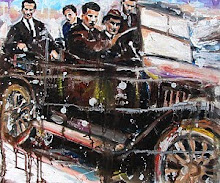
This blog contains articles on culture as well as a database of Realist and Social Realist art from around the world by Irish artist Caoimhghin Ó Croidheáin. These paintings can be viewed country by country by clicking on the list of countries and themes down the right-hand side of the blog. The artwork of Caoimhghin Ó Croidheáin, consisting of cityscapes of Dublin, images based on Irish history and other work with social/political themes, can be seen at www.gaelart.net.
Portrane Beach, 2021 (Photo: Caoimhghin Ó Croidheáin)
A recent walk at a local beach revealed to me how fast coastal erosion is affecting local communities. This area where I live is essentially a peninsula with two large popular beaches, Donabate beach and Portrane beach which are joined by cliffs, on the coast of north County Dublin, Ireland.
I have already written about erosion at Donabate beach and erosion at the cliffs over the years but, in a far worse condition, is Portrane beach.
As can be seen from photos I took in 2013 compared with the ones I took a few days ago, coastal erosion is happening at a significant rate.
Portrane Beach (looking south), 2013 (Photo: Caoimhghin Ó Croidheáin)
Portrane Beach
(looking south), 2021 (Photo: Caoimhghin Ó Croidheáin)
"“We live in the midsection of the beach and our property has lost upwards of about 20 metres of established garden since 2018. [...] At the current rate of erosion, our garden was 30 metres and it’s gone to 20 metres in two years so it doesn’t take much to calculate that we don’t have very long."
Portrane Beach
(looking north), 2013 (Photo: Caoimhghin Ó Croidheáin)
Portrane Beach
(looking north), 2021 (Photo: Caoimhghin Ó Croidheáin)
The local council has tried to stem the rate of erosion with concrete Seabees before more permanent groynes are constructed. A groyne is a structure built perpendicular to the shore, that interrupts water flow and limits the movement of sediment and can be made out of wood, concrete, or stone. According to a local spokesman the Seabees will be "an interim solution pending the installation of specially designed Y-shaped groynes structures which will be complemented by a beach renourishment scheme in order to achieve a suitable beach level. This will reduce incident wave energy along the coastline by limiting the prevailing water depth and thus mitigating the threat of erosion."
The seriousness of the problem can be seen as the Seabees are almost completely submerged at high tides.
Seabees,
Portrane Beach, 2021 (Photo: Caoimhghin Ó Croidheáin)
The Housing and Planning Minister, Darragh O’Brien, has commented that:
“Around Ireland, it’s projected that by 2050, the impact of coastal erosion could potentially affect up to 2 million people who live within 5km of the coast, all the major cities, and much of the country’s industry and infrastructure and utilities, including transport, electricity and water supplies.”
A European Commission document describes Irish vulnerability to climate change:
"Ireland is the third largest European island. It is situated at the north-west of continental Europe. The coastline measures 4 577 km, bordering the Atlantic Ocean on the north-west and the Irish Sea on the south-east. More than 50% of the population lives within 15km of the Irish coastline. Most of the population is concentrated in cities, with the major coastal cities being Dublin, Cork, Limerick and Galway."
They further note that: "Approximately 20% of Ireland’s entire coast is at risk of erosion. Sea Level Rise (SLR) combined with an increase in severity and frequency of coastal storms is expected to exacerbate the problems, especially along the Atlantic coast."
Portrane Beach, 2021 (Photo: Caoimhghin Ó Croidheáin)
Historically, vertical seawalls were common but now flat-sloped revetments (sloping structures placed on banks or cliffs in such a way as to absorb the energy of incoming water) using rock or unusual shaped concrete units are used to reduce impact on beaches.
It is interesting to see that "in the US hard structures such as revetments and groynes are no longer allowed in many states because of potential negative impacts on the beach and coastal protection is provided by nourishing the beach with sand brought in from external sources. This is called beach nourishment and is now the most common method of coastal protection worldwide but is rarely used in Ireland and it needs to be repeated every three to five years to replenish lost sand. This recurring cost does not fit well with how Irish projects are funded."
Portrane Beach, 2021 (Photo: Caoimhghin Ó Croidheáin)
It can be seen that engineers are under serious pressure to come up with new ideas to deal with coastal erosion and, maybe over time and with more experience and newer technology, they will be able to limit erosion with more success. However, we know the seas are rising and despite efforts to hold back the waters, it seems that what is really needed is global action now before large swathes of the planet become uninhabitable.
Caoimhghin Ó Croidheáin is an Irish artist, lecturer and writer. His artwork
consists of paintings based on contemporary geopolitical themes as well
as Irish history and cityscapes of Dublin. His blog of critical writing
based on cinema, art and politics along with research on a database of
Realist and Social Realist art from around the world can be viewed
country by country here. He is a Research Associate of the Centre for Research on Globalization.
He is a Research Associate of the Centre for Research on Globalization.
'Inde etiam habitus nostri honor et frequens toga; paulatimque discessum ad delenimenta vitiorum, porticus et balinea et convivorum elegantiam. Idque apud imperitos humanitas vocabatur, cum pars servitutis esset'
('They adopted our dressing fashion, and begun wearing the togas; little by little they were drawn to touches such as colonnades, baths, and elegant talks. Because they didn't know better, they called it 'civilization,' when it was part of their slavery') Tacitus, Agricola
Introduction
The general problem of culture today is its ability to facilitate and support negative aspects of society through encouraging escapism, diversion and ignorance regarding many important issues of contemporary life, such as economic crises, repressive legislation, poverty, and climate chaos. Or worse still, the use of culture to promote elite views of society regarding power and money, as well as imperialist agendas through negative depictions of a targeted ethnic group or country.
In this, some would call a neo-feudalist age, we see echoes of an earlier feudalism with its abuse of power and wealth that the philosophers of the Enlightenment tried to deal with and rectify. The Enlightenment was an intellectual and philosophical movement that dominated the world of ideas in Europe during the 17th and 18th centuries.
It was led by philosophers such as Cesare Beccaria, Denis Diderot, David Hume, Immanuel Kant, Gottfried Wilhelm Leibniz, John Locke, Montesquieu, Jean-Jacques Rousseau, Adam Smith, Hugo Grotius, Baruch Spinoza, and Voltaire. Their concerns about injustice, intolerance and autocracy led to the introduction of democratic values and institutions, and the creation of modern, liberal democracies.
A painting of the 1840 Anti-Slavery Conference. The Anti-Slavery Society Convention, 1840, by Benjamin Robert Haydon (died 1846), given to the National Portrait Gallery, London in 1880 by the British and Foreign Anti-Slavery Society. Oil on canvas, 1841. 117 in. x 151 in. (2972 mm x 3836 mm). This monumental painting records the 1840 convention of the British and Foreign Anti-Slavery Society which was established to promote worldwide abolition.
However, a new movement in the arts and literature arose in the late 18th century, Romanticism, which emphasized inspiration, subjectivity, and the primacy of the individual. Romanticism was a reaction to the Industrial Revolution, aristocratic society and politics, and the scientific rationalization of nature. Romanticism became the basis of many subsequent cultural movements whose common feature has been anti-science and individualism.
The Romanticist influence can be seen in ‘mainstream’ mass culture and high culture in terms of its emphasis on formal experimentation or emotions over sociopolitical content. Romanticist reaction stressed “sensibility” or feeling, and tended towards looking inwards. It was a movement whose ideas have come to dominate much of culture today.
Weighing scales, planets, and fractals
Romanticism is portrayed as having left and right aspects. If we picture a weighing scale with opposing ideas, for example, we can have the radical opposition to fascism (Romanticist Expressionism) on one side and the radical right of National Socialism on the other side. However, what if this weighing scale was on one side of an even bigger scale? On the other side of that bigger scale would be Enlightenment ideas.
Little weighing scale on one side of an even bigger scale
We rarely get to see the Enlightenment side of the larger scales. We live in a society where we are generally presented with the small scales two-sides-to-everything (the bi-party system, good Nazis [only following orders] v the bad Nazis [gave the orders], this 'good' person v that 'bad' person, good cop v bad cop) but the reality is that they are usually different sides of the same coin. Similarly, on the smaller scale, the left and right aspects of Romanticist ideas are also two sides of the same coin, because what they both have in common is their rejection of science and reason.
Yet, on the big scales, the Enlightenment side we find progressive politics, the left opposition who were the first to be put into the concentration camps in the 1930s, the community workers, writers, and activists who work diligently today for change in the background are all squeezed out of the large, dominant media-controlled picture.
The problem with this skewed picture is that understanding what is going on becomes as difficult to ascertain as the movements of the planets were to the ancients. Seeming to go in all sorts of strange directions, the ancient Greeks called the planets 'planeta' or 'wanderers'. The movements of the planets were perplexing in a geocentric (earth-centered) universe. It was only with the application of modern science, putting the sun at the center of a solar system, that the odd movements of the planets suddenly fell into place and made sense. We have the same experience of 'revelation' or understanding when science is applied to many different difficult problems in various aspects of history, philosophy and society itself.
'Planets appear to go in one direction, take a looping turn, and then go in the opposite direction. This appears because of the differences of our orbits around the Sun. The Earth gets in an inside or outside track as we pass them causing a planet to look as if it had backed up and changed direction. They wander around the sky.'
The word 'science' comes from the Latin word 'scientia' meaning 'knowledge' and is a systematic exploration that allows us to develop knowledge in the form of testable explanations and predictions about the universe. The development of science has allowed us to determine what is truth and what is falsehood. Truth is defined as the property of being in accord with fact or reality and the application of science allows us to verify truth in a provable way.
In this sense truth is like a fractal. Fractals are geometrical shapes that have a certain definite appearance. When we magnify a fractal we see the same shape again. No matter how much we magnify the shape, the same geometrical patterns appear infinitely. Truth is similar to a fractal in that whether the truth of something is held by one person, a group of people, a community or a nation its essence remains the same on a micro or macro level.
'Fractals appear the same at different levels, as illustrated in successive magnifications of the Mandelbrot set. Fractals exhibit similar patterns at increasingly small scales called self-similarity, also known as expanding symmetry or unfolding symmetry.'
The heliocentric view of the universe remains true even if only one person believes or many believe, even in the face of powerful forces. For example, Galileo's championing of heliocentrism led him to be investigated by the Roman Inquisition in 1615, where he was found guilty of heresy and spent the rest of his life under house arrest. The truth eventually came out and Galileo was pardoned by the Roman Catholic church (359 years later).
Contradictions and falsehoods
It has often been said that the truth will set you free. We live in a society of contradictions and falsehoods where lies, cheating and deception contradict reality. However, many refuse to see the truths of modern society, while others are actively involved in creating the deceptions that maintain the status quo. We know that people are 'unfree' and we accept many different levels of this condition: captivity, imprisonment, suppression, dependency, restrictions, enslavement, oppression.
We may even see this condition as applying to others and not to ourselves. But if we examine closely and truthfully our own position in the societal hierarchy we may recognize our own powerlessness: the contradiction between our view of ourselves and the reality of our situation. Although we vote and we recognize the social contract by rendering taxes to the state, the fact is that very little of substance changes and generally things seem to get worse.
As I have written elsewhere, the fact is that we are triply exploited: we are taxed on wages, alienated from wealth created (profits), and we pay interest on the money borrowed from the wealthy to pay for the capital and current expenditure needed for the maintenance of society and fill in the gap
created
by the wealthy in the first place.
How is this system of exploitation maintained? Aside from the obvious threat of imprisonment for nonpayment of taxes, and the existence of police and army to enforce the laws of the state: the most influential, and sometimes most subtle tool, is through culture.
The culture of slavery
Culture has a long history of use and abuse, from the bread and circuses of Roman times to the social media of today.
In modern society mass culture helps to maintain this system of exploitation and keeps people in general from questioning their position in the societal hierarchy. The middle classes are lulled into thinking they are free because of better wages making for an easier life, while the working class work ever harder to achieve the benefits of the middle class: higher education, higher status, higher wages. (It has been suggested that the middle class are essentially 'working class people with huge debts' e.g. large mortgages.)
However, in general, people work in a globalized system of exploitation in states that support and maintain it thus making wage slaves of the 99 per cent.
Slaves in chains during the period of Roman rule at Smyrna (present-day İzmir), 200 CE.
The traditional definition of slavery is 'someone forbidden to quit their service for another person and is treated like property.' Modern slavery takes on different forms such as human trafficking, debt bondage, and forced labour:
"Experts have calculated that roughly 13 million people were captured and sold as slaves between the 15th and 19th centuries; today, an estimated 40.3 million people – more than three times the figure during the transatlantic slave trade – are living in some form of modern slavery, according to the latest figures published by the UN’s International Labour Organization (ILO) and the Walk Free Foundation. Women and girls comprise 71% of all modern slavery victims. Children make up 25% and account for 10 million of all the slaves worldwide."
While this may apply to the most extreme cases in modern society, the majority of workers have no control over the wealth they produce:
"one of the defining features of the employment relationship in all capitalist countries is that the worker’s will is, by law, “subordinate” to the employers. The employer has the right, within broad bounds, to define the nature of the task, who performs it, and how. This shows up in all kinds of surveillance, control, and submission — also known as maximizing productivity and extracting profit."
The investors and the shareholders benefit the most, while the employees receive wages of varying levels according to the demand for their particular skillset.
We are encouraged to accept this way of life and there are plenty of different state methods to make sure that we do. However, culture is an important tool of soft power, in particular, mass culture.
The role of mass culture is absolutely essential for the creation, maintenance, and perpetuation of a broad acceptance of the ever-changing forms of technological 'progress' and geopolitical shifts in modern capitalist societies, particularly as the global financial crisis (corporate and national debt) deepens.
Culture on three levels
To do this, modern mass culture operates on three different levels. The first level is creating acceptance through diversion and escapism and turning people into passive consumers. Secondly, through the overt representation of elite ideology. Thirdly, and more controversially, through covert manipulation of mass culture to benefit the agenda of elites.
In the first case, consumption becomes inseparable from the ideas of enjoyment and fun. Earlier twentieth century theorists of the Frankfurt School saw consumers as essentially passive but later theoreticians such as Baudrillard saw consumption as an unconscious social conditioning, consuming culture to achieve social mobility by showing awareness of the latest trends in mass culture.
Secondly, overt representation of elite ideology is evident in mass culture that glorifies the upper classes and promotes racism and militarist imperialism. In particular, mass culture depicting historical and contemporary events can be portrayed from an elite perspective.
Thirdly, conscious manipulation of the masses using psychological means, and more controversially, predictive programming. In the 1930s Edward Bernays was a pioneer in the public relations industry using psychology and other social sciences to design public persuasion campaigns. Bernays wrote: "If we understand the mechanism and motives of the group mind, is it not possible to control and regiment the masses according to our will without their knowing about it? The recent practice of propaganda has proved that it is possible, at least up to a certain point and within certain limits."
'For Adorno and Horkheimer, the culture industry creates false needs to keep us purchasing products we do not actually need by manipulating our psychological impulses and desires.'
Another form of mass manipulation is the concept of predictive programming. Predictive Programming is the theory "that the government or other higher-ups are using fictional movies or books as a mass mind control tool to make the population more accepting of planned future events." It is by its nature hard to prove yet the many extraordinary coincidences between events depicted in mass culture and later actual events is, at the very least, disconcerting. For example, the filmThe Manchurian Candidate depicting the son of a prominent U.S. political family who is brainwashed into being an unwitting assassin for a Communist conspiracy, was released in 1962, a year before the assassination of J F Kennedy in 1963 by Lee Harvey Oswald, an emotionally disturbed 'communist sympathizer' who declared his innocence and believed he was being used as a 'patsy'.
Thus, these three levels allow elites to control how the past, the present, and the future is depicted in mass culture, according to national and geopolitical agendas.
Cultural producers
In their defense, the role of cultural producers has never been easy, and the more money or support that is needed for a cultural project, the harder it is to maintain an independent position.
While with modern production methods and technology it is easier to produce books, films and music independently of the major producers and distributors, in the past elite pressure, censorship, and imprisonment were common.
Pushkin, for example, in his Ode to Liberty, exclaimed with indignation:
"Unhappy nation! Everywhere Men suffer under whips and chains, And over all injustice reigns, And haughty peers abuse their power And sombre prejudice prevails."
However, later during the time of Nicholas I, he changed and 'adopted the theory of art for art's sake':
"According to the touching and very widespread legend, in 1826 Nicholas I graciously “forgave” Pushkin the political “errors of his youth,” and even became his magnanimous patron. But this is far from the truth. Nicholas and his right-hand man in affairs of this kind, Chief of Police Benkendorf, “forgave” Pushkin nothing, and their “patronage” took the form of a long series of intolerable humiliations. Benkendorf reported to Nicholas in 1827: “After his interview with me, Pushkin spoke enthusiastically of Your Majesty in the English Club, and compelled his fellow diners to drink Your Majesty’s health. He is a regular ne’er-do-well, but if we succeed in directing his pen and his tongue, it will be a good thing.” The last words in this quotation reveal the secret of the “patronage” accorded to Pushkin. They wanted to make him a minstrel of the existing order of things. Nicholas I and Benkendorf had made it their aim to direct Pushkin’s unruly muse into the channels of official morality."
Pushkin’s contemporaries, the French Romanticists, were also, with few exceptions, ardent believers in art for art’s sake, the idea of the absolute autonomy of art with no other purpose than itself.
In the twentieth century, Ars Gratia Artis (Latin: Art for Art’s Sake) would become the motto for the American media company Metro-Goldwyn-Mayer, to designate art that is independent of political and social pressures.
Of course, while some believe that art should not be politicized, others think that if art was not a social endeavor then it would be used as a commercial item only available to the rich, e.g. a profitable escapist product while simultaneously maintaining and promoting a conservative mindset.
'During
the Cold War period, films were an important factor in the persuasion
of the masses. They would be used in various ways, to present the ideal
image of their country and to distinguish a national enemy, to name a
few.'
However, any thoughts of art as a progressive tool were soon quashed by the HUAC (House Un-American Activities Committee) in the USA, a body which was set up in 1938 to investigate alleged disloyalty and subversive activities on the part of private citizens, public employees, and any organizations with left wing sympathies.
Dialectic of Enlightenment Not long after, a theoretical analysis of consumerist mass culture was published in a book by Theodor Adorno (1903–1969) and Max Horkheimer (1895–1973) in 1947 entitled Dialectic of Enlightenment in which they coined the term the Culture Industry. For Adorno and Horkheimer "the mass-media entertainment industry and commercialized popular culture, which they saw as primarily concerned with producing not only symbolic goods but also needs and consumers, serving the ideological function of diversion, and thus depoliticizing the working class."
They believed that the production of culture had become like a "a factory producing standardized cultural goods — films, radio programmes, magazines, etc.— that are used to manipulate mass society into passivity."
Thomas Hart Benton, Hollywood 1937-38 oil on canvas; 56x84 in. (142.2x213.4 cm)
More significantly, Adorno and Horkheimer also believed that the scientific thinking the Enlightenment philosophers had developed "led to the development of technologically sophisticated but oppressive and inhumane modes of governance."
Adorno and Horkheimer believed that because the rationalization of society had ultimately led to Fascism, science and rationalism provided little optimism for future progress and human freedom.
However, this view of the history of science and its relationship with human emancipation is, according to Jeffrey Herf in '"Dialectic of Enlightenment" Reconsidered', one that ignores many progressive movements and changes brought about by Enlightenment ideas, and that Horkheimer and Adorno's view of modern society and politics simply reduced modernity to technology, science, and bureaucracy. Herf outlines many of the events, institutions, laws, rights, treatments and other human benefits that Adorno and Horkheimer (and others) had ignored:
"In Weber's sociology, Heidegger's philosophical ruminations, or Dialectic of Enlightenment, the panoply of ideas and events associated with the 1688 revolution in Britain, the moderate wing of the French Revolution, and the ideas and institutions that emerged from the American Revolution, and then from the victory of the North in the American Civil War, are simply absent. As a result of this paucity of historical specificity, Horkheimer and Adorno's view of modernity during World War II was a very German caricature that did not include ideas about the extension of citizenship, British antislavery, American abolitionism, feminism in Europe and the United States, and the rule of law. Theirs was modernity without liberal democratic ideas and institutions, the rule of law, and the freedom of speech, of assembly, of the press, and of religion or unbelief. [...] Dialectic of Enlightenment presented modern science as primarily an exercise in the domination of nature and of human beings. Theirs was a view of the history of the scientific revolution that left out Galileo's challenge to religious authoritarianism and Francis Bacon's liberating restatement of the role of evidence in resolving contentious issues. From reading Horkheimer and Adorno — as well as Heidegger and Baumann — one would conclude that modern science was first and foremost a source of control, and would have no idea of how modern medicine, unthinkable without the Enlightenment and the scientific revolution, had come into existence." [1]
Thus, Adorno and Horkheimer's view leaves us with an almost Nietzschian nihilism, that knowledge is impossible, and life is meaningless because to try and improve society will fail and ultimately only increase oppression. Without action, Nietzsche predicted a society of 'the last man', the "apathetic person or society who loses the ability to dream, to strive, and who become unwilling to take risks" and slave morality characterized by pessimism and cynicism. A society which has not only lost its 'will to power' but also its will to revolt.
The culture of resistance
Throughout history, oppression has been met with resistance in many forms such as uprisings, rebellions, and insurrections.
'Richard II meeting with the rebels of the Peasants' Revolt of 1381. The Peasants' Revolt, also named Wat Tyler's Rebellion or the Great Rising, was a major uprising across large parts of England in 1381. The revolt had various causes, including the socio-economic and political tensions generated by the Black Death pandemic in the 1340s, the high taxes resulting from the conflict with France during the Hundred Years' War, and instability within the local leadership of London.'
The resistance often starts with strikes, boycotts, and civil disobedience, leading to mass movements of people who ultimately reject the old system of governance and change it for a new system which can be anti-colonial, anti-imperialist or anti-capitalist. The rise of resistance seems to generally develop in three stages, each affecting culture in very different ways. These different stages could be called criticism, substitution and implementation.
Irish Citizen Army group outside Liberty Hall. Group are lined up outside ITGWU HQ under a banner proclaiming "We serve neither King nor Kaiser, but Ireland!". Photo taken in early years of WWI.
Criticism
Resistance often begins as criticism of the policies or nature of government, or the state. This can be aesthetic or intellectual resistance appearing, for example, in various art forms. Critiques can be of an ideological nature, or simply highlight social problems and issues. Resistance can take the form of criticism of officially sanctioned culture through demonstrations and boycotting.
It may also take a violent form, for example, the blowing up of colonial statues in Ireland (see my comprehensive list of statues blown up in my blog post here). The blowing up of Nelson's Pillar in Dublin in 1966 was celebrated subsequently in two different ballads which became immensely popular, an aesthetic critique arising out of a violent 'critique'.
On a formal level resistance can also be 'form-poor' as struggle without help from educated or trained professionals is left to amateurs.
Substitution
Gradually, a new ideology, a different reading of history, a new set of artists and writers produce culture which eventually substitutes the old culture with a new culture as the movement gathers momentum.
The less costly forms like art, music, ballads, books etc. can become very popular and important elements of the resistance itself. The more expensive cultural forms are difficult to produce in the new culture, e.g., cinema, theatre, opera, TV etc., (unless of course if the format is changed like in community theatre substituting for state theatre). Digital equipment can be vastly cheaper to use for the making of movies for mass viewing assuming that the outlet for presentation, the internet, is not closed off through censorship.
Implementation
The final stage is implementation, whereby popular resistance takes control of the state and is able to implement progressive culture as state policy. This is particularly important for the most costly art forms which also gain access to state finance and auditoriums. It allows movies, for example, to cover ignored themes such as histories of resistance, or to show past events from more radical perspectives than the previous elite mindset and agendas.
These different levels of cultural change: criticism, substitution, and implementation can be a long process or all come together in a short span of time.
The storming of the Bastille, 14 July 1789, during the French Revolution.
I have tried to show in my previous examination of ten different art-forms (see: art, music, theatre, opera, literature, poetry, cinema, architecture, TV, and dance articles) that since the Age of Enlightenment there has been a strong vein of radical ideas relating to social progress. Over the centuries radical culture has looked at the plight of the oppressed using different forms such as naturalism, realism, social realism, and working class socialist realism.
The philosophers of the Enlightenment believed that advancements in science, technology, economic development and social organization would have universal application globally. They also believed in the idea that empirical knowledge should be the basis of society and that with these ideas political and societal change would strengthen civilization itself. While social progressivism, as a political philosophy, is reformist in nature, it also has the potential to snowball into more radical action through discussion around questions as to who runs the state and ownership of the means of production.
The form and content of the culture of resistance has many aspects. Some emphasize change on the community level, developing the skills, community spirit, and artistic sensibilities of the community members whether they be producers, creators or observers. An important element of this strategy for social change is encouraging critical thinking through participation in active dialogue. General themes for discussion have been, for example, gender equality, human rights, the environment and democracy.
The Bash Bush Band musical protesters at Bush's 2nd inauguration, Washington DC.
Others have taken a more radical approach of examining human conflict and its sources. They look at human conflict from a social perspective and see society in terms of conflicting economic classes. By portraying economic classes in conflict they hope to evolve or expand a working class consciousness or at least an understanding of, and empathy with, oppressed groups. Radical artists, writers, composers etc are encouraged to take a scientific approach and work against superstitions and blind practices. As radical cultural producers they try to present the truth and inspire wide-ranging social and political activism.
Future of culture?
Modern resistance, often in digital form on the internet today, is now subject to a creeping censorship as big tech tries to slow down the efficacy of the internet at making widely available different perspectives on many different issues. At the same time, big tech tries to portray technological progress as social progress, and is at the forefront of liberal campaigns for individual rights at the expense of mass movements for collective or group rights. Such group rights allow for organizations to speak for, and negotiate on behalf of trade unions, trade associations, specific ethnic groups, political parties, and nation-states.
However, internet censorship and the gradually increasing power of the state (through police, courts, and prisons) using current and new legislation will be able to continue unabated, that is, unless the slave culture that facilitates it is shaken off and a new culture of resistance is born.
Notes:
[1] Jeffrey Herf, "Dialectic of Enlightenment" ReconsideredSource: New German Critique , FALL 2012, No. 117, Special Issue for Anson Rabinbach (FALL 2012), pp. 81-89 Published by: Duke University Press [p84] Stable URL: https://www.jstor.org/stable/23357065
Caoimhghin Ó Croidheáin is an Irish artist, lecturer and writer. His artwork
consists of paintings based on contemporary geopolitical themes as well
as Irish history and cityscapes of Dublin. His blog of critical writing
based on cinema, art and politics along with research on a database of
Realist and Social Realist art from around the world can be viewed
country by country here. He is a Research Associate of the Centre for Research on Globalization.
The drum is always there. In life and death. In between is dance. Always the drum is everywhere. Peniel Guerrier
I don't think this world was made for a small minority to dance on the faces of everyone else. H.G. Wells (In the Days of the Comet)
Nothing happens until something moves. Albert Einstein
Introduction
The
dance group Diversity's 'I Can't Breathe' routine evoked around 24,500
complaints from members of the public when it aired on ITV on 5
September, 2020. The performance was inspired by the killing of George
Floyd in the USA. Its choreography references progress from stock market
bubbles, the growth of digital shopping, the effect of mobile phones on
family life, the coronavirus pandemic and subsequent lockdowns, to the
killing of George Floyd, and then ending with street protests and the
riot police. The show was a spectacular mix of spoken word, song, visual
and stage effects, as well as Diversity's trademark blend of complex
routines, breakdancing, backflips and theatricality.
While
the troup garnered much international praise for the 4 1/2 minute
anti-racist performance, the many complaints focused on its political
content. According to Ashley Banjo, troupe member and choreographer, "We
got bombarded with messages and articles … horrible stuff about all of
us, our families … it’s sad."
This level of negative public reaction to a dance routine on TV in the UK was unprecedented.
Dance
has been an important part of of TV entertainment, especially in the UK
and the USA, since the 1960s with shows such as American Bandstand and
Soul Train, dance groups on Top of the Pops and in more recent decades,
shows such as Dancing on Ice, Dancing with the Stars, So You Think You
Can Dance and Strictly Come Dancing.
However, maybe the
innocuousness of such TV history has lulled people into seeing dance as
pure entertainment, safe from the radical social commentary that other
artforms put on display now and then in theatres, galleries and cinemas.
The
history of dance shows that it has always been with us, and, like with
other art forms, dance has a mixed history of social and radical roles.
It has also, like other art forms, been highly influenced by
Enlightenment and Romanticist ideas in more recent centuries, changing
how we see and understand the role of dance in society today.
In
this article I will examine how dance has changed since the
Enlightenment and why it has had an increasing popularity in the last
century. I will also look at the potential for a radical dance culture
to become a vehicle for increasing social and political awareness on a
global scale.
Early and medieval dance history
Dance
has been a part of human culture from prehistoric times to Egyptian tomb
paintings depicting dancing figures from c. 3300 BC. Folk dance, in
particular, has been an important part of festivals, seasonal
celebrations and community celebrations such as weddings and births.
In
Europe during the Middle Ages there are references to circular dances
called 'carole' from the 12th and 13th centuries. People also danced
around trees holding hands in a leader and refrain style. These dances
and songs became the carols we know today.
From a manuscript of the Roman de la Rose, c. 1430.
Le Roman de la Rose (The Romance of the Rose) is a medieval poem in Old French, styled as an allegorical dream vision.
However,
the literary history of dance in terms of detailed descriptions goes
back to Italy in the middle of the fifteenth century after the start of
the Renaissance. During this time there also developed a divergence
between court dances and country dances, between performance and
participation. Court dancers trained for dances for entertainment, while
anyone could learn country dances. At court formal display dancing
would be followed by informal country dances for all to participate in.
Dance at Herod's Court, ca. 1490, Israhel van Meckenem, engraving. Couples circling in a basse danse.
Ballet
also began at this time developing out of court pageantry in Italy at
aristocratic weddings. Its choreography was based on court dance steps
and performers dressed in the formal gowns of the time rather than the
later tutus and ballet slippers.
It was then brought to France by
Catherine de' Medici in the 16th century where it developed into a
performance-focused art form during the reign of Louis XIV where: "His
interest in ballet dancing was political motivated. He established
strict social etiquettes through dancing and turned it into one of the
most crucial elements in court social life, effectively holding
authority over the nobles and reigning over the state."
By the
17th century ballet became professionalised and its challenging
acrobatic movements could "only be performed by highly skilled street
entertainers."
The Enlightenment and ballet in the 18th century
It
was ballet that also became a focal point for criticism by the
Enlightenment philosophes during the 18th century. Philosophes (French
for 'philosophers') "were public intellectuals who applied reason to the
study of many areas of learning, including philosophy, history,
science, politics, economics, and social issues."
The philosophes
"argued that ancient superstitions and outmoded customs should be
eliminated, and that reason should play a major role in reforming
society." They desired to see "the development of art forms that gave
meaningful expression to human thoughts, ideas, and feelings, and they
disregarded merely decorative or ornamental forms of art."
Jean-Georges
Noverre (1727–1810) was a French dancer and balletmaster, and is
generally considered the creator of ballet d'action, a precursor of the narrative ballets of the 19th century. His birthday is now observed as International Dance Day.
Denis
Diderot, for example, (one of the editors of the quintessential
enlightenment project: the Encylopédie) wrote in his essay 'Entretiens
sur 'Le Fils Naturel'':
"I would like someone to tell me what all
these dances performed today represent — the minuet, the passe-pied,
the rigaudon, the allemande, the sarabande — where one follows a traced
path. This dancer performs with an infinite grace; I see in each
movement his facility, his grace, and his nobility, but what does he
imitate? This is not the art of song, but the art of jumping. A dance is
a poem. This poem must have its own way of representing itself. It is
an imitation presented in movements, that depends upon the cooperation
of the poet, the painter, the composer, and the art of pantomime. The
dance has its own subject which can be divided into acts and scenes.
Each scene has a recitative [type of singing that is closer to speech than song] improvised or obligatory, and its ariette [a short aria]."
To
achieve this the philosophes argued for more naturalism in style and
less of the "contrived sophistication and majesty" of earlier Baroque
aesthetics. This criticism eventually led to new forms of ballet "that
attempted to convey meaning, drama, and the human emotions" in
particular the ballet d'action: "a dance containing an entire integrated
story line".
Ballet in the 19th century: Romanticism
Enlightenment
ideas which led to the 'Age of Reason' and classical ideas of order,
harmony and balance gave way to Romanticist emphasis on emotion,
individualism and anti-rationalist medievalism. The "vogue for exotic,
escapist fantasy which dominated Romanticism in all the other arts" soon
affected ballet in two major aspects: a new preoccupation with the
supernatural, and the exotic. The plots in Romantic ballet:
"were
dominated by spirit women—sylphs [imaginary spirits of the air], wilis
[a type of supernatural being in Slavic folklore], and ghosts—who
enslaved the hearts and senses of mortal men and made it impossible for
them to live happily in the real world. Women dancers were dressed in
diaphanous white frocks with little wings at their waist, and were
bathed in the mysterious poetic light created by newly developed gas
lighting in theatres. They danced in a style more fluid and ethereal
than 18th-century dancers and were especially prized for their ballon
[the ability to appear effortlessly suspended while performing movements
during a jump] as they tried to create the illusion of flight."
The second important Romantic influence in ballet was:
"a
fascination with the exotic, which was figured through gypsy or
oriental heroines and the use of folk or national dances from ‘foreign’
cultures (such as Spain, the Middle East, and Scotland). Such dances
were considered highly expressive both of character and of exotic local
colour, though in some countries, such as Italy, indigenous dances were
featured in ballets whose plots reflected that region's surge of
nationalist feeling."
An early example of the Romantic ballet is
La Sylphide which was first performed at the Paris Opera in 1823
starring Marie Taglioni:
"La Sylphide is a story ballet about a
supernatural female creature, half-woman, half-bird, who is doomed to an
eternity of dancing. The Sylphide falls in love with a peasant man,
James, who is soon to be married. However, James falls in love with the
sylphide and leaves his wedding to spend his life with her. The ballet
takes a turn when James consults a witch on how to keep the Sylphide
from flying off. The witch tells him to tie a scarf around the
Sylphide’s waist, and James obeys. The scarf ends up killing the
Sylphide, and James is ultimately killed by the witch in an attempt to
avenge her death. The Sylphide is symbolic of an unattainable dream, and
James is the naive hero who pursues her. This ballet was the first
romantic ballet and typifies the romantic themes of fantasy,
supernaturalism and man vs. nature."
However, it was also the
19th century which saw the creation of what is considered by many to be
the finest achievement of the Classical style, Sleeping Beauty. As
Victoria Rose Niblett writes:
"Sleeping Beauty is opulent,
returning to the intermingling of traditional French court dances in the
choreography and the refinement of the Apollonian [relating to the
rational, ordered, and self-disciplined aspects of human nature as
opposed to Dionysian characteristics of excess, irrationality, lack of
discipline, and unbridled passion] expression. This was a shift away
from the emotional exploration of the Romantic period and back to reason
and rational philosophy. [...] In the Romantic period, dance was
designed by the external power of the music, but in the Classical period
choreographers had a more influential role with the construction of the
symphony. This involvement allowed choreography to follow an academic,
pattern-oriented structure that insured the association between dance
and music. [...] While Romantic ballet focused on fragile and emotional
femininity, Classical ballet focused more on the type of femininity that
could be expressed in the refinement, strength, and charm of the female
character."
A publicity photo for the premiere of Tchaikovsky's ballet The Sleeping Beauty (1890).
While
this era saw the rise of ballet as a truly international art form,
Romanticism in ballet declined rapidly "as ballets were so weighted
towards the feminine and the febrile", while "male dancers were
frequently relegated to the role of porteur [supporting the ballerina]".
Folk dance and Herder
The
rise of nationalist feeling in the 19th century was also associated
with the new emphasis on local culture and traditions. Folk dances
attained a new significance as the spread of nationalist and socialist
ideas gave a new emphasis and importance to the culture of the peasants
and the working classes. In Ireland, for example, céilí dances were
popularised by Conradh na Gaeilge (Gaelic League) in its goal to promote
Irish cultural independence and de-anglicisation.
It was the
18th century Enlightenment philosopher Johann Gottfried von Herder
(1744–1803) who recognised the importance of traditional culture. Herder
established fundamental ideas concerning the intimate dependence of
thought on language which "appears in its greatest purity and power in
the uncivilized periods of every nation." Hence Herder's interest in
collecting ancient German folk songs. His focus upon language and
cultural traditions as the ties that create a 'nation' "were extended to
include folklore, dance, music and art."
Herder
developed his folk theory to the point of believing that "there is only
one class in the state, the Volk, (not the rabble), and the king
belongs to this class as well as the peasant". His idea that the Volk
was not the rabble was a new idea at this time, and thus Herder laid the
basis for the idea of "the people" as the basis for later democratic
ideologies.
Therefore, as Vicki Spencer writes:
"Herder's
intention, then, was not to urge moderm intellectuals and artists to
reject the philosophical and intellectual features of their own culture
in favor of the simple naivety of earlier folk literature. Instead, he
argued that their relationship to their own culture needed to change, in
order to capture the complexities and spontaneity in the way of life,
language, and character of their own unique culture." [1]
Moreover,
Herder believed it was important to look back through history for the
nation to 'grow organically' into the future. According to David Denby:
"Herder
believes in a human drive towards perfection and self-improvement, but
this is a process which operates always in given contexts and within
given constraints, which must be understood and respected historically.
It is when societies are denied the opportunity to grow organically
that they fail to progress. Tradition and progress are not
opposites: progress must emerge out of a social and historical tradition
if it is to take root, and, conversely, ‘a living tradition was
inconceivable without the progressive emergence of new goals’."
[2]
Later, Herder's ideas on folk culture became strongly
associated with Romanticism and national chauvinism. However, Herder
"understood and feared the extremes to which his folk-theory could tend"
and he "refused to adhere to a rigid racial theory, writing that
'notwithstanding the varieties of the human form, there is but one and
the same species of man throughout the whole earth'."
Thus Herder
saw the importance of understanding one's own culture as a foundation
stone for future national projects to be built upon, and not about
seeing the past as a Golden Age to be nostalgic about as in Romanticist
theory.
The twentieth century and Modernism
By the
beginning of the twentieth century folk dance was firmly established and
formed an important part of national culture. Many countries around the
world had state folk dance ensembles by the middle of the century. In
particular this could be seen in the Soviet Union after the Russian
revolution of 1917 where the state supported and promoted folk dance as
part of the culture of the people. The Red Army Choir, an official army
choir of the Russian armed forces, was set up in the 1920s, and by the
1930s was touring with an ensemble of dancers.
The Alexandrov Choir with Dance Ensemble, Warsaw 2009 (Also known as the Red Army Choir and the Song and Dance Ensemble of the Russian Army)
Ballet continued life after the revolution too but with new revolutionary content. As Georg Predota writes:
"Ballet
companies had to cope with a mass exodus of leading figures of the
stage, but also defend against grassroots Communist voices that decried
ballet as an artificial, frivolous art form, a decadent playground for
grand dukes hopelessly out of touch with reality. Yet gradually,
government policy opened the former bastions of imperial high culture to
the masses, making ballet performances available to a wider audience by
distributing free or subsidized tickets."
For example, the
Russian ballet, The Red Poppy, with a score written by Reinhold Glière,
was created in 1927 and was a huge success. It had a modern
revolutionary theme, as Predota notes:
"Set in a port in
Kuomintang China in the 1920’s, The Red Poppy eventually became the
first truly Soviet ballet. The story tells of the love between a Soviet
sailor and a Chinese girl, who is eventually killed by the sailor’s
capitalist rival. The tyrannical British imperialist commander of the
port sanctions her murder, as Tao-Hoa tries to escape her homeland on
board a Soviet ship. As she falls dying, she gives her compatriots a red
poppy as an emblem in their fight for freedom."
In
Europe the ballet company Ballet Russes, was formed in 1909 and toured
Europe as well as North and South America. Although set up by the
Russian impresario Serge Diaghilev (and even used Russian dancers), the
company never performed in Russia. It became part of the Modernist
movement with music commissioned from Rimsky-Korsakov and Stravinsky and
the designs of Picasso, Rouault, Matisse, and Derain.
Modernism -
an extension of Romanticist thinking - emphasised individualism, art
for art’s sake, suspicion of reason, subjectivism and rejected
Enlightenment ideas. In the arts, Modernism tended to emphasise
constantly changing form over sociopolitical content and this became
particularly notable in the twentieth century.
Dance in general
also developed in many different directions in the twentieth century but
the Modernist movement set the stage for dance trends and styles in the
United States and Europe which tended to emphasise individualism and
diversion, and then later developed into freestyle. This could be seen
in western concert or theatrical dance where modern dance continued as
an art form:
"Modern dance is a broad genre of western concert
or theatrical dance, primarily arising out of Germany and the United
States in the late 19th and early 20th centuries. Modern dance is often
considered to have emerged as a rejection of or rebellion against,
classical ballet. Socioeconomic and cultural factors also contributed to
its development. In the late 19th century, dance artists such as
Isadora Duncan, Maud Allan and Loie Fuller were pioneering new forms and
practices in what is now called aesthetic or free dance for
performance. These dancers disregarded ballet's strict movement
vocabulary, the particular, limited set of movements that were
considered proper to ballet and stopped wearing corsets and pointe shoes
in the search for greater freedom of movement."
Later in the
twentieth century, as in the other arts, dance was affected by
Postmodernism from the 1960s to the 1980s. While Postmodernism rejected
the grand narratives [e.g. Christian ideology, Freudian psychology,
political democracy etc.] and ideologies of Modernism, it was similar to
Modernism in that it also rejected Enlightenment ideas and was thus
another form of Romanticism. With Postmodernism, the politicisation of
dance or the use of dance as a form of collective resistance to
capitalism and imperialism, became a more remote prospect as "the
postmodern dance movement rapidly developed to embrace the ideas of
postmodernism, which rely on chance, self-referentiality, irony, and
fragmentation." For example, Postmodern dance incorporated
"improvisation, spontaneous determination, and chance", cast non-trained
dancers, and changed the relationship of dance to the tempo of
accompanying music. Later it became more conceptual and abstract while
distancing "itself from expressive elements such as music, lighting,
costumes, and props."
Josephine Baker dancing the Charleston at the Folies Bergère, Paris, in 1926
As
Postmodern dance distanced itself from the masses, popular dances in
the form of novelty and fad dances went to the other extreme, regularly
spreading among the people like wildfires that soon burnt themselves
out. They took different forms: solo dances, partner dances, group
dances and freestyle dances. From 1909 to the mid 1940s there was: The
Grizzly Bear, Charleston, Duckwalk, Carioca, Suzie Q, The Lambeth Walk,
Thunder Clap, Conga, and the Hokey cokey. During the 1950s there was
Bomba, The Chicken, Bunny Hop, The Hop, The Meatstick, Madison, The
Stroll, and Hully Gully. The 1960s had Shimmy, Twist, The Chicken Walk,
The Gravy ("On My Mashed Potato"), The Loco-Motion, Martian Hop, Mashed
Potato, The Monster Mash, The Swim, Watusi, Chicken Dance, Hitch hike,
Monkey, The Frug, Jerk, The Freddie, Limbo, Batusi, and The Shake.
In
the 1970s it was Sprinkler, Penguin, Hustle, Time Warp, Bump, Tragedy,
Grinding, Car Wash, Electric Slide, Robot, The Running Man, Y.M.C.A.,
and Little Apple. The 1980s saw Moonwalk, Cotton-Eyed Joe, Harlem Shake,
Agadoo (aka Agadou), Superman (aka Gioca Jouer), The Safety, Lambada,
Thriller, The Hunch, Wig Wam Bam, Cabbage Patch, Da Butt. In the 1990s
there was The Carlton, Locomía, Boot Scootin' Boogie, Do the Bartman,
Hammer, The Humpty, Vogue, The Urkel, Achy Breaky Heart (Line dance),
Macarena, Saturday Night, Tic, Tic Tac, Thizzle, La Bomba (not to be
confused with Bomba), The Roger Rabbit, and Tootsee Roll.
As can
be seen from the quantity cited and the regularity of change there is no
end to Modernism's ability to move with the markets or keep up with the
constantly changing mass consumer pop music scene. A few styles of
dance had periods of mass popularity and are still going today as social
dances encouraged by regular classes in, for example, jive, salsa, and
ballroom dancing.
Cinema also aided the popularity of dance in
the twentieth century as can be seen in films featuring ballet in the
1940s (The Red Shoes), tap dancing in the 1950s (Singin' in the Rain),
modern dance in the 1960s (West Side Story), disco in the 1970s
(Saturday Night Fever), club/performance partner dancing in the 1980s
(Dirty Dancing), tango in the 2000s (Chicago) and modern dance theatre
in the 2010s (Pina). The global popularity of Hollywood musicals and
Bollywood song-and-dance sequences have made dance an important element
to be considered in any new film musical.
Rehearsals for West Side Story, 1960 American dancer, choreographer, and director Jerome Robbins (1918 - 1998) (in white) demonstrates a dance move to American actor George Chakiris (left, foreground) during the filming of 'West Side Story,' directed by Robbins and Robert Wise, New York, New York, 1961.
In
terms of live performance the Irish stage show, Riverdance, featuring
Irish step-dancing, opened in Dublin in 1995. It went on to perform in
over 450 venues worldwide and has "been seen by over 25 million people,
making it one of the most successful dance productions in the world."
The show also incorporated international dance elements of flamenco and
tap dancing.
Thus the twentieth century has seen an explosion in
interest in dance in general, and in the quantity of styles and
techniques. It also has seen the overt politicisation of dance in
nationalist and socialist struggles, and as an art form as affected by
Romanticist and Enlightenment ideas as every other major art form.
The 21st century and new debates
Dance
has become even more prevalent in the 21st century with the internet
and global satellite media, for example, through apps like TikTok and
dance shows on TV. Riverdance is still touring and ballet is as popular
as ever. Novelty and fad dances still come and go. Social dancing and
traditional dance are still in demand due to classes, competitions and
people's natural love of dance as a form of socialising.
Riverdancecast at the Gaiety Theatre, Dublin, 2019.
However,
it could be asked if popular dance has simply become a form of social
catharsis, and performance dance as escapism and diversion? Is there a
role for dance in progressive culture? The negative reaction to
Diversity's 'I Can't Breathe' radical narrative may have been simply an
overreaction in a society unused to seeing dance used in a critical
setting. The connection between dance and story has become relevant
again as Modernist and Postmodernist aesthetic strategies have waned in
popularity. 21st century ballet has seen discussion revolving around
narrative or story ballet (has plot and characters), as Alastair
Macaulay writes: "Nowhere more than in narrative has ballet become the
land of low expectations. Audiences regularly sit through a poverty of
dance-narrative expression that they would never tolerate in a movie, a
novel, an opera, a play or even a musical."
Hanna Rubin discusses issues relating to choreography: "Choreographing
story ballets that will appeal to contemporary audiences presents
unique challenges even for experienced dancemakers. A too-literal
approach or too-traditional staging can seem quaint or flat. And what
makes a suitable narrative for those coming of age in a digital era,
where there are no strictures on what can be searched, seen and shared?
How can a story ballet hold audiences' attention? If mere distraction
becomes the goal, how can a ballet achieve the resonance that will give
it continued life?"
However, choreographer Helen Pickett notes
that "[n]ew stories are being created from other people's histories".
She points out that traditional ballerina roles haven't always been
empowering ones. "Putting the female on the pedestal was a way to say
she is untouchable, but not in an elevated way — in a way that she is
perhaps suffering [...] There was a lot of that in the Romantic era:
Giselle goes nuts for her love."
In her own work, Pickett has
featured strong female characters, and has worked on an adaptation of
Arthur Miller's The Crucible for the Scottish Ballet. This is certainly
an interesting direction as The Crucible was a "dramatized and partially
fictionalized story of the Salem witch trials that took place in the
Massachusetts Bay Colony during 1692–93. Miller wrote the play as an
allegory for McCarthyism, when the United States government persecuted
people accused of being communists."
Scottish Ballet’s The Crucible – Theatre Royal, Glasgow . Image: Jane Hobson. Based on the play by Arthur Miller. Choreographer: Helen Pickett. "The
real trick of telling the story of The Crucible through dance is not to
overexplain everything." Helen Pickett inThe Scotsman
Yet,
although laudable, progressive narratives of resistance can also be
cheapened. According to Macaulay: "'Spartacus,' the Bolshoi Ballet’s
biggest hit of the last half-century, reduces its freedom-fighting story
to the dimensions of trash (irresistible and sensational trash in the
right performance), as enjoyable as “Flash Gordon” and scarcely more
serious."
Finding the right balance between form and progressive
content in ballet may be one of the biggest challenges of the 21st
century for many reasons: conservative owners/backers/critics, the
negative effects of Modernism and Postmodernism on form and ideology,
and the lingering effects of Romanticist over-emphasis on emotion and
the individual rather than on context and sociopolitical struggles.
Similarly
with other forms of dance. The synthesis of the new with the old can
make for exciting and engaging art (like 'I Can't Breathe') when it is
based on the stories of people's actual lived lives.
While Diversity have the luxury of prime time television and a mass audience to present their views and choreographies, other choreographers work on their stories in more difficult situations, as Veronica Jiao writes:
"There are countless choreographers who have dedicated their entire body of work to the story-telling of blackness in America (Kyle Abraham, Camille Brown, Okwui Okpokwasili and the collaborators/choreographers of Urban Bush Women, to name a few). There are the nameless choreographers working four part-time jobs in order to share their stories and experiences in a downtown factory-turned-studio-turned-theatre."
Dance has
truly taken its place as a significant global cultural movement. While
there are still social divisions in dance today, as in the past, the
difference is that the performance dances of the elites have the
potential to be radical and progressive, just as the group dances of the
masses today can be self-absorbed and escapist.
The future of
participative dance will also depend on the level of engagement of
people in sociopolitical struggle. In the past, in Ireland, for example,
people flocked to traditional dance as it tied in with their
nationalist and socialist beliefs. It was a way of connecting their past
to a perceived or hoped for future. Similarly, in sport the Irish
people flocked to Gaelic games while the previous mass support for
cricket dropped dramatically as cricket was perceived to be a 'British'
sport. People seek what gives their life meaning as they become more
politicised, and this leads to pride in their own radical culture and
radical history as a form of resistance. Participative dance will no
doubt change again on this more conscious basis because it is an
important part of people's social and cultural lives.
Conclusion
Dance
has had a long journey through human history. It has always been
associated with people's celebrations and festivities as a collective
expression of human emotions. However, over time particular dances
became more and more associated with different classes and groups as
societies grew ever more complex. During the time of the Enlightenment,
dance became a focus of research and criticism. Performance dance became
imbued with Classical ideals and participative dance was seen in a new
way as an important part of the heritage of all the people, and not
backward or even inferior as in the past. Later, such dances took on
even more powerful roles with revolutionary content and state folk
ensembles. However, Romanticist ideas turned dance in on itself,
shearing it of sociopolitical ideals and progressive content. That is,
until Diversity hit the stage with a performance which may yet prove to
be the beginning of a new chapter in the history of dance.
Notes: [1]
Vicki Spencer, In Defense of Herder on Cultural Diversity and Interaction, The Review of Politics , Winter, 2007, Vol. 69, No. 1 (Winter, 2007), pp. 79-105 Published by: Cambridge University Press for the University of Notre Dame du lac on behalf of Review of Politics
Caoimhghin Ó Croidheáin is an Irish artist, lecturer and writer. His artwork
consists of paintings based on contemporary geopolitical themes as well
as Irish history and cityscapes of Dublin. His blog of critical writing
based on cinema, art and politics along with research on a database of
Realist and Social Realist art from around the world can be viewed
country by country here. He is a Research Associate of the Centre for Research on Globalization.