Tuesday, March 30, 2010

(Social) Realism: Netherlands


Vincent Willem van Gogh (1853 – 1890)


[A]nyone who prefers to have his peasants looking namby-pamby had best suit himself. Personally I am convinced that in the long run one gets better results from painting them in all their coarseness than from introducing a conventional sweetness.
Vincent Van Gogh


Vincent Willem van Gogh (30 March 1853 – 29 July 1890) was a Dutch post-Impressionist painter whose work had a far-reaching influence on 20th century art for its vivid colors and emotional impact. He suffered from anxiety and increasingly frequent bouts of mental illness throughout his life, and died largely unknown, at the age of 37, from a self-inflicted gunshot wound.
http://en.wikipedia.org/wiki/Van_Gogh


Vincent Willem van Gogh The Red Vineyard 1888


Vincent Willem van Gogh Kartoffelerntende-Frau


Vincent Willem van Gogh A pair of shoes


Charley Toorop (1891 — 1955)

Charley Toorop (24 March 1891, Katwijk — 5 November 1955, Bergen, North Holland) was a Dutch painter and lithographer. Her full name was Annie Caroline Pontifex Fernhout-Toorop.
http://en.wikipedia.org/wiki/Charley_Toorop
http://www.artnet.com/magazineus/features/kuspit/kuspit3-27-09.asp


Charley Toorop Still Life with White Pitcher 1954


Charley Toorop Farmers 1930


Charley Toorop Self-portrait 1940


Charley Toorop Clown in the Ruins of Rotterdam 1940-41


World (Social) Realist Art (Index of Countries)
This blog page is part of an ongoing project by artist and part-time lecturer Caoimhghin Ó Croidheáin (http://gaelart.net/) to explore Realist / Social Realist art from around the world. The term Realism is used in its broadest sense to include 19th century Realism and Naturalism as well as 20th century Impressionism (which after all was following in the path of Courbet and Millet). Social Realism covers art that seeks to examine the living and working conditions of ordinary people (examples include German Expressionism, American Ashcan School and the Mexican Muralists).

Click here for (Social) Realist Art Definitions, World (Social) Realism and Global Solidarity, Art and Politics, Social Realism in history and Country Index.

Suggestions for appropriate artists from around the world welcome to caoimhghin@yahoo.com.

Monday, March 29, 2010

Festival of World Cultures


I went to the Dún Laoghaire-Rathdown County Council's, Festival of World Cultures (29/30 August 2009). On Saturday evening the extrordinary Ukrainian band DakhaBrakha (DakhaBrakha means “give/take” in the old Ukrainian language) were playing at the Royal Marine Hotel.


I found their website at http://www.dakhabrakha.com.ua/ and some of their music can be heard in full on their site.

[Foto: Jakub Badelek]


World Music

For those interested in world music see -

The Rough Guide to World Music

The Second Edition has 2 volumes:

World Music (Africa, Europe and the Middle East): The Rough Guide Volume 1: Europe, Africa and the Middle East v. 1 by Simon Broughton, Mark Ellingham, and Richard Trillo (Paperback - 25 Nov 1999)

World Music (Latin and North America, Caribbean, India, Asia and Pacific): The Rough Guide Volume 2: v. 2 by Simon Broughton, Mark Ellingham, James McConnachie, and Orla Duane (Paperback - 31 Aug 2000)

The Third Edition will have 3 volumes (no info on third volume yet):

The Rough Guide to World Music: Africa and the Middle East v. 1 (Rough Guide Music Guides) by Rough Guides (Paperback - 28 Sep 2006)

The Rough Guide to World Music: Europe and Asia v. 2 (Rough Guide Music Reference) by Rough Guides (Paperback - 1 Dec 2009)

Realism and related terms: Definitions


realism

Term used with various meanings in the history and criticism of the arts. In its broadest sense the word is used as vaguely as Naturalism, implying a desire to depict things accurately and objectively.

Often, however, the term carries with it the suggestion of the rejection of conventionally beautiful subjects, or of idealization, in favour of a more down-to-earth approach, often with a stress on low life or the activities of the common man.


Richard Thomas Moynan (1856 - 1906)
Taking Measurements: the artist copying the cast of a lion from the Mausoleum at Halicarnassus in the National Gallery of Ireland 1887


In a more specific sense, the term (usually spelled with a capital R) is applied to a movement in 19th-century (particularly French) art characterized by a rebellion against the traditional historical, mythological, and religious subjects in favour of unidealized scenes of modern life. The leader of the Realist movement was Courbet, who said, ‘painting is essentially a concrete art and must be applied to real and existing things’.


Thomas Couture (1815 - 1879) La Peinture Realiste (Realist Painting) 1865
[Mocking the Realists]

The term Social Realism has been applied to 19th- and 20th-century works that are realistic in this second sense and make overt social or political comment. It is to be distinguished from Socialist Realism, the name given to the type of art that was officially promoted in the Soviet Union and some other Communist countries; far from implying a critical approach to social questions, it involved toeing the Party line in an academic style.

Magic Realism and Superrealism are names given to two 20th-century styles in which extreme realism—in the sense of acute attention to detail—produces a markedly unrealistic overall effect. Since the 1950s the term ‘realism’ has also been used in a completely different way, describing certain types of art that eschew conventional illusionism. This usage is found mainly in the terms New Realism and Nouveau Réalisme, which have been applied to works made of materials or objects that are presented for exactly what they are and are known to be. See also Verism.
IAN CHILVERS. "realism." The Concise Oxford Dictionary of Art and Artists. 2003. Encyclopedia.com. 29 Mar. 2010 http://www.encyclopedia.com/doc/1O3-realism.html


Realism

Realism in the visual arts and literature refers to the general attempt to depict subjects "in accordance with secular empirical rules," as they are considered to exist in third person objective reality, without embellishment or interpretation. As such, the approach inherently implies a belief that such reality is ontologically independent of man's conceptual schemes, linguistic practices and beliefs, and thus can be known (or knowable) to the artist, who can in turn represent this 'reality' faithfully. [...]

Realism often refers more specifically to the artistic movement, which began in France in the 1850s. These realists positioned themselves against romanticism, a genre dominating French literature and artwork in the late 18th and early 19th centuries. Purporting to be undistorted by personal bias, Realism believed in the ideology of objective reality and revolted against the exaggerated emotionalism of the romantic movement. Truth and accuracy became the goals of many Realists. Many paintings which sprung up during the time of realism depicted people at work, as during the 19th century there were many open work places due to the Industrial Revolution and Commercial Revolutions.
http://en.wikipedia.org/wiki/Realism_%28arts%29


Social Realism

A very broad term for painting (or literature or other art) that comments on contemporary social, political, or economic conditions, usually from a left-wing viewpoint, in a realistic manner.

Often the term carries with it the suggestion of protest or propaganda in the interest of social reform.

However, it does not imply any particular style; Ben Shahn's caricature-like scenes on injustice and social hypocrisy in the USA, the dour working-class interiors of the Kitchen Sink School in Britain, and the declamatory political statements of Guttoso in Italy are all embraced by the term. See also Realism.
IAN CHILVERS. "Social Realism." The Concise Oxford Dictionary of Art and Artists. 2003. Encyclopedia.com. 29 Mar. 2010 . http://www.encyclopedia.com/doc/1O3-SocialRealism.html


Social Realism
Social Realism, also known as Socio-Realism, is an artistic movement, expressed in the visual and other realist arts, which depicts social and racial injustice, economic hardship, through unvarnished pictures of life's struggles; often depicting working class activities as heroic. The movement is a style of painting in which the scenes depicted typically convey a message of social or political protest edged with satire.
http://en.wikipedia.org/wiki/Social_realism


Realism and Impressionism
Photography in the nineteenth century both challenged painters to be true to nature and encouraged them to exploit aspects of the painting medium, like color, that photography lacked. This divergence away from photographic realism appears in the work of a group of artists who from 1874 to 1886 exhibited together, independently of the Salon. The leaders of the independent movement were Claude Monet, August Renoir, Edgar Degas, Berthe Morisot, and Mary Cassatt. They became known as Impressionists because a newspaper critic thought they were painting mere sketches or impressions. The Impressionists, however, considered their works finished.

Many Impressionists painted pleasant scenes of middle class urban life, extolling the leisure time that the industrial revolution had won for middle class society. In Renoir's luminous painting Luncheon of the Boating Party, for example, young men and women eat, drink, talk, and flirt with a joy for life that is reflected in sparkling colors. The sun filtered through the orange striped awning colors everything and everyone in the party with its warm light. The diners' glances cut across a balanced and integrated composition that reproduces a very delightful scene of modem middle class life.

Since they were realists, followers of Courbet and Manet, the Impressionists set out to be "true to nature," a phrase that became their rallying cry. When Renoir and Monet went out into the countryside in search of subjects to paint, they carried their oil colors, canvas, and brushes with them so that they could stand right on the spot and record what they saw at that time. In contrast, most earlier landscape painters worked in their studio from sketches they had made outdoors.

The more an Impressionist like Monet looked, the more she or he saw. Sometimes Monet came back to the same spot at different times of day or at a different time of year to paint the same scene. In 1892 he rented a room opposite the Cathedral of Rouen in order to paint its facade over and over again. He never copied himself because the light and color always changed with the passage of time, and the variations made each painting a new creation. The differences are obvious when we compare the painting of Rouen Cathedral that is now in Switzerland with the one that is now in Washington, D.C. [Compare the two Rouen paintings in the Artchive: "Dull Weather" and "Full Sunlight"]

Realism meant to an Impressionist that the painter ought to record the most subtle sensations of reflected light. In capturing a specific kind of light, this style conveys the notion of a specific and fleeting moment of time. Impressionist painters like Monet and Renoir recorded each sensation of light with a touch of paint in a little stroke like a comma. The public back then was upset that Impressionist paintings looked like a sketch and did not have the polish and finish that more fashionable paintings had. But applying the paint in tiny strokes allowed Monet, Renoir, or Cassatt to display color sensations openly, to keep the colors unmixed and intense, and to let the viewer's eye mix the colors. The bright colors and the active participation of the viewer approximated the experience of the scintillation of natural sunlight.

The Impressionists remained realists in the sense that they remained true to their sensations of the object, although they ignored many of the old conventions for representing the object "out there." But truthfulness for the Impressionists lay in their personal and subjective sensations not in the "exact" reproduction of an object for its own sake. The objectivity of things existing outside and beyond the artist no longer mattered as much as it once did. The significance of "outside" objects became irrelevant. Concern for representing an object faded, while concern for representing the subjective grew. The focus on subjectivity intensified because artists became more concemed with the independent expression of the individual. Reality became what the individual saw. With Impressionism, the meaning of realism was transformed into subjective realism, and the subjectivity of modem art was born.
- From "Experiencing Art Around Us", by Thomas Buser
http://www.artchive.com/artchive/impressionism.html


Impressionism
Impressionism was a 19th-century art movement that began as a loose association of Paris-based artists whose independent exhibitions brought them to prominence in the 1870s and 1880s. The name of the movement is derived from the title of a Claude Monet work, Impression, Sunrise (Impression, soleil levant), which provoked the critic Louis Leroy to coin the term in a satiric review published in Le Charivari.

Characteristics of Impressionist paintings include visible brush strokes, open composition, emphasis on light in its changing qualities (often accentuating the effects of the passage of time), ordinary subject matter, the inclusion of movement as a crucial element of human perception and experience, and unusual visual angles. [...]

Radicals in their time, early Impressionists broke the rules of academic painting. They began by giving colours, freely brushed, primacy over line, drawing inspiration from the work of painters such as Eugène Delacroix. They also took the act of painting out of the studio and into the modern world. Previously, still lifes and portraits as well as landscapes had usually been painted indoors. The Impressionists found that they could capture the momentary and transient effects of sunlight by painting en plein air.

Painting realistic scenes of modern life, they portrayed overall visual effects instead of details. They used short "broken" brush strokes of mixed and pure unmixed colour, not smoothly blended or shaded, as was customary, in order to achieve the effect of intense colour vibration.
http://en.wikipedia.org/wiki/Impressionism


Naturalism

Naturalism in art refers to the depiction of realistic objects in a natural setting. The Realism movement of the 19th century advocated naturalism in reaction to the stylized and idealized depictions of subjects in Romanticism, but many painters have adopted a similar approach over the centuries.
http://en.wikipedia.org/wiki/Naturalism_%28arts%29


Socialist realism

Socialist realism is a style of realistic art which developed under Socialism in the Soviet Union and became a dominant style in other communist countries. Socialist realism is teleologically-oriented style which has as its purpose the furtherance of the goals of socialism and communism. Although related, it should not be confused with Social realism a type of art that realistically depicts subjects of social concern. Unlike Social realism, Socialist realism often glorifies the roles of the poor.
http://en.wikipedia.org/wiki/Socialist_realism

Further reading:

'revolutionary romanticism'
Maxim Gorky discusses 'revolutionary romanticism' in 'Soviet Literature' - Speech delivered in August 1934 at the Soviet Writers’ Congress 1934.
http://marxists.org/archive/gorky-maxim/1934/soviet-literature.htm

'Revolutionary and Proletarian Literature'
Karl Radek on 'Contemporary World Literature and the Tasks of Proletarian Art' in a speech delivered in August 1934 at the Soviet Writers’ Congress 1934.
http://marxists.org/archive/radek/1934/sovietwritercongress.htm


Romanticism
Romanticism or Romantic Era is a complex artistic, literary, and intellectual movement that originated in the second half of the 18th century in Europe, and gained strength in reaction to the Industrial Revolution. In part, it was a revolt against aristocratic social and political norms of the Age of Enlightenment and a reaction against the scientific rationalisation of nature, and was embodied most strongly in the visual arts, music, and literature, but had a major impact on historiography, education and natural history.

The movement validated strong emotion as an authentic source of aesthetic experience, placing new emphasis on such emotions as trepidation, horror and terror and awe—especially that which is experienced in confronting the sublimity of untamed nature and its picturesque qualities, both new aesthetic categories. It elevated folk art and ancient custom to something noble, made of spontaneity a desirable character (as in the musical impromptu), and argued for a "natural" epistemology of human activities as conditioned by nature in the form of language and customary usage.

Romanticism reached beyond the rational and Classicist ideal models to elevate a revived medievalism and elements of art and narrative perceived to be authentically medieval, in an attempt to escape the confines of population growth, urban sprawl, and industrialism, and it also attempted to embrace the exotic, unfamiliar, and distant in modes more authentic than Rococo chinoiserie, harnessing the power of the imagination to envision and to escape.

In European painting, led by a new generation of the French school, the Romantic sensibility contrasted with the neoclassicism being taught in the academies. In a revived clash between color and design, the expressiveness and mood of color, as in works of J.M.W. Turner, Francisco Goya, Théodore Géricault and Eugène Delacroix, emphasized in the new prominence of the brushstroke and impasto the artist's free handling of paint, which tended to be repressed in neoclassicism under a self-effacing finish.

As in England with J.M.W. Turner and Samuel Palmer, Germany with Caspar David Friedrich, Norway with J.C. Dahl and Hans Gude, Spain with Francisco Goya, and France with Théodore Géricault, Eugène Delacroix, Théodore Chassériau, and others; literary Romanticism had its counterpart in the American visual arts, most especially in the exaltation of an untamed American landscape found in the paintings of the Hudson River School. Painters like Thomas Cole, Albert Bierstadt and Frederic Edwin Church and others often expressed Romantic themes in their paintings. They sometimes depicted ancient ruins of the old world, such as in Fredric Edwin Church’s piece Sunrise in Syria. These works reflected the Gothic feelings of death and decay. They also show the Romantic ideal that Nature is powerful and will eventually overcome the transient creations of men. More often, they worked to distinguish themselves from their European counterparts by depicting uniquely American scenes and landscapes. This idea of an American identity in the art world is reflected in W. C. Bryant’s poem, To Cole, the Painter, Departing for Europe, where Bryant encourages Cole to remember the powerful scenes that can only be found in America. This poem also shows the tight connection that existed between the literary and visual artists of the Romantic Era.

Some American paintings promote the literary idea of the “noble savage” (Such as Albert Bierstadt’s The Rocky Mountains, Landers Peak) by portraying idealized Native Americans living in harmony with the natural world. Thomas Cole's paintings feature strong narratives as in The Voyage of Life series painted in the early 1840s that depict man trying to survive amidst an awesome and immense nature, from the cradle to the grave.
http://en.wikipedia.org/wiki/Romanticism


Romantic realism
Romantic realism is an aesthetic term that usually refers to art which combines elements of both romanticism and realism. Although the terms "romanticism" and "realism" have been used in varied ways, they are typically seen as opposed to one another. Romantic realists combine elements from each tradition.

The term has long standing in literary criticism. For example, Joseph Conrad's relationship to romantic Realism is analyzed in Ruth M. Stauffer's 1922 book Joseph Conrad: His Romantic Realism. Liam O'Flaherty's relationship to romantic realism is discussed in P.F. Sheeran's book The Novels of Liam O'Flaherty: A Study in Romantic Realism. Fyodor Dostoyevsky is described as a romantic realist in Donald Fanger's book, Dostoevsky and Romantic Realism: A Study of Dostoevsky in Relation to Balzac, Dickens, and Gogol. Historian Jacques Barzun argued that romanticism was falsely opposed to realism and declared that "...the romantic realist does not blink his weakness, but exerts his power."

The term also has long standing in art criticism. Art scholar John Baur described it as "a form of realism modified to express a romantic attitude or meaning". According to Theodor W. Adorno, the term "romantic realism" was used by Joseph Goebbels to define the official doctrine of the art produced in Nazi Germany, although this usage did not achieve wide currency.

The writer/philosopher Ayn Rand described herself as a romantic realist, and many followers of her Objectivist philosophy who work in the arts apply this term to themselves. Rand defined romantic realism as a portrayal of life "as it could be and should be." "Could be" implied realism, as contrasted with mere fantasy. "Should be" implied a moral vision and a standard of beauty and virtue. This combination is based on the idea that heroic values, and similar themes, are rational and realistic, as a romantic realist wouldn't believe in a necessary dichotomy between 'romanticism' and 'realism.' Ayn Rand's romantic realism differs from Goebbels' in the sense that its chief aim is not to educate in the sense of propaganda, but to project the artist's metaphysical values.
http://en.wikipedia.org/wiki/Romantic_realism


Cynical realism
Cynical realism is a contemporary movement in Chinese art, especially in the form of painting, that began in the 1990s. Beginning in Beijing, it has become the most popular Chinese contemporary art movement in mainland China. It arose through the pursuit of individual expression by Chinese artists that broke away from the collective mindset that existed since the Cultural Revolution. The major themes tend to focus on socio-political issues and events since Revolutionary China (1911) to the present. These include having a, usually humorous and post-ironic, take on a realist perspective and interpretation of transition that Chinese society has been through, from the advent of Communism to today's industrialization and modernization.
http://en.wikipedia.org/wiki/Cynical_Realism


World (Social) Realist Art (Index of Countries)
This blog page is part of an ongoing project by artist and part-time lecturer Caoimhghin Ó Croidheáin (http://gaelart.net/) to explore Realist / Social Realist art from around the world. The term Realism is used in its broadest sense to include 19th century Realism and Naturalism as well as 20th century Impressionism (which after all was following in the path of Courbet and Millet). Social Realism covers art that seeks to examine the living and working conditions of ordinary people (examples include German Expressionism, American Ashcan School and the Mexican Muralists).

Click here for (Social) Realist Art Definitions, World (Social) Realism and Global Solidarity, Art and Politics, Social Realism in history and Country Index.

Suggestions for appropriate artists from around the world welcome to caoimhghin@yahoo.com.

(Social) Realism: Spain


Mariano José María Bernardo Fortuny y Marsal (1838 – 1874)

Mariano José María Bernardo Fortuny y Marsal (June 11, 1838 – November 21, 1874) was a Spanish painter. His brief career encompassed both the Romantic fascination with orientalist themes, and a prescient loosening of brush-stroke and color.
http://en.wikipedia.org/wiki/Mariano_Fortuny_%28painter%29


Joaquín Sorolla y Bastida (1863 – 1923)

Joaquín Sorolla y Bastida (February 27, 1863 – August 10, 1923) was a Spanish painter, born in Valencia, who excelled in the painting of portraits, landscapes, and monumental works of social and historical themes. His most typical works are characterized by a dexterous representation of the people and landscape under the sunlight of his native land.
http://en.wikipedia.org/wiki/Joaqu%C3%ADn_Sorolla


Joaquín Sorolla y Bastida Segovian Figures 1912


Joaquín Sorolla y Bastida On the Sand Valencia Beach


Joaquín Sorolla y Bastida Tuna Catch


Joaquín Sorolla y Bastida El Bote Blanco


Joaquín Sorolla y Bastida La Siesta 1911


Ignacio Zuloaga y Zabaleta (1870 – 1945)
Ignacio Zuloaga y Zabaleta (July 26, 1870 – October 31, 1945) was a Spanish Basque painter, born in Eibar, in the Basque country, near the monastery of Loyola. He was the son of metalworker and damascener Plácido Zuloaga and grandson of the organizer and director of the royal armoury in Madrid.
http://en.wikipedia.org/wiki/Ignacio_Zuloaga


Manuel Benedito Vives (1875 - 1963)
His creations encompassed all the themes in Spain’s most traditional calendar’s iconography: mine workers (1909), scenes of bourgeois children (1910 and 1913) and hunting as a leisure activity (1911 and 1913), as well as the representation of the prevailing tastes in female beauty (1917 and 1930).

He was a member of the San Fernando Royal Academy of Fine Arts (of which he also became director) and the San Carlos Academy of Fine Arts in Valencia. He was also appointed advisor to the Royal Tapestry Factory (1918), Knight of the French Legion of Honour (1919), Correspondent Member of the Hispanic Society of York (1925) and member of the National Fine Arts Academy of Lisbon (1935), as well as receiving the prestigious Grand Cross of the Civil Order of Alfonso X the Wise, one of the highest distinctions awarded by the Spanish state.

Having started under his wing, the name of Manuel Benedito continued to be associated with that of Sorolla, firstly because he replaced him as professor of colour and composition at the San Fernando Royal Academy and secondly because in 1941 he was appointed chairman of the board of the Sorolla Museum in Madrid.
http://www.maxam-corp.com/maxam/opencms/maxam/eng/fundacion_uee/coleccion_uee/pintores/ManuelBeneditoVives.htm
http://www.jdiezarnal.com/pintura/manuelbenedito.html


José María López Mezquita, (1883-1954)
José María López Mezquita, (1883-1954), era un pintor español. Nació en Granada el 23 de abril de 1883 en el seno de una familia de comerciantes que, no era ciertamente el ambiente más propicio para el surgimiento de la faceta artística a la que consagró su vida. A los 9 años inició su formación en el taller de J. Larocha y a los 13, cuando su familia por negocios se traslada a Madrid, continuó en la Escuela de Pintura y Grabados. En 1901 recibió la medalla de oro en la Exposición Nacional de Bellas Artes por su lienzo La cuerda de presos (Museo Reina Sofía, Madrid) y menciones especiales a otros presentados. Su formación le permitió viajar a Bélgica, Holanda, Inglaterra y Francia, bajo el mecenazgo de la infanta Isabel de Borbón y Borbón a la que retrató junto con la marquesa de Nájera (Museo de Historia de Madrid, 1915).

Regresó a su querida Granada en 1905 donde pintó Retrato de mis amigos, El velatorio, La juerga... si bien ya destacó en el retrato también son de esa época Otoño en la Alhambra y Vista del Albaicín. Co-fundador en 1910 de la Asociación Española de Pintores y Escultores. Este destacado retratista y académico de San Fernando, marchó en 1926 a Estados Unidos, donde permanecíó largos años pero con breves regresos a España y cosechó éxitos en Bruselas, Buenos Aires, etc. Trabajador silencioso y disciplinado, López Mezquita nos lleva de lo sencillo y espontáneo a lo consciente, de lo superficial a lo profundo, de la apariencia a la realidad, de la mirada a la visión. Pintor de prestigio internacional, fue miembro de la Hispanic Society -para la que pintó una serie de retratos- y lo fue también de las Academias de Bellas Artes de Lisboa, Amberes y Cuba. Tras la guerra civil, permaneció en el extranjero, y hasta 1952 no regresó a España. Próxima su muerte, todavía siguió trabajando hasta que el 6 de diciembre de 1954 falleció en Madrid. Entre sus discípulos, podemos citar al pintor granadino Francisco Soria Aedo. Co-fundador, el 11 de febrero de 1933 de la Asociación de Amigos de la Unión Soviética, creada en unos tiempos en que la derecha sostenía un tono condenatorio en relación a los relatos sobre las conquistas y los problemas del socialismo en la URSS.
http://es.wikipedia.org/wiki/Jos%C3%A9_Mar%C3%ADa_L%C3%B3pez_Mezquita
http://www.culturandalucia.com/Jos%C3%A9%20Mar%C3%ADa%20L%C3%93PEZ%20MEZQUITA_Obras%20emblem%C3%A1ticas.htm


Manel Anoro (1945)
Anoro was born June 13, 1945 in the Catalan capital of Barcelona. Perhaps the most startling fact about Anaro's development as an artist is that he was thirty-five when he begun to paint in color. Colors, according to the Manel Anaro, are the fastest route to a direct connection with happiness.

Anoro views art - and happiness - as a "dialogue between oneself and things outside." The surrounding panorama at his stone house in Menorca, with views of the Pyrenees Mountains and the Costa Brava, is his sourcebook. Says Manel Anoro, "I believe you must truly know the countryside you are painting, as you must know a person before you do his portrait. In some of my earliest landscapes, the land and I weren't yet on intimate terms." It is impossible to imagine Manel Anoro's art without his vivid palette, encompassing all of the shimmering, light-infused tones of the Mediterranean. The influence of the fauves is obvious — in glowing nudes; interiors; still lifes, and landscapes. Anoro's landscapes are distinguished by what he calls a "constructed" quality. Though he regards Cézanne, Constable and Turner as "kings of naturals construction," the crisp delineation of forms within Anoro's plein air paintings most recalls Cézanne.

http://www.pcart.com/anoro/index.html
http://www.anoro.com/
http://www.artistsandart.org/2010/02/manel-anoro-amazing-spanish-artist.html


World (Social) Realist Art (Index of Countries)
This blog page is part of an ongoing project by artist and part-time lecturer Caoimhghin Ó Croidheáin (http://gaelart.net/) to explore Realist / Social Realist art from around the world. The term Realism is used in its broadest sense to include 19th century Realism and Naturalism as well as 20th century Impressionism (which after all was following in the path of Courbet and Millet). Social Realism covers art that seeks to examine the living and working conditions of ordinary people (examples include German Expressionism, American Ashcan School and the Mexican Muralists).

Click here for (Social) Realist Art Definitions, World (Social) Realism and Global Solidarity, Art and Politics, Social Realism in history and Country Index.

Suggestions for appropriate artists from around the world welcome to caoimhghin@yahoo.com.

(Social) Realism: France


Jean-Baptiste-Camille Corot (1796 – 1875)
Jean-Baptiste-Camille Corot (July 17, 1796 – February 22, 1875) was a French landscape painter and printmaker in etching. Corot was the leading painter of the Barbizon school of France in the mid-nineteenth century. He is a pivotal figure in landscape painting and his vast output simultaneously references the Neo-Classical tradition and anticipates the plein-air innovations of Impressionism.
http://en.wikipedia.org/wiki/Jean-Baptiste-Camille_Corot
http://commons.wikimedia.org/wiki/Jean-Baptiste-Camille_Corot


Honoré Daumier (1808 – 1879)
Honoré Daumier (February 26, 1808 – February 10, 1879) was a French printmaker, caricaturist, painter, and sculptor, whose many works offer commentary on social and political life in France in the 19th century.
http://en.wikipedia.org/wiki/Honor%C3%A9_Daumier
http://commons.wikimedia.org/wiki/Category:Paintings_by_Honor%C3%A9_Daumier


Honoré Daumier The Uprising 1860


Jean-François Millet (1814 – 1875)
Jean-François Millet (October 4, 1814 – January 20, 1875) was a French painter and one of the founders of the Barbizon school in rural France. Millet is noted for his scenes of peasant farmers; he can be categorized as part of the naturalism and realism movements.
http://en.wikipedia.org/wiki/Jean-Fran%C3%A7ois_Millet


Jean-Louis Ernest Meissonier (1815 – 1891)
Jean-Louis Ernest Meissonier (21 February 1815 – 31 January 1891) was a French Classicist painter and sculptor famous for his depictions of Napoleon, his armies and military themes. He documented sieges and manoeuvres and was the teacher of Édouard Detaille.
http://en.wikipedia.org/wiki/Jean-Louis-Ernest_Meissonier
http://commons.wikimedia.org/wiki/Category:Jean-Louis-Ernest_Meissonier


Marcel Verdier (1817-1856)

http://glasstire.com/2005/02/02/deep-wells-and-reflecting-pools-organized-by-david-mcgee/
http://hitchcock.itc.virginia.edu/Slavery/details.php?categorynum=16&categoryName=&theRecord=26&recordCount=84
http://hitchcock.itc.virginia.edu/SlaveTrade/collection/large/Image-2.JPG


Jean Pierre Alexandre Antigna (1817 – 1878)
Jean Pierre Alexandre Antigna (March 7, 1817 – February 26, 1878) was a French painter. Antigna was born in Orléans, France, where his earliest training took place, under a local painter, Francois Salmon. On October 9, 1837, he entered the Ecole des Beaux-Arts in Paris where he was a pupil of Sebastien Norblin de la Gourdaine as well as the renowned Paul Delaroche. Until 1845 his paintings were generally religious scenes and portraits. Yet, after living in the poor quarter of the Île Saint-Louis in Paris he would incorporate images of the suffering and burden of urban poor into his works. By the 1848 Revolution Antigna was devoted to the Realist style, and continued to paint in this manner until c. 1860 when he began to produce paintings in the Naturalist vein.
http://en.wikipedia.org/wiki/Alexandre_Antigna


Jean Désiré Gustave Courbet (1819 – 1877)
Jean Désiré Gustave Courbet (10 June 1819–31 December 1877) was a French painter who led the Realist movement in 19th-century French painting. The Realist movement bridged the Romantic movement (characterized by the paintings of Théodore Géricault and Eugène Delacroix), with the Barbizon School and the Impressionists. Courbet occupies an important place in 19th century French painting as an innovator and as an artist willing to make bold social commentary in his work.
http://en.wikipedia.org/wiki/Gustave_Courbet
http://commons.wikimedia.org/wiki/Gustave_Courbet


Jules Adolphe Aimé Louis Breton (1827 – 1906)
Jules Adolphe Aimé Louis Breton (May 1, 1827 – July 5, 1906) was a 19th century French Realist painter. His paintings are heavily influenced by the French countryside and his absorption of traditional methods of painting helped make Jules Breton one of the primary transmitters of the beauty and idyllic vision of rural existence.
http://en.wikipedia.org/wiki/Jules_Breton
http://commons.wikimedia.org/wiki/Category:Jules_Breton


Édouard Manet (1832 – 1883)
Édouard Manet (French pronunciation: [edwaʁ manɛ]), 23 January 1832 – 30 April 1883, was a French painter. One of the first nineteenth century artists to approach modern-life subjects, he was a pivotal figure in the transition from Realism to Impressionism.

His early masterworks The Luncheon on the Grass and Olympia engendered great controversy, and served as rallying points for the young painters who would create Impressionism. Today these are considered watershed paintings that mark the genesis of modern art.

Manet's paintings of cafe scenes are observations of social life in nineteenth century Paris. People are depicted drinking beer, listening to music, flirting, reading, or waiting. Many of these paintings were based on sketches executed on the spot. He often visited the Brasserie Reichshoffen on boulevard de Rochechourt, upon which he based At the Cafe in 1878. Several people are at the bar, and one woman confronts the viewer while others wait to be served. Such depictions represent the painted journal of a flâneur. These are painted in a style which is loose, referencing Hals and Velázquez, yet they capture the mood and feeling of Parisian night life. They are painted snapshots of bohemianism, urban working people, as well as some of the bourgeoisie.
http://commons.wikimedia.org/wiki/%C3%89douard_Manet
http://en.wikipedia.org/wiki/Manet
http://www.manetedouard.org/the-complete-works.html


Edgar Degas (1834 – 1917)
Edgar Degas (19 July 1834 – 27 September 1917), born Hilaire-Germain-Edgar De Gas (French pronunciation: [ilɛʁ ʒɛʁmɛnɛdɡɑʁ dəˈɡɑ]), was a French artist famous for his work in painting, sculpture, printmaking and drawing. He is regarded as one of the founders of Impressionism although he rejected the term, and preferred to be called a realist. A superb draughtsman, he is especially identified with the subject of the dance, and over half his works depict dancers. These display his mastery in the depiction of movement, as do his racecourse subjects and female nudes. His portraits are notable for their psychological complexity and depiction of human isolation.

By the late 1860s, Degas had shifted from his initial forays into history painting to an original observation of contemporary life. Racecourse scenes provided an opportunity to depict horses and their riders in a modern context. He began to paint women at work, milliners and laundresses. Mlle. Fiocre in the Ballet La Source, exhibited in the Salon of 1868, was his first major work to introduce a subject with which he would become especially identified, dancers.

In many subsequent paintings dancers were shown backstage or in rehearsal, emphasizing their status as professionals doing a job. From 1870 Degas increasingly painted ballet subjects, partly because they sold well and provided him with needed income after his brother's debts had left the family bankrupt. Degas began to paint café life as well. He urged other artists to paint "real life" instead of traditional mythological or historical paintings, and the few literary scenes he painted were modern and of highly ambiguous content.
http://en.wikipedia.org/wiki/Edgar_Degas
http://flametree-studios.com/paintings.php?ref=580
http://junie-moon.blogspot.com/2008_01_01_archive.html


Alphonse Legros (1837 - 1911)
Alphonse Legros (8 May 1837 - 8 December 1911), painter, etcher and sculptor was born in Dijon. His father was an accountant, and came from the neighbouring village of Véronnes. Young Legros frequently visited the farms of his relatives, and the peasants and landscapes of that part of France are the subjects of many of his pictures and etchings.
http://en.wikipedia.org/wiki/Alphonse_Legros
http://commons.wikimedia.org/wiki/Category:Alphonse_Legros
http://www.vam.ac.uk/images/image/14453-popup.html


Oscar Claude Monet (1840 – 1926)
Claude Monet , born Oscar Claude Monet (14 November 1840 – 5 December 1926) was a founder of French impressionist painting, and the most consistent and prolific practitioner of the movement's philosophy of expressing one's perceptions before nature, especially as applied to plein-air landscape painting. The term Impressionism is derived from the title of his painting Impression, Sunrise (Impression, soleil levant).
http://en.wikipedia.org/wiki/Monet


Jules Bastien-Lepage (1848 – 1884)
Jules Bastien-Lepage (November 1, 1848 – December 10, 1884), was a French naturalist painter, a style related to the Realist movement. Jules Bastien-Lepage's first teacher was his father, himself an artist. His first formal training was at Verdun, and prompted by a love of art he went to Paris in 1867, where he was admitted to the École des Beaux-arts, working under Cabanel. He was awarded first place for drawing but spent most of his time working alone, only occasionally appearing in class. Nevertheless, he completed three years at the école. In a letter to his parents, he complained that the life model was a man in the pose of a mediaeval lutanist. After exhibiting in the Salons of 1870 and 1872 works which attracted no attention, in 1874 he made his mark with his Song of Spring, a study of rural life, representing a peasant girl sitting on a knoll looking down on a village. His Portrait of my Grandfather, exhibited in the same year, was not less remarkable for its artless simplicity and received a third-class medal.

When the Franco-Prussian war broke out, Bastien fought when men were needed for the troops. Bastien was a man by this time, medium height and stout. After the war, he returned home to paint the villagers. In 1873 he painted his grandfather in the garden, and this painting later became a favorite for many art lovers.
http://en.wikipedia.org/wiki/Jules_Bastien-Lepage
http://commons.wikimedia.org/wiki/Category:Jules_Bastien-Lepage


Gustave Caillebotte (1848 – 1894)
Gustave Caillebotte (French pronunciation: [ɡystav kajbɔt]; 19 August 1848 – 21 February 1894) was a French painter, member and patron of the group of artists known as Impressionists, though he painted in a much more realistic manner than many other artists in the group. Caillebotte was noted for his early interest in photography as an artform.
http://en.wikipedia.org/wiki/Caillebotte


Jean-François Raffaëlli (1850 - 1924)
Jean-François Raffaëlli (April 20, 1850 at Paris- February 11, 1924 at Paris) was a French realist painter, sculptor, and printmaker who exhibited with the Impressionists. He was also active as an actor and writer. He was born in Paris, and showed an interest in music and theatre before becoming a painter in 1870. One of his landscape paintings was accepted for exhibition at the Salon in that same year. In October 1871 he began three months of study under Jean-Léon Gérôme at the Ecole des Beaux-Arts in Paris; he had no other formal training. Raffaëlli produced primarily costume pictures until 1876, when he began to depict the people of his time—particularly peasants, workers, and rag-pickers seen in the suburbs of Paris—in a realistic style.
http://en.wikipedia.org/wiki/Jean-Fran%C3%A7ois_Raffa%C3%ABlli
http://commons.wikimedia.org/wiki/Category:Jean-Fran%C3%A7ois_Raffa%C3%ABlli


Julien Dupré (1851–1910)
Julien Dupré (1851–1910) was a French painter. He was born in Paris on March 18, 1851 to Jean Dupré (a jeweler) and Pauline Bouillié and began his adult life working in a lace shop in anticipation of entering his family's jewelry business. The war of 1870 and the siege of Paris forced the closure of the shop and Julien began taking evening courses at the Ecole des Arts Décoratifs and it was through these classes that he gained admission to the École des Beaux-Arts.

At l'Ecole he studied with Isidore Pils (1813–1875) and Henri Lehmann (1814–1882). In the mid 1870s he traveled to Picardy and became a student of the rural genre painter Désiré François Laugée (1823–1896), whose daughter Marie Eléonore Françoise he would marry in 1876; the year he exhibited his first painting at the Paris Salon. Throughout his career Dupré championed the life of the peasant and continued painting scenes in the areas of Normandy and Brittany until his death on April 16, 1910.
http://en.wikipedia.org/wiki/Julien_Dupr%C3%A9
http://commons.wikimedia.org/wiki/Category:Julien_Dupr%C3%A9


Maximilien Luce (1858 – 1941)
Maximilien Luce (March 13, 1858 – February 6, 1941) was a French artist associated with Neo Impressionism. A printmaker, painter, and anarchist, Luce is best known for his pointillist canvases. He grew up in the working class Montparnasse, and became a painter of landscapes and urban scenes which frequently emphasize the activities of people at work. Maximilien Luce was a member of the Groupe de Lagny with Léo Gausson, Émile-Gustave Cavallo-Péduzzi and Lucien Pissarro.

Like Camille Pissarro, Luce was active with anarchist groups in Paris in the 1890s, and in 1894 served a brief prison term during the Trial of the thirty, before being acquitted. One of his friends in this period was the Swedish artist Ivan Aguéli. During World War I, Luce painted war scenes, depicting soldiers struggling against the horrors of the Great War. Luce died in Paris in 1941.
http://en.wikipedia.org/wiki/Maximilien_Luce
http://commons.wikimedia.org/wiki/Category:Maximilien_Luce
http://france.jeditoo.com/IleDeFrance/hauts-seine/tableaux/
http://recollectionbooks.com/bleed/Encyclopedia/LuceMaximilien.htm
http://raforum.info/IMG/jpg/luce-terrassiers.jpg
http://raforum.info/spip.php?article5470&lang=fr
http://picasaweb.google.com/lh/photo/s70ydGUycikeuMbMOkYVfQ
http://www.wikigallery.org/wiki/painting_248724/Maximilien-Luce/Moissonneurs


Jules Adler (1865-1952)
Born in Luxeuil, France, Jules Adler studied under Bouguereau. His scenes and subjects typically reflected the life of everyday Parisians, and he rarely portrayed the bourgeoisie class. From historical scenes of the First World War to typical street scenes, Adler carefully documented life in late 19th and early 20th century France. Particularly, Adler is best-known for his work “La Greve Au Creusot” (or “The Strike at Creusot”). This painting depicts the march of striking steelworkers, which was a fairly historical event.

Like most artists, Adler was not afraid to experiment with mediums. He left behind many lithographs, oil paintings, watercolor, charcoal and even crayon sketches in his oeuvre. Adler was known particularly for his involvement in the war effort, and even illustrated a number of war posters. Though Adler is typically not as well-known as his contemporaries worldwide, he is still regarded as one of the top French artists of his era. His paintings of the poor, working class French with titles like “The Weary” still resonate today.


André Devambez (1867 - 1944)
André Victor Édouard Devambez was born May, 26th, 1867, when his father was 23 and his mother was 22. Growing up in an artistic atmosphere, André Devambez resolved to become an artist. He studied with the portrait painter and orientalist Jean Benjamin-Constant, and also received advice from Gabriel Guay and Jules Lefebvre at the Académie Julian.
In 1899 he was elected a member of the Société des Artistes Français, at whose annual Salon he exhibited. In 1890 he won the Grand Prix de Rome de Peinture. There are nine of his works in the Musée d'Orsay in Paris, including his most famous painting, La Charge. This dramatic street scene, painted c.1902, shows a violent confrontation between police and demonstrators on the Boulevard Montmartre, viewed from a high angle. This plunging perspective was one of Devambez’ artistic trademarks, as was the production of paintings on wood in small formats, works known as "les Tout-Petits". A retrospective of his work was held at the Musée de Beauvais in 1988.
http://en.wikipedia.org/wiki/Devambez
http://www.artinconnu.com/2008/01/andre-devambez-1867-1944.html
http://www.mheu.org/en/timeline/barricade.aspx
http://peinture-de-nuit.fr/home/images/88.jpg


Pierre Adolphe Valette (1876 – 1942)
Pierre Adolphe Valette (1876 – 1942) was a French Impressionist painter. His most acclaimed paintings are urban landscapes of Manchester, now in the collection of Manchester Art Gallery. Today, he is chiefly remembered as L. S. Lowry's tutor. Born in St Etienne in 1876, he trained at the Ecole Municipale de Beaux-Arts et des Arts Decoratifs in Bordeaux. Valette arrived in England for unknown reasons in 1904 and studied at the Birbeck Institute, today part of the University of London. In 1905 he travelled to the North West of England where he began a short career designing greetings cards and calendars for a Manchester printing company. He attended evening classes at Manchester Municipal School of Art and in 1907 he was invited to join the staff as a teacher. His French teaching style, painting by demonstration, was new to the United Kingdom. Lowry expressed great admiration for Valette, who taught him new techniques and showed him the potential of the urban landscape as a subject.

In 1920 he resigned from the Institute due to ill health. He stayed in Lancashire for a further eight years, teaching privately and painting in Manchester and Bolton. In 1928 he returned to Paris, where he died in 1942. His paintings are distinctively Impressionist; a style that suited the damp fogginess of Manchester. Manchester Art Gallery has a room devoted to him, where the viewer may compare some of his paintings with some of Lowry's, and judge to what extent Lowry's own style was influenced by Valette and by French Impressionism generally.
http://en.wikipedia.org/wiki/Pierre_Adolphe_Valette
http://www.manchestergalleries.org/the-collections/search-the-collection/display.php?EMUSESSID=796872786b338d2a9517525446a0a204&irn=3512
http://www.manchestergalleries.org/the-collections/search-the-collection/display.php?EMUSESSID=95c4b8ecba1586dfee8821c9598dd82a&irn=3509
http://gaskellblog.wordpress.com/page/6/


Jean-Julien Lemordant (1882 - 1968)
Jean-Julien Lemordant (1882 St. Malo-1968 Paris) was a Breton artist and French soldier and patriot. Lemordant grew up in Brittany and was orphaned in his teens. At first he studied architecture but made his career as a painter, initially in Rennes and later in Paris, studying under Léon Bonnat at the Beaux-Arts. The life of Brittany figured prominently in his early paintings, including his paintings for the Hôtel de l'Épée dining rooms at Quimper, and for the ceiling of the Theatre of Rennes. He was associated with Charles Cottet, and his influences included Gauguin, the Fauves, and the School of Pont-Aven. When his work was exhibited in Paris, it was to broad critical acclaim.
http://en.wikipedia.org/wiki/Jean-Julien_Lemordant
http://artinconnu.blogspot.com/2009/05/jean-julien-lemordant-1882-1968.html


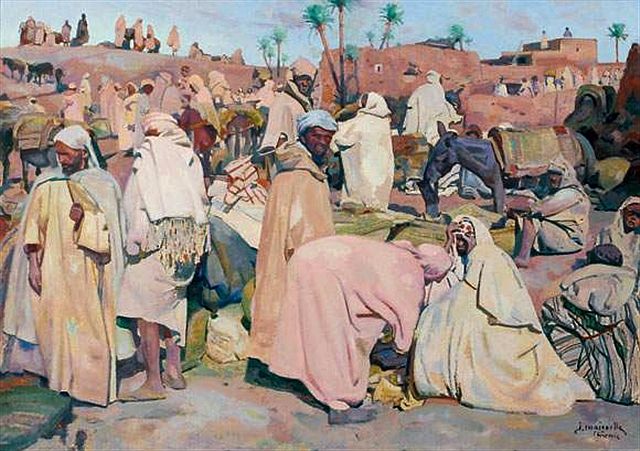
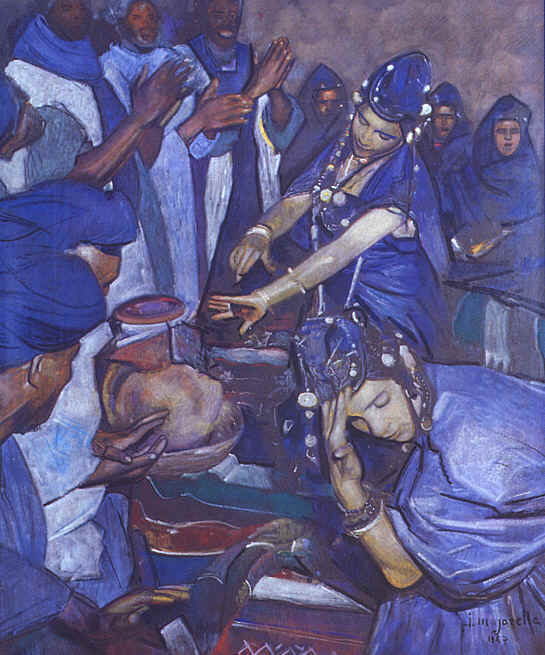
Jacques Majorelle (1886 - 1962)
Jacques Majorelle (March 7, 1886 - October 14, 1962), son of the celebrated Art Nouveau furniture designer Louis Majorelle, was a French painter. He studied at the École des Beaux-Arts in Nancy in 1901 and later at the Académie Julian in Paris with Schommer and Royer. In 1919 he went to Marrakech, Morocco to recover from heart problems. He returned to France in 1962 after a car incident and died later that year of complications from his injuries. His biggest art work is said to be Majorelle Garden which he created in 1924. A special colour of blue which he used extensively in the garden is named after him, Majorelle Blue.
http://en.wikipedia.org/wiki/Jacques_Majorelle
http://dafina.net/forums/file.php?49,file=193235,filename=Le_souk_de_Khemis_Jacques_Majorelle.jpg
http://www.artcurial.com/Full/414/10164414.jpg
http://2.bp.blogspot.com/_1hrzHEUjeWA/Sw_-q5Rt-fI/AAAAAAAAMwo/2WgqpTxyC9Q/s1600/major2.jpg
http://www.lemondedesarts.com/images/Majorelle2.jpg
http://gibbi.blogspot.com/2009/04/jacques-majorelle-1886-1962.html
https://blogger.googleusercontent.com/img/b/R29vZ2xl/AVvXsEiIno0P77tMUYpbl3AUyiz4PE9pA2mY_eoX1DqyiVh2t1iR0RxonAnzV3e1px2ZqZGPND3Bo1es3dZHfG-FNdcxHu35ZV8Y-3sW17pr99-0IVkS3amwE1pfZEemZ3WkFsioeNCtJUqT2RHI/s400/10164414.jpg
https://blogger.googleusercontent.com/img/b/R29vZ2xl/AVvXsEhnuPDa4euKuQLtC2YcDFm59MUqTXfGiwnQXpU-3tc69Njs6az2N-ZFvqzsn3ULxEXtDixpQIHKAxyX6KDh6BG8o-qzUwUmuSKbRf4FIHEhAb8nbPXHwh7CwszRaNRs6JMuDmKd9if0SeDc/s1600-h/f%C3%AAte+%C3%A0+Marrakech.jpeg
http://www.gazette-drouot.com/gif-magazine/gif_florilege/130209/33.jpg
http://images.artnet.com/WebServices/picture.aspx?date=20080603&catalog=138696&gallery=110890&lot=00035&filetype=2
http://www.artcurial.com/fr/actualite/cp/2010/_media/1835_tableaux-orientalistes/tableaux-orientalistes-_Page_02_Image_0001.jpg
http://www.artcurial.com/fr/actualite/cp/2010/_media/1835_tableaux-orientalistes/tableaux-orientalistes-_Page_01_Image_0001.jpg
http://www.drouot-presse.com/img_people/2009_bilan/majorelle.jpg


André Fougeron (1913-1998)

André Fougeron est un peintre français né le 1er octobre 1913 à Paris et mort le 10 septembre 1998.
http://fr.wikipedia.org/wiki/Andr%C3%A9_Fougeron
http://membres.multimania.fr/geographiehistoire/Annales/EDH-la_civilisation_atlantique_1953_Andre_Fougeron.htmhttp://www.tate.org.uk/servlet/ViewWork?cgroupid=999999961&workid=77&searchid=12414
http://www.poetrysociety.org.uk/content/commissions/tateetc/june/


André Fougeron La Civilisation atlantique 1953


André Fougeron Massacre at Sakiet III 1958


André Fougeron Return from the Market (Retour du marché) 1953


World (Social) Realist Art (Index of Countries)
This blog page is part of an ongoing project by artist and part-time lecturer Caoimhghin Ó Croidheáin (http://gaelart.net/) to explore Realist / Social Realist art from around the world. The term Realism is used in its broadest sense to include 19th century Realism and Naturalism as well as 20th century Impressionism (which after all was following in the path of Courbet and Millet). Social Realism covers art that seeks to examine the living and working conditions of ordinary people (examples include German Expressionism, American Ashcan School and the Mexican Muralists).

Click here for (Social) Realist Art Definitions, World (Social) Realism and Global Solidarity, Art and Politics, Social Realism in history and Country Index.

Suggestions for appropriate artists from around the world welcome to caoimhghin@yahoo.com.